

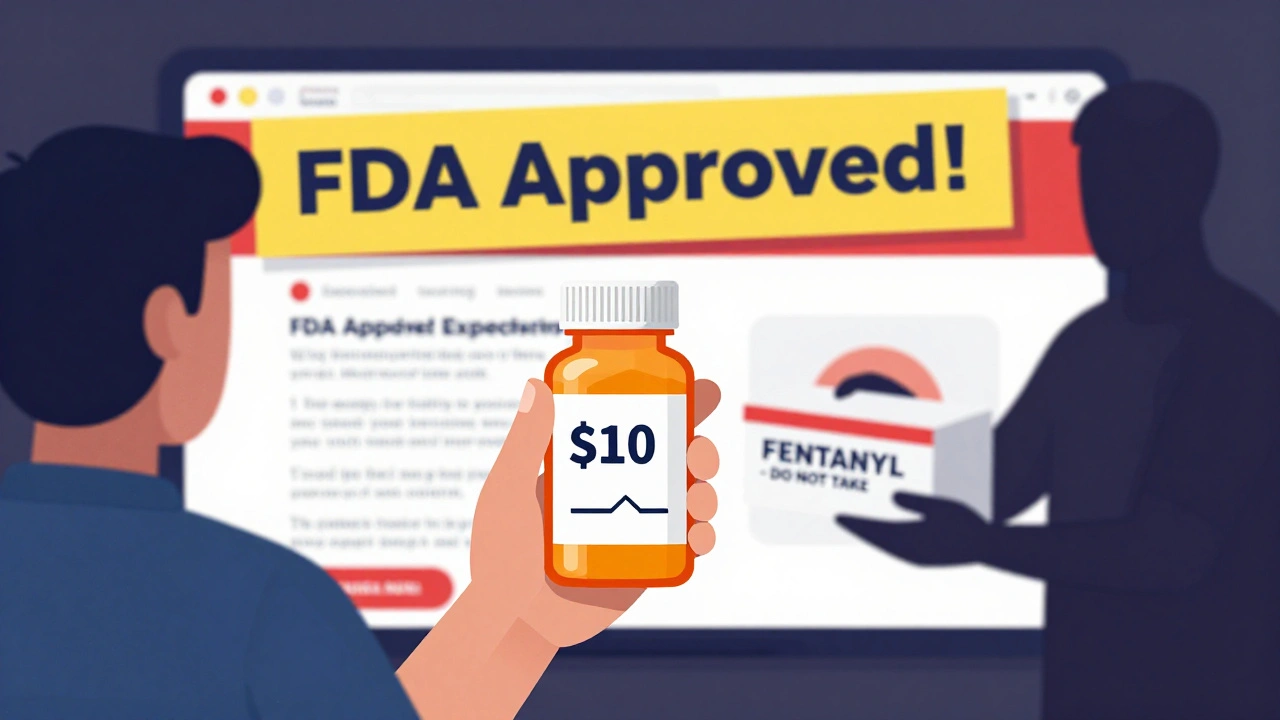
Every year, millions of people around the world take medication they think is real-only to find out it’s a deadly fake. Counterfeit drugs aren’t just missing the right ingredients; they can contain toxic chemicals, wrong dosages, or even deadly substances like fentanyl. And with online pharmacies exploding in number, it’s easier than ever to accidentally buy something dangerous. The good news? You don’t need to be a pharmacist to spot the warning signs. Here’s what to look for when you’re buying medicine-whether it’s from a website, a street vendor, or even a pharmacy that seems too good to be true.
Price That’s Too Good to Be True
If a bottle of Viagra, Ozempic, or metformin is being sold for half the price you’d pay at a regular pharmacy, walk away. Legitimate pharmaceutical companies rarely discount prescription drugs by more than 20%. Counterfeiters, on the other hand, slash prices by 50% to 80% to lure in customers. A 2024 Consumer Reports survey found that websites offering prices 60% below retail had an 87% chance of selling fake medication. Even if the site looks professional, has fake reviews, or claims to be “FDA-approved,” low price is still the biggest red flag. Real medicine costs money to make, test, and ship. If it’s dirt cheap, it’s not real.Packaging That Doesn’t Match
The packaging of a real medication is made with precision. The font, colors, and layout are exact. Counterfeiters copy what they see online-but they don’t have access to the original molds or printing plates. Look closely. Is the spelling off? A 2023 FDA report found that 63% of counterfeit drugs had typos in the label, like “Viagaa” or “Metformin 500mgs.” Are the batch or lot numbers missing, smudged, or repeated across multiple bottles? That’s a sign. Expiry dates that look hand-written or are placed in the wrong spot? Another warning. Even small things like a slightly different shade of blue on the pill bottle or a logo that’s a bit blurry can mean it’s fake. At 10x magnification, real packaging has sharp, clean edges. Counterfeits show pixelation or ink bleeding.Pills That Look or Feel Wrong
Real pills are manufactured to exact standards. They’re uniform in size, weight, and texture. If your metformin tablet is slightly smaller than the last bottle, or if it crumbles when you touch it, that’s not normal. Legitimate tablets vary by less than 5% in weight and 2% in diameter. Fake ones? They can be uneven, cracked, or have bubbly coatings. Some counterfeit pills are even made with chalk or talc and pressed into shape-they don’t hold together. One common complaint from users: pills that dissolve in water within two minutes. Real tablets should take at least 30 minutes to break down under gentle stirring. If your pill vanishes in the glass, it’s not medicine-it’s a chemical mix.Unexpected Side Effects or No Effect
If you’ve been taking a medication for months and suddenly feel dizzy, nauseous, or have a sudden drop in blood sugar, it could be a fake. In 2024, the Journal of Clinical Pharmacy and Therapeutics reported a case where patients taking counterfeit metformin experienced severe hypoglycemia because the pills contained glyburide, a completely different diabetes drug. Others have reported no effect at all. A 2024 survey by the American Pharmacists Association found that 73% of pharmacists identified counterfeit drugs after patients came in saying, “This isn’t working like it used to.” If your blood pressure isn’t dropping, your cholesterol hasn’t changed, or your pain hasn’t improved-ask yourself: Is this even the right drug?
Online Pharmacies Without a Prescription
No legitimate pharmacy in the U.S., Australia, or EU will sell prescription drugs without a valid prescription. If a website lets you click “Buy Now” without asking for a doctor’s note, it’s illegal. The DEA reports that 92% of verified counterfeit drug sales come from these kinds of sites. Even worse, many of these sites use fake “pharmacist consultations” to trick you into thinking you’re getting a real service. The only trusted online pharmacies have the .pharmacy domain. As of January 2025, only 6,214 websites worldwide have this verified badge. Over 35,000 fake ones are still operating. Check the NABP’s website to verify any site before you buy.Seals, Labels, and Tamper Evidence
Real medicine bottles have tamper-evident seals. Once opened, they show visible damage-broken plastic rings, torn inner foil, or a cap that won’t screw back on properly. If the seal looks like it was resealed with glue or tape, or if the cap spins too easily, that’s a red flag. One Reddit user described a bottle where the seal felt “like it had been reapplied.” That’s exactly what happened. Counterfeiters open real bottles, remove the pills, and refill them with fake ones. Then they reseal them to look authentic. Always check the seal before you take a single pill. If it looks off, don’t risk it.Microscopic Clues You Can’t See With the Naked Eye
Some counterfeiters have gotten really good. They copy holograms, barcodes, and even embossing patterns on pills. But they can’t replicate the tiny details. Legitimate manufacturers use precision tooling that leaves microscopic marks-patterns only visible under 50x magnification. The WHO’s 2024 report found that even the most convincing fakes fail this test. In 2024, the FDA announced a new system called PharmMark, which will require all controlled substances to be marked with invisible luminescent nanoparticles. These particles glow under UV light (365nm) and can’t be copied without the original formula. By December 2026, every oxycodone or Adderall pill made in the U.S. will have this. Until then, if you have access to a UV light, shine it on the pill or packaging. If nothing glows, it’s not real.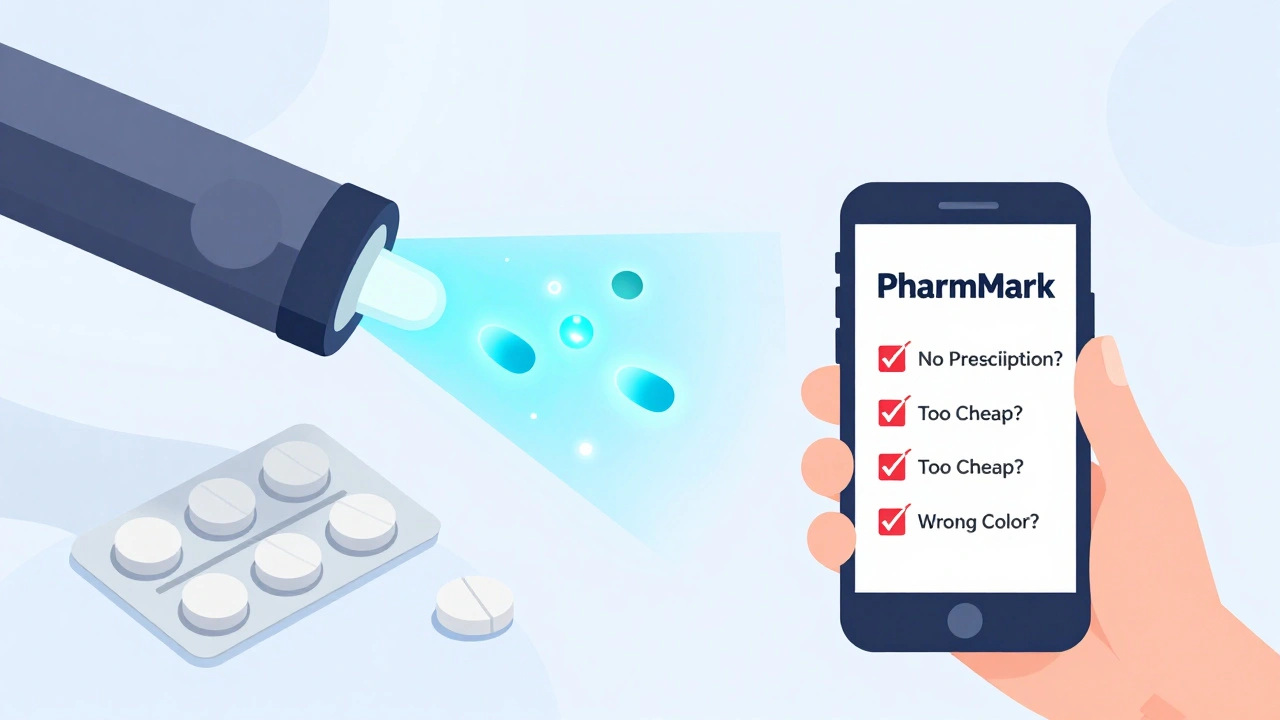
 Medications
Lucinda Bresnehan
December 3, 2025 AT 12:59Just got my metformin from CVS and checked the bottle-font was slightly off and the lot number looked smudged. I called the pharmacy and they were shocked. Turned out it was a batch they got from a new distributor. They pulled it and refunded me. Don’t trust anything that feels ‘off’ even if it’s from a ‘legit’ place.
Also, I used my phone’s flashlight to check the pill under UV-nothing glowed. Scared me straight.
Thanks for the heads up.
Eric Vlach
December 4, 2025 AT 19:38Been a pharmacist for 18 years and I can tell you the biggest red flag is when people say ‘it worked fine last time’ but the pill looks different. That’s not tolerance that’s counterfeit. We’ve had patients come in with pills that crumble like chalk. One guy thought his anxiety meds were ‘stronger’-turns out they were laced with benzodiazepines. He ended up in the ER. Don’t mess with this stuff. Check the NDC code. Always.
Jack Arscott
December 5, 2025 AT 01:09Just checked my Ozempic bottle with my UV pen 🌟 and nothing glowed. I’m so glad I read this. I almost ordered more off Instagram. Yikes. Thanks for the info. I’m going to the pharmacy tomorrow and bringing my old bottle for comparison.
Irving Steinberg
December 5, 2025 AT 10:56Why are we even talking about this like its a surprise? Everyone knows Amazon and Instagram are full of fake meds. People just want the cheap stuff and then act shocked when they get sick. I mean come on. You want a miracle drug for $20? You’re gonna get poison. Simple as that. 😒
Lydia Zhang
December 7, 2025 AT 04:05My grandma bought fake blood pressure pills off a Facebook ad. She ended up in the hospital. Never again.
Souvik Datta
December 8, 2025 AT 09:49Let me tell you something-this isn’t just about pills. This is about trust in healthcare systems. When people in rural India or Nigeria buy medicine from roadside vendors because they can’t afford real ones, they’re not being careless. They’re surviving. The real crime isn’t the counterfeiters-it’s the global pricing system that makes life-saving drugs unaffordable. Fix that and you fix half the problem. Until then, we’re just playing whack-a-mole with poison.
Priyam Tomar
December 8, 2025 AT 16:13Everyone’s freaking out about UV lights and lot numbers but you know what’s worse? The fact that the FDA doesn’t even regulate supplements. You think your ‘natural’ weight loss pill is safe? It’s probably laced with sibutramine or worse. And no one checks it. So stop pretending this is just about prescription meds. The entire supplement industry is a scam. Wake up.
Courtney Co
December 10, 2025 AT 15:16I just want to say I feel so seen. I bought fake insulin last year and I thought I was having a panic attack but it was the fake stuff. I cried for three days. I felt so stupid. But then I found a support group online and now I’m helping others spot fakes. It’s not your fault. It’s the system. I’m still scared to buy meds but I’m learning. Thank you for writing this. I needed this.
Dennis Jesuyon Balogun
December 11, 2025 AT 08:14From a pharmacoeconomist’s standpoint, the structural vulnerability lies in the fragmentation of the global supply chain and the absence of interoperable serialization protocols in emerging markets. The proliferation of counterfeit pharmaceuticals is not an emergent phenomenon-it is an inevitable consequence of regulatory arbitrage, asymmetric information asymmetry, and the commodification of biopharmaceuticals under neoliberal market logic. The WHO’s PharmMark initiative, while technically elegant, remains a band-aid on a systemic hemorrhage. We must mandate blockchain-based traceability at the point of manufacture, enforce punitive liability on distributors who bypass GMP, and establish universal drug authentication as a human right. Until then, we are merely cataloging corpses.
Shashank Vira
December 12, 2025 AT 13:11Let me tell you about the time I bought ‘Viagra’ from a street vendor in Delhi. I took it. I didn’t get hard. I got dizzy. I thought I was dying. Turns out it was powdered chalk and caffeine. I spent 48 hours in a clinic with my uncle screaming at the doctor in Hindi. Now I only buy from the government pharmacy. And I carry a UV light in my pocket like a knight with a sword. Because in this world, truth is invisible unless you shine a light on it.
Linda Migdal
December 13, 2025 AT 23:03Look, I get it. People want cheap meds. But when you buy from some shady website, you’re not just risking your life-you’re undermining American pharmaceutical innovation. We spend billions developing these drugs. And then some guy in a basement in China copies the bottle and sells it for $5. That’s not capitalism. That’s theft. And if you’re buying fake Ozempic, you’re basically funding terrorists. I’m not even joking. The money goes to cartels. So stop being naive. Buy American. Buy licensed. Or stay sick.
Jeremy Butler
December 15, 2025 AT 02:43The empirical data presented in this exposition, while methodologically sound and statistically significant, fails to adequately address the ontological implications of pharmaceutical commodification under late-stage capitalism. The preoccupation with superficial indicators-packaging, UV luminescence, and price differentials-reifies the symptomatology of systemic failure while obfuscating the deeper epistemic rupture between patient agency and corporate control. One cannot authenticate a pill without first authenticating the social contract that permits its existence. The real counterfeit is not the tablet-it is the illusion of choice.