

You’ve been eating clean, hitting the gym, tracking every calorie-and yet the scale won’t budge. It’s been weeks. Maybe months. You’re not lazy. You’re not failing. Your body is just doing what it’s been wired to do for thousands of years: protect you from starvation.
Why Your Weight Loss Stopped (It’s Not Your Fault)
When you lose weight, your body doesn’t just shrug and say, ‘Okay, new normal.’ It fights back. This isn’t a glitch. It’s biology. The technical term is metabolic adaptation, also called adaptive thermogenesis. Simply put, your body burns fewer calories than it should based on your new, lighter weight. That’s why cutting calories further doesn’t work-it makes things worse.
Research from the Minnesota Starvation Experiment in the 1940s showed participants’ metabolic rates dropped by nearly 40% beyond what their weight loss alone would predict. Fast forward to today, and studies confirm the same thing. In a 2022 study from the University of Alabama at Birmingham, people who lost significant weight saw their resting energy expenditure drop by an extra 92 kcal per day-on top of what their smaller bodies should naturally burn. That’s like eating a small banana every day you didn’t account for. Over time, that adds up to a stalled scale.
And it’s not just about calories burned at rest. Your body lowers thyroid hormone, drops leptin (the ‘full’ hormone) by up to 70%, and ramps up cortisol (the stress hormone). Your muscles become more efficient, so they use less energy. Even your brown fat-your body’s natural furnace-slows down. All of this happens automatically, without you thinking about it. You didn’t quit. Your metabolism did.
Why Cutting Calories More Doesn’t Work
Most people’s first reaction to a plateau? Eat less. Cut another 200 calories. Go from 1,500 to 1,300. Maybe even 1,200. But here’s the truth: the lower you go, the harder your body fights. Studies show that very low-calorie diets (under 1,000 kcal/day) trigger the strongest metabolic adaptation. The faster you lose weight, the more your body goes into survival mode.
Think of it like this: your body has a ‘defended weight’ range. It’s not a fixed number, but a zone-like a thermostat set to your old weight. When you drop below it, your brain interprets that as a threat. It turns down your metabolism, amps up hunger, and makes you feel sluggish. That’s why you’re hungrier than ever, even though you’re eating less. It’s not weakness. It’s your brain trying to bring you back.
Reddit users on r/loseit report the same pattern: 78% of people stuck on plateaus were eating 1,200-1,500 calories a day, yet still seeing no progress. Many said they felt exhausted, irritable, and obsessed with food. Cutting calories further just made the hunger worse. And it didn’t help the scale.
What Actually Works: Science-Backed Breakthrough Strategies
There are ways out. But they don’t involve starving yourself more. They involve working with your biology, not against it.
1. Take a Diet Break
Instead of pushing through, pause. Go back to your maintenance calories for 1-2 weeks. That means eating enough to hold your current weight-not lose, not gain. Do this every 8-12 weeks of dieting.
Why? Because your metabolism doesn’t reset overnight. A 2018 study found that a 2-week break at maintenance calories reduced metabolic adaptation by up to 50%. Your leptin levels rise. Your thyroid resets. Your energy comes back. When you go back to cutting, your body isn’t as defensive. It’s like hitting the reset button on your metabolism.
2. Lift Weights-Not Just Cardio
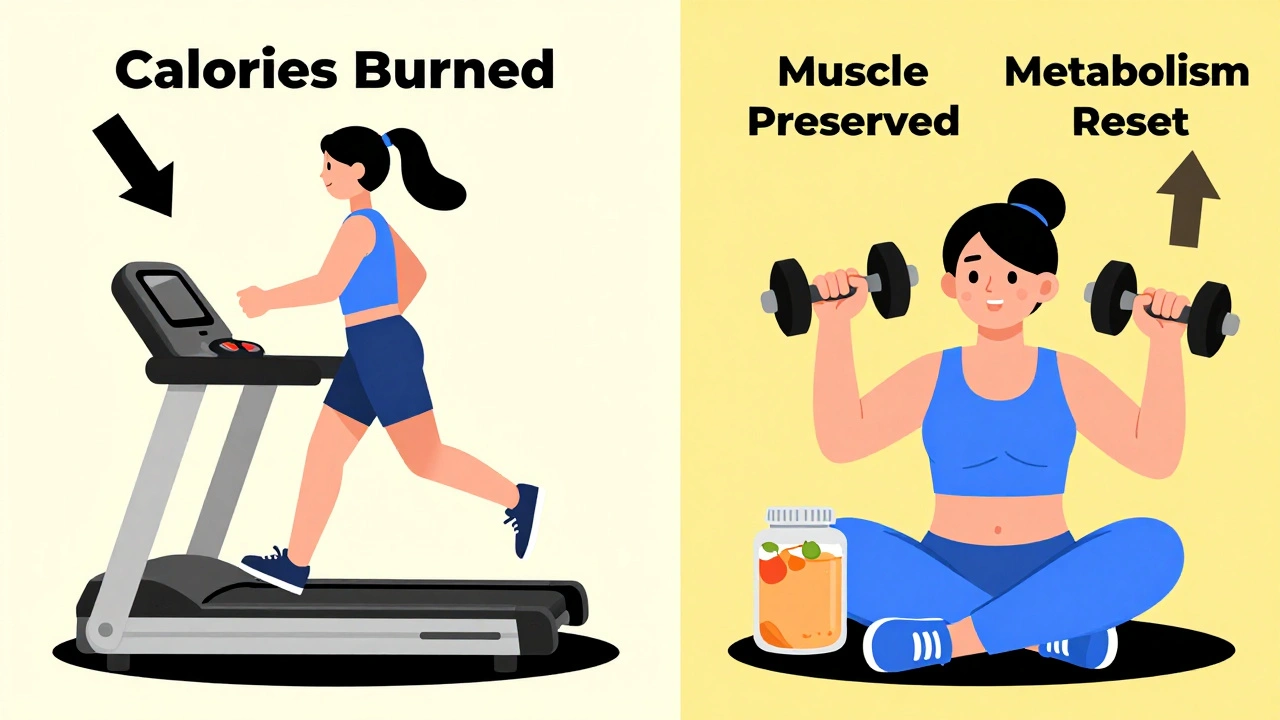
Cardio burns calories while you’re doing it. But muscle burns calories 24/7. Losing muscle during weight loss is one of the biggest reasons your metabolism crashes. Resistance training three to four times a week helps you keep the muscle you’ve got.
Studies show people who lift weights during weight loss lose 8-10% less resting metabolic rate than those who only do cardio. That’s huge. Even if you’re not trying to get big, lifting keeps your furnace running. Bodyweight squats, push-ups, dumbbell rows-anything that challenges your muscles counts.
3. Eat More Protein
Protein isn’t just for building muscle. It helps you stay full, protects your metabolism, and reduces muscle loss during calorie restriction. Aim for 1.6 to 2.2 grams of protein per kilogram of body weight. For a 70kg person, that’s 112-154 grams a day.
A 2013 study found that people who ate higher protein during weight loss lost 3.2kg more fat and 1.3kg less muscle than those on lower protein diets. That’s not just about looks-it’s about keeping your metabolism strong.
4. Try Reverse Dieting
If you’ve been eating at rock-bottom calories for months, your metabolism may have slowed so much that even maintenance feels like too much. Reverse dieting means slowly adding calories-50-100 per week-until you hit maintenance. This isn’t about gaining weight. It’s about retraining your body to burn more again.
People who try reverse dieting after a long plateau often find they can eat more without gaining fat. Their energy improves. Their hunger drops. And when they cut again, they lose weight more easily.
What About Weight Loss Drugs and Surgery?
For some people, especially those with obesity-related health issues, medical help is necessary. GLP-1 agonists like semaglutide (Wegovy) work by reducing hunger and helping the body maintain weight loss. In trials, users lost nearly 15% of their body weight on average. But these aren’t magic pills-they work best when paired with lifestyle changes.
Bariatric surgery has the strongest effect on metabolism. Studies show it reduces metabolic adaptation by about 60% compared to dieting alone. But it’s invasive, expensive, and comes with risks. It’s not for everyone.
What’s interesting is that companies like WW and Noom are now building metabolic adaptation into their apps. WW adjusts points based on your metabolism. Noom has ‘metabolic reset’ modules. Even the weight loss industry is catching on.
Why Most Programs Fail (And How to Avoid Them)
Most diet plans treat weight loss like a math problem: calories in, calories out. But your body isn’t a calculator. It’s a living system that adapts. Programs that ignore metabolic adaptation set people up for failure. They blame the person for ‘not sticking to it’ when the real issue is physiology.
Research from StatPearls in 2023 says flat-out: ‘Delay in achieving weight-loss goals is often wrongly blamed on poor adherence.’ It’s not you. It’s the model.
The best programs now acknowledge this. They don’t just tell you to eat less. They teach you how to work with your body’s natural rhythms. That means cycling calories, preserving muscle, managing hunger, and giving your metabolism room to recover.
What’s Next for Weight Loss Science
Scientists are now looking at ways to boost brown fat activity-your body’s natural heat burner. Early studies show cold exposure (like cold showers or lowering your thermostat) can increase energy expenditure by 5-7%. It’s not a miracle, but it’s a tool.
Pharmaceutical companies are pouring over $1 billion into drugs that target metabolic adaptation pathways. In the next few years, we’ll likely see more personalized tools-like wearable devices that measure your metabolic rate in real time.
By 2025, experts predict 85% of science-backed weight loss programs will include strategies to handle metabolic adaptation. The old way-starve, sweat, repeat-is fading. The new way is smarter: restore, rebuild, then lose again.
Final Thought: Patience Isn’t Passive
Hitting a plateau doesn’t mean you’ve failed. It means your body is doing its job. The goal isn’t to fight it. It’s to understand it. Take a break. Eat enough protein. Lift weights. Give your metabolism time to reset. Then come back stronger.
Weight loss isn’t a race. It’s a long-term adjustment. And the people who succeed aren’t the ones who push the hardest. They’re the ones who know when to pause-and how to come back.
Why am I not losing weight even though I’m eating very little?
Your body has adapted to the lower calorie intake by reducing your metabolic rate. This is called adaptive thermogenesis. Cutting calories further can make this worse. Instead of eating less, try taking a diet break at maintenance calories for 1-2 weeks to reset your metabolism.
Does metabolism permanently slow down after weight loss?
No, but it can stay lower than expected for years-even after maintaining your new weight for over a year. The good news is that strategies like diet breaks, resistance training, and higher protein intake can help reverse this slowdown over time.
Should I stop dieting if I hit a plateau?
No, but you should change your approach. Stopping entirely might lead to weight regain. Instead, shift from continuous restriction to a cyclical model: 8-12 weeks of dieting, followed by 1-2 weeks at maintenance. This helps prevent metabolic adaptation from becoming too severe.
Can exercise fix a slow metabolism?
Cardio alone won’t fix it. But resistance training does. Lifting weights helps preserve muscle mass, which keeps your resting metabolic rate higher. People who lift weights during weight loss lose 8-10% less metabolic rate than those who only do cardio.
Is reverse dieting just gaining weight back?
No. Reverse dieting is a controlled, gradual increase in calories to raise your metabolism back to a healthy level. It’s done slowly-50-100 calories per week-to avoid fat gain. The goal is to eat more without gaining weight, so future fat loss becomes easier.
Do weight loss medications help with metabolic adaptation?
Yes. Drugs like semaglutide (Wegovy) reduce hunger and help maintain weight loss by partially countering the hormonal changes caused by metabolic adaptation. But they work best when combined with diet and exercise-not as a replacement.
 Medications





Eddy Kimani
December 3, 2025 AT 06:35Metabolic adaptation is such a well-documented phenomenon in adaptive thermogenesis literature-it’s not just about calories in vs out, it’s about energy flux, leptin dynamics, and thyroid axis suppression. The Minnesota Starvation Experiment data is still the gold standard, but modern studies like the 2022 UAB paper show even after weight stabilization, RMR remains suppressed by ~90 kcal/day. That’s not laziness, that’s physiology.
Chelsea Moore
December 5, 2025 AT 03:07Oh my GOD, I’ve been saying this for YEARS!! People just don’t get it!! You cut calories too much and your body turns into a furnace… that’s been turned OFF!! It’s not your fault!! It’s the diet industry’s fault!! They sell you lies!! You’re not weak!! You’re not broken!! You’re just BIOLGICALLY BETRAYED!!
John Biesecker
December 6, 2025 AT 19:21man i just wanna say… this post hit me right in the soul 😔
been dieting for 14 months, lost 40lbs, plateaued for 6… tried eating less… ended up crying over a banana
took a break, ate like a normal human for 10 days… energy came back, sleep improved, i didn’t gain a pound
now i’m back at a slight deficit… and it’s actually working again
your body isn’t your enemy. it’s your teammate. you just gotta learn its language 🤝
Genesis Rubi
December 8, 2025 AT 06:13lol america is so soft now. we used to just eat less and push through. now we need diet breaks and reverse dieting and protein macros like we’re astronauts. in my country we just worked harder and ate rice. no apps. no tracking. no ‘metabolic reset’. just discipline. you think your body is a computer? it’s a beast. train it, don’t coddle it.
Doug Hawk
December 8, 2025 AT 11:28the key insight here is that metabolic adaptation isn’t a bug, it’s a feature. your body is trying to preserve energy, not punish you. the problem is that most programs treat it like a failure to comply rather than a biological response. lifting weights isn’t just about aesthetics-it’s about maintaining lean mass to preserve BMR. protein isn’t optional-it’s metabolic insurance. diet breaks aren’t cheating-they’re recalibration. this isn’t new science, it’s just ignored by the industry because it doesn’t sell supplements.
John Morrow
December 10, 2025 AT 10:47It’s worth noting that the 92 kcal/day deficit observed in the UAB study is statistically significant but clinically negligible when contextualized against total daily energy expenditure. The real driver of weight loss stagnation is likely non-exercise activity thermogenesis (NEAT) decline, not basal metabolic rate suppression. Furthermore, the 50% reduction in metabolic adaptation following a diet break is based on a small sample size (n=18) and lacks longitudinal follow-up. The notion that reverse dieting ‘retrains’ metabolism is biologically implausible without hormonal re-sensitization, which remains unproven in humans. This is anecdotal narrative disguised as evidence.
Kristen Yates
December 10, 2025 AT 15:07I’ve been through this. I didn’t know why I felt so tired. I thought I was failing. Then I learned about leptin. I started eating more protein. I lifted weights. I stopped punishing myself. It took time. But I didn’t quit. I just changed how I showed up.
Saurabh Tiwari
December 11, 2025 AT 16:57bro this is so true man
in india we eat a lot of carbs and still lose weight
but when we try western dieting
we just crash
your body knows what it needs
not the app
take break
lift
eat protein
sleep
that’s it 🤙
Michael Campbell
December 11, 2025 AT 17:42they’re lying to you. the government and big pharma are pushing this ‘metabolic reset’ nonsense so you’ll keep buying their apps and supplements. the real fix? stop dieting. eat real food. move your body. don’t track. don’t count. just live. they don’t want you to know that.
Victoria Graci
December 11, 2025 AT 21:16It’s like your body is a jazz musician-when you force it into a rigid metronome (calorie counting), it improvises a slower, quieter solo. But if you let it breathe-give it space, protein, resistance, rhythm-it finds its groove again. Metabolism isn’t a machine. It’s a conversation. And you’ve been yelling. Time to listen.
Saravanan Sathyanandha
December 12, 2025 AT 19:58This is an exceptionally well-researched and balanced perspective. The integration of physiological mechanisms with practical interventions reflects a mature understanding of human metabolism. The emphasis on preserving lean mass through resistance training and adequate protein intake aligns with current consensus in sports nutrition literature. Furthermore, the acknowledgment of reverse dieting as a metabolic recalibration tool-not a weight gain strategy-is both scientifically sound and clinically pragmatic. Well done.
alaa ismail
December 13, 2025 AT 21:18just took a 2 week break after 6 months of cutting. ate like i used to. didn’t gain weight. felt human again. went back to deficit. lost 3lbs in 10 days. mind blown.
ruiqing Jane
December 14, 2025 AT 07:36To everyone who says ‘just eat less’-you’re not helping. You’re repeating the same broken logic that got people stuck in the first place. This isn’t about willpower. It’s about biology. And if you haven’t experienced a plateau, you don’t get to judge those who have. This post is a gift. Read it. Share it. Live it.
william tao
December 15, 2025 AT 01:39While the article is superficially compelling, it lacks rigorous peer-reviewed meta-analytic support. The cited studies are observational or have small sample sizes. The concept of ‘metabolic adaptation’ is often conflated with measurement error in indirect calorimetry. Furthermore, the recommendation of diet breaks contradicts the long-term efficacy of continuous energy restriction demonstrated in the Look AHEAD trial. This is pseudoscientific populism dressed as medical advice.