

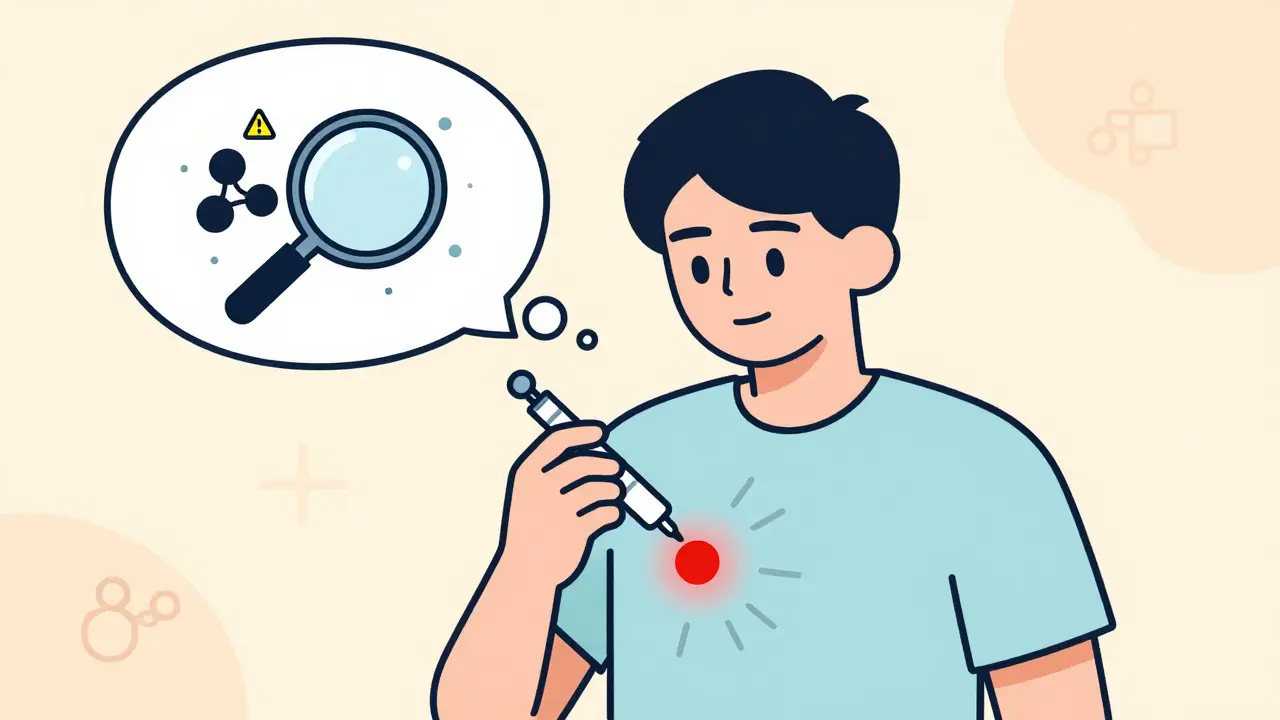
Most people with diabetes assume that if they have a red, itchy spot where they injected insulin, it’s just irritation. But what if it’s more? What if your body is actually fighting back? Insulin allergies are rare-only about 2.1% of insulin users experience them-but when they happen, they can be serious. And if you ignore them, you could end up in the hospital-or worse.
What Does an Insulin Allergy Really Look Like?
An insulin allergy isn’t just a rash. It’s your immune system mistaking insulin-or something mixed with it-for a threat. The reaction can show up in three ways: local, delayed, or systemic.Localized reactions are the most common. You’ll notice swelling, redness, and itching right where you injected. Sometimes, a hard, tender lump forms under the skin within 30 minutes to 6 hours after the shot. These usually fade within 24 to 48 hours. About 97% of all insulin allergies fall into this category, according to Joslin Diabetes Center data.
Delayed reactions are trickier. You might feel fine for hours-or even days-after your injection. Then, out of nowhere, your joints ache, your muscles feel sore, or a bruise appears that doesn’t go away for weeks. These aren’t IgE-driven like typical allergies. They’re T-cell mediated, meaning your immune system is slowly building up a response. This can happen even after 10 years of using the same insulin without issues.
Systemic reactions are rare but dangerous. Less than 0.1% of users experience these. Symptoms include hives all over your body, swelling of the lips or throat, trouble breathing, dizziness, or a sudden drop in blood pressure. These can turn into anaphylaxis within minutes. If you’ve ever felt like you’re drowning in your own airway after an insulin shot, this is why.
It’s Not Always the Insulin
Here’s something most people don’t know: the insulin molecule itself isn’t always the culprit. Modern insulins are highly purified, so allergic reactions to the actual hormone are rare. More often, it’s the additives-the preservatives and stabilizers-that trigger the reaction.Take metacresol, for example. It’s used in many insulin pens to keep the solution sterile. Humalog has more of it than other brands. If you’ve had reactions only with Humalog and never with Lantus or NovoRapid, metacresol could be the real problem. Zinc is another common suspect. It helps insulin stay stable in the pen, but it can cause irritation in sensitive people.
That’s why switching insulin types works for about 70% of people with allergies. If your current brand is causing trouble, it might not be the insulin-it’s the packaging.
How to Tell the Difference Between Allergy and Side Effect
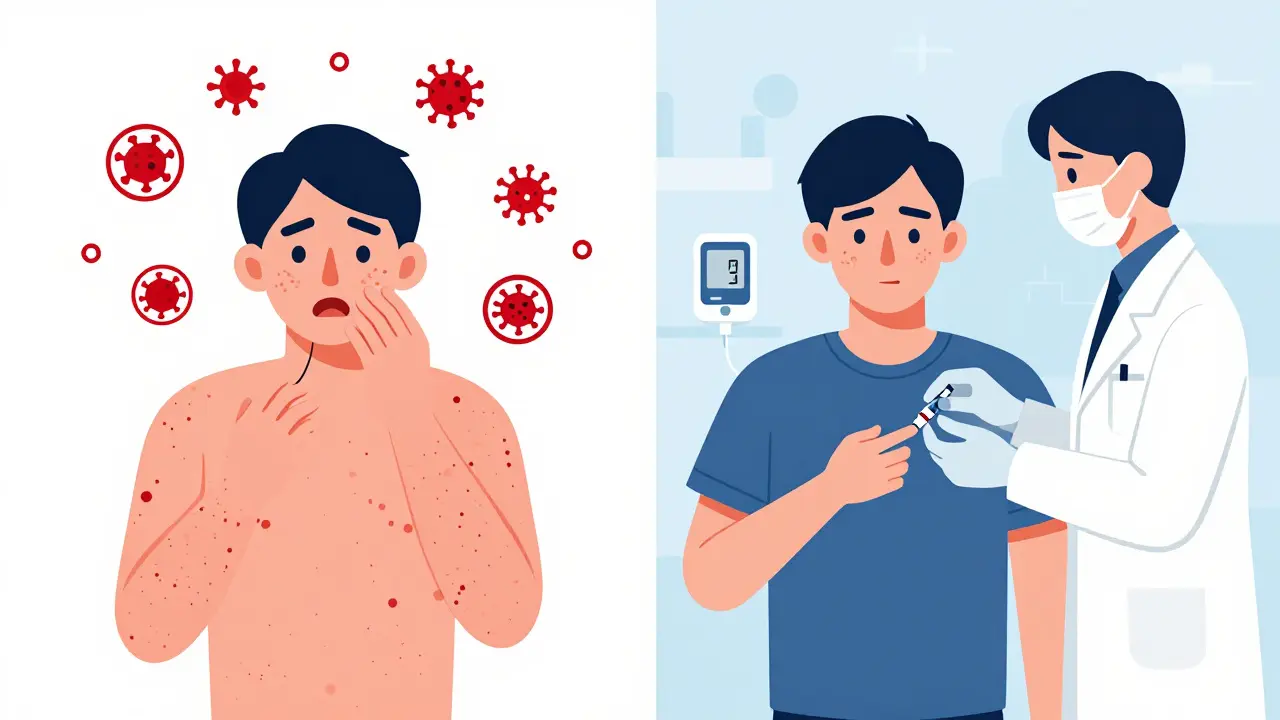
It’s easy to confuse an allergic reaction with low blood sugar. Shaking, sweating, and anxiety? Those are signs of hypoglycemia. But if you’re getting a rash, swelling, or hives-especially if you’re not low-then it’s not your blood sugar. It’s your immune system.The NHS makes this clear: true insulin allergies affect fewer than 1 in 100 users. If you’re having symptoms that match an allergic response, don’t assume it’s just “bad injection technique.” Get it checked.
What to Do Right Away
If you notice a localized reaction, don’t panic. Stop injecting in that spot. Rotate sites. Apply a cold compress. Over-the-counter antihistamines like cetirizine or loratadine can help with itching and swelling. For persistent redness or bumps, topical calcineurin inhibitors like tacrolimus or pimecrolimus can calm the immune response. Apply them right after your injection and again 4-6 hours later.For delayed reactions with joint pain or bruising, a mid-to-high potency steroid cream like flunisolide 0.05% applied twice daily for a few days can help. But if you’re having trouble breathing, your throat is closing, or your face is swelling-call emergency services immediately. Don’t drive yourself. Don’t wait. Dial 999 (or your local emergency number). Anaphylaxis doesn’t wait.
Diagnosis: Don’t Guess, Test
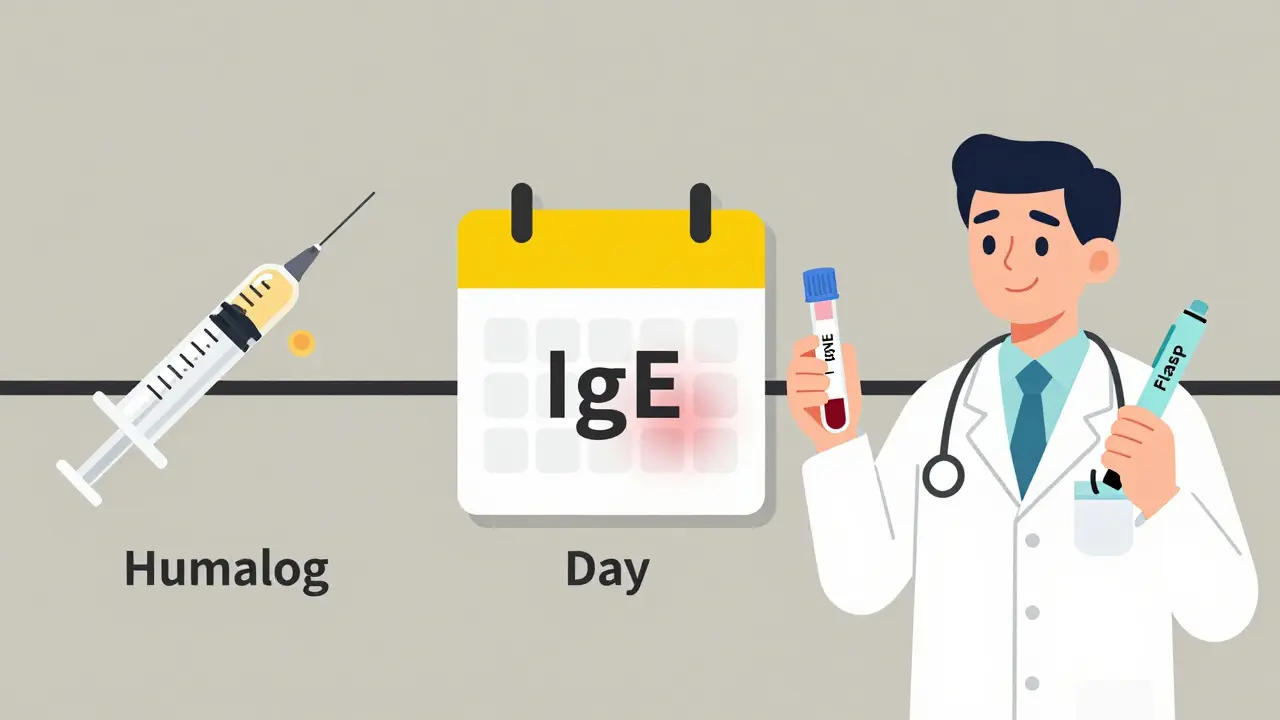
You can’t diagnose an insulin allergy by reading a symptom list. You need testing. A specialist allergist will do skin prick tests or intradermal tests using different insulin types and excipients. They’ll also check for specific IgE antibodies in your blood. This isn’t optional. If you’re allergic, you need to know exactly what’s triggering it.Dr. Robert Gubrecht from Joslin Diabetes Center says: “If you suspect an insulin allergy, get an allergological work-up right away.” Don’t wait. Don’t try to tough it out. The longer you wait, the higher the risk of a severe reaction.
Treatment Options That Actually Work
Once you know what’s causing the reaction, you have real options.- Switch insulin types - This works for 70% of people. Try switching from a brand with metacresol to one without. Or go from human insulin to a newer analog like Fiasp or Lyumjev.
- Immunotherapy - Also called desensitization. You get tiny, gradually increasing doses of the insulin you’re allergic to, under medical supervision. In one study, 66.7% of patients had complete symptom resolution. The rest saw major improvement.
- Topical steroids or immunomodulators - For localized or delayed reactions, these can suppress inflammation without affecting your blood sugar.
- Oral medications - For type 2 diabetes patients, some can switch to non-insulin drugs like GLP-1 agonists or SGLT2 inhibitors. But this isn’t an option for type 1. You can’t live without insulin.
One key thing to remember: stopping insulin because you’re scared of an allergic reaction is dangerous. Skipping doses can lead to diabetic ketoacidosis-a life-threatening condition. Never stop insulin without talking to your diabetes team.
Working With Your Care Team
Managing insulin allergies isn’t a solo job. You need both your endocrinologist and an allergist on the same page. The allergist handles the immune side. Your diabetes doctor handles your blood sugar. They have to coordinate.Keep a detailed log: note the time of injection, the insulin brand, the site, the symptoms, and how long they lasted. This helps spot patterns. Did you react only after switching to a new batch? Only with the pen version? Only in cold weather? These clues matter.
What’s Next for Insulin Allergy Management?
Research is moving fast. New insulin formulations are being designed with fewer allergenic additives. Continuous glucose monitors (CGMs) are making it safer to do desensitization-you can watch your blood sugar in real time while getting tiny insulin doses. And scientists are looking for biomarkers that could predict who’s at risk before they even react.For now, the message is clear: insulin allergies are rare, but they’re real. And they’re manageable-if you act fast, get tested, and don’t try to handle it alone.
Frequently Asked Questions
Can you develop an insulin allergy after years of using it without problems?
Yes. Delayed allergic reactions can appear even after 10 or more years of using the same insulin. These are often T-cell mediated, not IgE-driven, so they don’t show up on standard allergy tests right away. Symptoms like joint pain, bruising, or slow-healing bumps may be your body’s way of signaling a new sensitivity.
Is insulin allergy more common with animal insulin?
It used to be. In the 1930s, up to 15% of users had allergic reactions because animal insulin (from cows or pigs) was very different from human insulin. Today, almost all insulin is human-synthetic or analog, and reactions are rare-around 2.1%. But if you’re still on older animal insulin, your risk is higher. Switching to modern insulin often resolves the issue.
Can I use an EpiPen if I have an insulin allergy?
Yes-if you’ve had a systemic reaction before, your doctor may prescribe an EpiPen. But it’s not a substitute for emergency care. An EpiPen buys you time while you wait for help. If you use it, call emergency services immediately. Don’t assume you’re fine afterward. Anaphylaxis can rebound.
Do antihistamines stop insulin allergies completely?
No. Antihistamines help with itching and mild swelling, but they don’t stop the immune system from reacting. For true allergies, especially delayed or systemic ones, antihistamines are just a temporary fix. You need to identify the trigger and adjust your treatment plan.
Is immunotherapy safe for insulin allergies?
Yes, when done under medical supervision. In clinical studies, immunotherapy resolved symptoms in two-thirds of patients and improved them in the rest. It’s a slow process-doses are increased gradually over weeks or months. But for people who can’t switch insulin types or need to stay on insulin, it’s one of the most effective long-term solutions.
Can I switch to an insulin pump to avoid injection reactions?
Switching to a pump doesn’t automatically solve an allergy. The insulin in the pump is the same as in pens. If you’re allergic to the insulin or its additives, you’ll still react. But pumps do allow for smaller, more frequent doses, which can sometimes reduce the intensity of localized reactions. Talk to your doctor about whether this might help your specific case.
 Medications


Christina Widodo
January 12, 2026 AT 10:22My cousin had this happen last year after 8 years on Lantus. She thought it was just dry skin until her arm looked like a bad sunburn. Turned out it was metacresol. Switched to Fiasp and boom-no more issues. Don't ignore it.
Jennifer Phelps
January 13, 2026 AT 21:23Same. I had these weird joint aches for months. Docs thought it was arthritis. Turns out it was a delayed insulin reaction. Took a year to figure out. Now I know to test for excipients not just the insulin itself.
Bryan Wolfe
January 15, 2026 AT 17:12Guys, please don’t panic. I’ve seen so many people freak out over a little red spot and stop insulin. That’s way more dangerous than the allergy. Talk to your endo, get tested, don’t self-diagnose. You can manage this.
Sonal Guha
January 17, 2026 AT 00:43Typical American medical overreaction. In India we just use animal insulin and never had these problems. Modern insulins are overengineered garbage with too many chemicals. Stick to the old stuff if you can.
Sumit Sharma
January 18, 2026 AT 21:31The immunotherapy protocol outlined here is clinically validated per the 2021 JAMA Dermatology meta-analysis. Success rates exceed 66% with IgE-mediated reactions. However, T-cell-mediated responses require longer desensitization cycles-typically 12–18 weeks-with serial intradermal titrations under continuous CGM monitoring. Failure to implement biomarker-guided protocols increases recurrence risk by 3.2x.
Lawrence Jung
January 19, 2026 AT 01:36So what you're saying is we're all just guinea pigs for Big Pharma's additive experiments? I mean come on. We're injecting chemicals we can't even pronounce and then acting shocked when our bodies revolt. Wake up.
George Bridges
January 21, 2026 AT 00:31I had a friend in Nigeria who developed a reaction after switching from human insulin to a brand-new analog. He didn't tell anyone for months because he was scared of being labeled 'difficult'. Eventually he went to a clinic that worked with expats and got tested. They found he was allergic to benzyl alcohol. He's been fine on a different brand for two years now. Don't suffer in silence.
Craig Wright
January 21, 2026 AT 20:14As a British citizen, I find it alarming that American patients are being encouraged to self-manage potentially life-threatening reactions with over-the-counter antihistamines. The NHS protocol requires immediate referral to a specialist allergy clinic. This is not a DIY situation. You are not a scientist. You are a patient. Seek professional help.
Alice Elanora Shepherd
January 23, 2026 AT 13:59For anyone reading this: if you’ve ever had a reaction that came out of nowhere after years of no issues, please don’t dismiss it. I was one of those people. I thought I was just ‘getting older.’ Turns out, my body was slowly building a response to metacresol. I kept a symptom log for six months-time, site, brand, weather, stress level-and the pattern was obvious. My allergist said it was the clearest case she’d seen in years. Don’t wait for it to get worse.
Jay Powers
January 25, 2026 AT 09:23My brother’s a type 1 and he’s on an insulin pump. He had a reaction to one brand, switched to another, still reacted. Turns out it was the tubing material, not the insulin. They changed to a different polymer and now he’s fine. It’s not always what’s inside the cartridge-it’s what it touches. Ask your diabetes team about all components.
steve ker
January 26, 2026 AT 13:21Just stop taking insulin. You’ll be fine.