

Medication Tinnitus Risk Checker
This tool helps you identify if medications you're taking could be causing tinnitus (ringing in your ears). Enter the medications you're currently taking to check their risk level and what to do next.
Your Risk Assessment
Summary: Some of your medications carry tinnitus risk. Your next steps depend on the risk level.
What to Do Next
Have you started a new medication and suddenly noticed a ringing, buzzing, or hissing in your ears? You’re not alone. Many people experience tinnitus - that persistent sound with no external source - after beginning a new prescription or even an over-the-counter pill. What’s surprising is how common this is. More than 600 medications, from everyday painkillers to life-saving chemotherapy drugs, can trigger or worsen tinnitus. The good news? In many cases, it’s reversible. The key is knowing which drugs to watch for and what to do next.
How Medications Cause Ringing in the Ears
Tinnitus from medication happens because some drugs are ototoxic - meaning they damage the inner ear or the nerve that connects your ear to your brain. This damage can interfere with how sound signals are sent or processed. The exact mechanism isn’t fully understood, but it often involves changes in the fluid balance of the inner ear, disruption of hair cells that detect sound, or interference with nerve impulses.
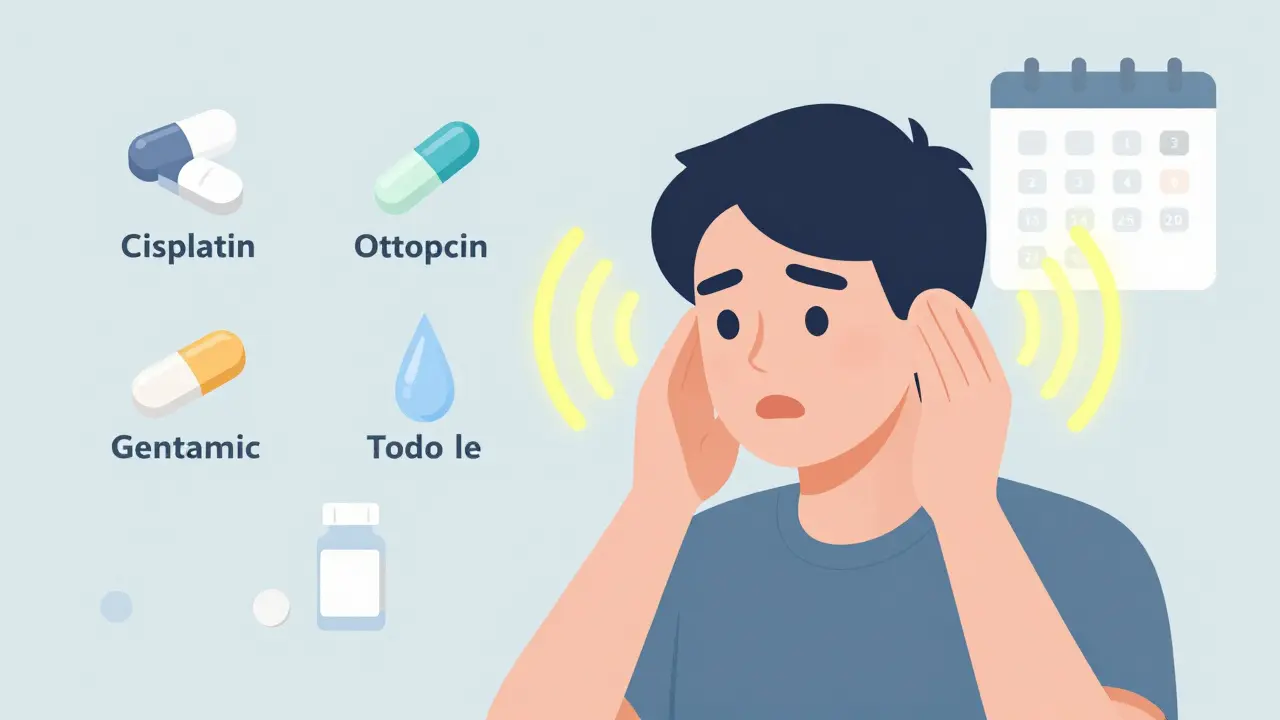
Not all tinnitus from drugs is the same. Some people notice ringing within hours of taking a high dose of aspirin. Others develop symptoms after weeks or months on an antidepressant. The timing and severity depend on the drug, the dose, and your body’s sensitivity. For example, cisplatin, a chemotherapy drug, can cause hearing loss that starts with high-pitched sounds you can’t even hear - like birds chirping - before it affects speech. Aminoglycoside antibiotics like gentamicin can cause permanent damage even after you stop taking them.
Drugs Most Likely to Cause Tinnitus
Some medications carry a much higher risk than others. Here are the main culprits, ranked by risk level:
- Aminoglycoside antibiotics (gentamicin, tobramycin): Used for serious infections. These are among the most dangerous. Up to 25% of patients on long-term IV treatment develop permanent hearing loss or tinnitus.
- Chemotherapy drugs (cisplatin, carboplatin): Up to 70% of patients on cisplatin experience some degree of hearing damage. The damage often starts in the high-frequency range and can progress.
- Loop diuretics (furosemide, bumetanide): Used for heart failure and fluid retention. High doses - especially when given IV - can cause temporary tinnitus and hearing loss.
- High-dose NSAIDs (aspirin, ibuprofen, naproxen): Tinnitus is common at doses above 4,000 mg of aspirin daily. But here’s the catch: most people never take that much. A standard headache dose of 325 mg is very unlikely to cause ringing. Still, some people are unusually sensitive - even low doses can trigger symptoms.
- Antimalarials (quinine): Used for malaria and sometimes leg cramps. Tinnitus can appear within 1-3 days and usually fades within weeks after stopping.
- Isotretinoin (Accutane): Used for severe acne. Around 5% of users report tinnitus, though the manufacturer claims it’s less than 1%. It’s still a recognized risk.
On the lower-risk side: antidepressants like SSRIs (sertraline, fluoxetine) and benzodiazepines (alprazolam) cause tinnitus in less than 1% of users. But even rare side effects matter if you’re the one experiencing them. Some people report tinnitus when they stop these drugs - not when they start them - which can be confusing.
Is Your Tinnitus Reversible?
This is the most important question. About 60% of medication-induced tinnitus goes away once you stop the drug. But not all of it. Aminoglycosides and cisplatin can cause permanent damage. The sooner you catch it, the better your chances of recovery.
Timing matters. Most people notice symptoms within the first two weeks of starting the medication. But some drugs, like certain antibiotics or chemotherapy agents, can cause delayed reactions - even up to 90 days later. If you’ve been on a new drug for a month and suddenly hear ringing, don’t ignore it.
Recovery isn’t always instant. After stopping a high-dose NSAID, tinnitus might fade in a few days. For gentamicin or cisplatin, it can take weeks or months - or never fully disappear. That’s why early detection is critical. If your doctor knows you’re experiencing symptoms, they can adjust your treatment before permanent damage occurs.

What to Do If You Think a Drug Is Causing Tinnitus
Never stop a prescribed medication on your own. That’s dangerous - especially for drugs like antibiotics, antidepressants, or blood pressure meds. Instead, follow these steps:
- Write down when the ringing started - and what medication you began around that time. Even if you’re taking several drugs, note the one you started most recently.
- Check the side effects on the medication’s leaflet or use a trusted source like the FDA’s website or the manufacturer’s prescribing info.
- Call your doctor. Say: “I’ve started ringing in my ears since beginning [drug name]. Could this be related?” Be specific. Don’t say “I think it’s the pill.” Say the name.
- Ask about alternatives. Your doctor might lower the dose, switch to a different drug in the same class, or change the timing of your dose. For example, if you’re on furosemide and getting tinnitus, they might switch you to a different diuretic.
- Request an audiogram. If you’re on a high-risk drug like cisplatin or gentamicin, your doctor should have already ordered baseline hearing tests. If not, ask. A simple hearing test can show if there’s damage and how severe it is.
Some doctors still don’t screen for ototoxicity. A 2022 survey found only 35% of primary care doctors routinely check for hearing changes before prescribing high-risk drugs. If your doctor brushes off your concerns, ask for a referral to an audiologist or an ear, nose, and throat specialist.
Managing Tinnitus While Staying on Necessary Medications
What if you can’t stop the drug? Maybe you’re on chemotherapy, or you need an antibiotic for a life-threatening infection. In those cases, the goal shifts from stopping the tinnitus to managing it.
Sound therapy helps. This means using background noise - like a fan, white noise machine, or soft music - to mask the ringing. It doesn’t fix the cause, but it makes the sound less noticeable. Studies show it helps 60-70% of people reduce their distress.
Cognitive behavioral therapy (CBT) is another proven tool. It doesn’t silence the ringing, but it changes how your brain reacts to it. Over time, many people stop noticing it altogether. CBT is especially helpful if the tinnitus is causing anxiety or sleep problems.
Some patients use hearing aids, even if they don’t have hearing loss. Modern devices can deliver customized sound therapy and are often covered by insurance if linked to tinnitus treatment.

What’s New in Prevention and Research
Science is making progress. In 2024, the NIH funded $12.5 million for research into otoprotective agents - drugs that can shield the inner ear from damage without reducing the effectiveness of the main treatment. Early trials are testing compounds that could be given alongside cisplatin or gentamicin to prevent hearing loss.
Genetic testing is also emerging. Some people have gene variants that make them far more sensitive to ototoxic drugs. In the next few years, doctors may be able to test for these variants before prescribing high-risk medications.
Hospitals are also improving monitoring. In 2018, only 45% of U.S. hospitals tracked hearing changes in patients on ototoxic drugs. By 2023, that number rose to 68%. More clinics now require baseline hearing tests before starting chemotherapy or long-term antibiotics.
Bottom Line: Don’t Panic, But Don’t Ignore It
Tinnitus from medication is more common than most people realize. But it’s rarely the first thing doctors think of. If you’re experiencing ringing, buzzing, or muffled hearing after starting a new drug, it’s worth investigating. Most cases are temporary. A few are serious - and preventable.
Keep a symptom journal. Note the date you started the drug, the dose, and when the tinnitus began. Share this with your doctor. Ask if there’s a safer alternative. Don’t assume it’s “just stress” or “aging.” If you’re on a high-risk medication, ask for a hearing test. Early action can save your hearing.
And remember: you’re not alone. Over 50 million Americans live with tinnitus. A significant portion of those cases are linked to medications. With better awareness and smarter monitoring, many of those cases could be avoided.
Can aspirin cause ringing in the ears?
Yes, but only at very high doses - usually above 4,000 mg per day. That’s far more than the 325-650 mg used for headaches or heart protection. Most people won’t experience tinnitus from standard aspirin use. However, a small number of individuals are unusually sensitive and may develop ringing even at low doses. If this happens, talk to your doctor about switching to acetaminophen or another pain reliever.
Do antidepressants cause tinnitus?
Tinnitus is a rare side effect of antidepressants, affecting less than 1% of users. Some people report ringing when they start an SSRI like sertraline or fluoxetine, while others notice it when they stop. The exact reason isn’t clear, but it’s not common. If you experience tinnitus while on an antidepressant, don’t stop the medication on your own. Talk to your doctor - they may adjust the dose or switch you to a different drug.
Is tinnitus from medication permanent?
It depends on the drug. About 60% of cases are reversible once you stop taking the medication. But some drugs, like aminoglycoside antibiotics (gentamicin) and chemotherapy agents (cisplatin), can cause permanent hearing damage. The longer you’re on these drugs and the higher the dose, the greater the risk. Early detection and stopping the drug quickly improve your chances of recovery.
What should I do if I think a drug is causing my tinnitus?
Don’t stop taking the medication without talking to your doctor. Instead, write down when the ringing started and which new drug you began around that time. Call your doctor and ask if the medication could be the cause. Request a hearing test if you’re on a high-risk drug. Ask about alternatives or dose adjustments. Your doctor can often switch you to a safer option without compromising your treatment.
Can I prevent medication-induced tinnitus?
You can reduce your risk. If you’re starting a high-risk drug like cisplatin or gentamicin, ask your doctor if a baseline hearing test is recommended. Avoid high doses of NSAIDs unless absolutely necessary. Let your doctor know if you’ve had tinnitus before - it may make you more sensitive. Stay hydrated and avoid loud noise while on ototoxic drugs. Most importantly, report any hearing changes immediately - early action is your best defense.
 Medications





Cara C
December 22, 2025 AT 12:26I’ve had tinnitus for years after being on high-dose ibuprofen for migraines. It faded after I switched to acetaminophen, but it took three months. Don’t ignore it-your ears aren’t just for hearing, they’re for surviving.
Also, hydration helps. I drank way more water after stopping the meds and noticed a difference.
Grace Rehman
December 22, 2025 AT 15:34So we’re just supposed to trust doctors who’ve never heard of ototoxicity until their patient’s hearing is gone? Cute.
Meanwhile, the pharmaceutical industry is busy patenting new drugs that make your ears sing while they make your bank account cry. I’m not mad, I’m just disappointed.
And yes, I’ve been told it’s ‘just stress’ five times. I’m not stressed. I’m just listening to a ghost in my skull.
Christina Weber
December 23, 2025 AT 17:19Let me correct a few things in this article. First, it’s not ‘600 medications’-it’s 617, according to the 2023 FDA Ototoxicity Database. Second, aspirin-induced tinnitus is dose-dependent, but sensitivity is genetic. You can’t just say ‘most people won’t experience it’-you’re ignoring pharmacogenomics.
Also, ‘loop diuretics’ aren’t the main culprit. It’s the IV bolus administration. Oral? Minimal risk. You’re misleading people by oversimplifying.
And for the love of science, stop saying ‘it’s reversible.’ It’s not. It’s *potentially* reversible if caught within 72 hours. That’s the difference between recovery and permanent damage.
Also, CBT doesn’t ‘make you stop noticing it.’ It rewires the limbic system’s response to auditory threat signals. Terminology matters.
Meina Taiwo
December 25, 2025 AT 16:23Stop the drug. See a specialist. Done.
Siobhan K.
December 26, 2025 AT 03:06My dad took gentamicin for sepsis in ‘08. Lost 70% of his hearing. They didn’t test him before or after. He’s 82 now and still hears the hospital beeps in his sleep.
Doctors don’t care until it’s too late. I made sure my OB-GYN ordered a hearing test before I got on doxycycline last year. No one else did. I’m not special. I’m just tired of being the one who speaks up.
Brian Furnell
December 27, 2025 AT 12:19It’s fascinating-ototoxicity operates via a complex interplay of mitochondrial dysfunction, reactive oxygen species (ROS) accumulation in the cochlea, and disruption of potassium ion homeostasis in the stria vascularis. The hair cell apoptosis cascade is initiated by TRPV1 and NMDA receptor overactivation, particularly in the basal turn of the cochlea, which explains the high-frequency onset.
Furthermore, genetic polymorphisms in the MT-RNR1 gene (e.g., m.1555A>G) confer extreme susceptibility to aminoglycosides-this is why some patients develop profound deafness after a single dose while others tolerate multiple courses.
And let’s not overlook the blood-labyrinth barrier’s compromised permeability under inflammatory conditions, which exacerbates drug penetration. This is why concurrent infections can amplify ototoxic risk.
Pharmacokinetic variability due to CYP450 enzyme polymorphisms further complicates dosing. We need population-specific ototoxicity risk algorithms-currently, we’re flying blind.
Jerry Peterson
December 29, 2025 AT 02:00I’m from the Midwest. We don’t say ‘ototoxic.’ We say ‘my ears are ringing after that pill.’
My cousin took Accutane for acne. Two weeks later, he couldn’t hear his dog barking. He thought he was going crazy. Took him six months to get a doctor to listen.
Just say the name of the drug. Don’t say ‘the acne one.’ Say ‘isotretinoin.’ They’ll look it up. Trust me.
Erika Putri Aldana
December 30, 2025 AT 11:26Big Pharma knows this. They just don’t care. 😒
My therapist says my tinnitus is anxiety. My ENT says it’s the Zoloft. My mom says it’s the moon.
Who do I believe? The guy who got paid to write the pamphlet? Or the guy who’s been hearing a jet engine since Tuesday?
Also, why is no one talking about how they test these drugs on rats but not on humans with real ears? 🤡
Orlando Marquez Jr
December 30, 2025 AT 22:11It is imperative to underscore that the current paradigm of pharmacovigilance in ototoxicity remains profoundly reactive rather than proactive. The absence of mandatory baseline audiometric testing prior to initiation of high-risk therapeutics constitutes a systemic failure in clinical risk mitigation.
Furthermore, the underreporting of adverse events by both clinicians and patients, compounded by the lack of standardized terminology in electronic health records, impedes epidemiological accuracy.
It is incumbent upon regulatory bodies to enforce structured ototoxicity monitoring protocols, particularly in oncology and critical care settings, where the consequences of negligence are irreversible.
Dan Adkins
January 1, 2026 AT 05:27As a medical professional with over two decades of clinical experience in tropical medicine, I must respectfully assert that the assertion regarding the reversibility of tinnitus is not only oversimplified but dangerously misleading.
In sub-Saharan Africa, where aminoglycosides are often administered without audiometric monitoring due to resource constraints, permanent sensorineural hearing loss occurs in upwards of 40% of pediatric patients treated for tuberculosis.
The notion that this is ‘commonly reversible’ is a privilege of the Global North. In Nigeria, where I practice, we do not have the luxury of ‘waiting to see if it fades.’ We must choose: save the life, or preserve the hearing. And we almost always choose the life.
This is not a medical question. It is a moral one.
Adrian Thompson
January 3, 2026 AT 01:09They don’t want you to know this, but the government is using these drugs to silence whistleblowers. The ringing? That’s not a side effect-it’s a signal. They’re broadcasting through your cochlea. You think it’s random? Why do so many people on SSRIs start hearing the same tone?
They’re testing neural response patterns. The VA knows. The FDA knows. But they won’t tell you.
Turn off your phone. Buy a Faraday cage. And stop taking anything with a label that says ‘prescription only.’
Southern NH Pagan Pride
January 3, 2026 AT 05:28the drugs are made by the illuminati to control our minds
they put lithium in the water and asprin in the pills so we hear the frequency of the new world order
ask your doctor if your meds are synced to 18.5 hz
also the moon is made of cheese
ps. i stopped taking my blood pressure med and my tinnitus went away... for 3 days
then the aliens came back
they dont like when you question the pills