| Dec 2, 1 highly sensitive period 2013, even a single dose caused significant malformations.
The UK distributor, Distillers, stopped sales on December 2, 1961. However, the UK government did not issue a formal public warning until May 1962, leaving many vulnerable families waiting too long for guidance. This delay highlighted how slow regulatory communication could be at the time. Despite this, the United States avoided widespread tragedy largely due to one individual.
FDA medical officer Frances Oldham Kelsey refused to approve the drug for the American market. She stood firm despite pressure from the U.S. licensee Richardson-Merrell, citing insufficient safety data. Her refusal likely saved thousands of American lives from this specific catastrophe, earning her the Presidential Medal of Freedom later on.
Understanding the Damage
When we talk about teratogenic medications, we are referring to drugs capable of causing fetal abnormalities. Thalidomide is the most infamous example. The physical toll on those affected was immense. Approximately 40% of the infants died within their first year of life. Survivors lived with complex disabilities.
- Phocomelia: Limb reduction defects resulting in flippers instead of arms or legs.
- Facial palsy: Paralysis of facial muscles affecting eating and expression.
- Eye defects: Including microphthalmia or complete absence of eyes.
- Internal organ issues: Heart defects, urinary tract abnormalities, and aplasia of the gallbladder.
A detailed UK Government-sponsored report published in 1964 documented that almost all tissues and organs could be affected. It noted atresia of the esophagus, duodenum, and anus. Beyond the physical traits, neurological problems emerged early on. During the fall and winter of 1960, long-time users reported polyneuritis. Symptoms included tingling hands and thumb atrophy. These warnings appeared on packaging inserts by 1960, but the primary threat remained hidden until clinicians connected the dots regarding pregnancy.
The reason the medical community was slow to catch this was the timing. Birth defects occurred only when the drug was taken between the fourth and eighth weeks of pregnancy. This narrow window meant many women didn't know they were pregnant when taking the pills. The teratogenic window was precisely determined to be between 34 and 49 days after the last menstrual period.
Regulatory Shockwaves
This disaster forced governments to rethink how they approve medicines. The direct result was the establishment of stricter laws globally. In the United States, Congress passed the Kefauver-Harris Amendments in 1962. These changes required manufacturers to prove both safety and efficacy before getting approval for a new drug. Before this, companies only needed to prove safety.
In the UK, the tragedy led to the creation of the Committee on the Safety of Medicines in 1963. Similar bodies formed worldwide. These reforms fundamentally changed pharmaceutical regulation by requiring rigorous testing for toxicity during pregnancy. Every new drug intended for women of childbearing age now undergoes stringent screening to ensure it does not harm a developing fetus.

A Second Life for the Drug
You might ask how a drug responsible for so much pain found its way back into hospitals. It began in 1964. Dr. Jacob Sheskin accidentally discovered its efficacy for erythema nodosum leprosum, a painful inflammatory condition associated with leprosy. This finding led to FDA approval for this indication in 1998.
The real renaissance came in the 1980s. Researchers discovered thalidomide was a powerful anti-angiogenic drug. It inhibits the growth of blood vessels in tumors. Since cancer cells need blood supply to grow, cutting off that supply stops the tumor. In 2006, thalidomide gained FDA approval for multiple myeloma treatment. Clinical trials showed improved progression-free survival. At the 3-year follow-up, patients on the drug had a 42% progression-free survival rate compared to 23% for the control group. Overall survival also improved to 86% versus 75%.
However, neurologic toxicities were still a major side effect. Up to 60% of patients had to discontinue use due to these side effects. Despite this, annual sales reached approximately $300 million globally as of 2020, primarily for oncology indications.
The Science Finally Clicked
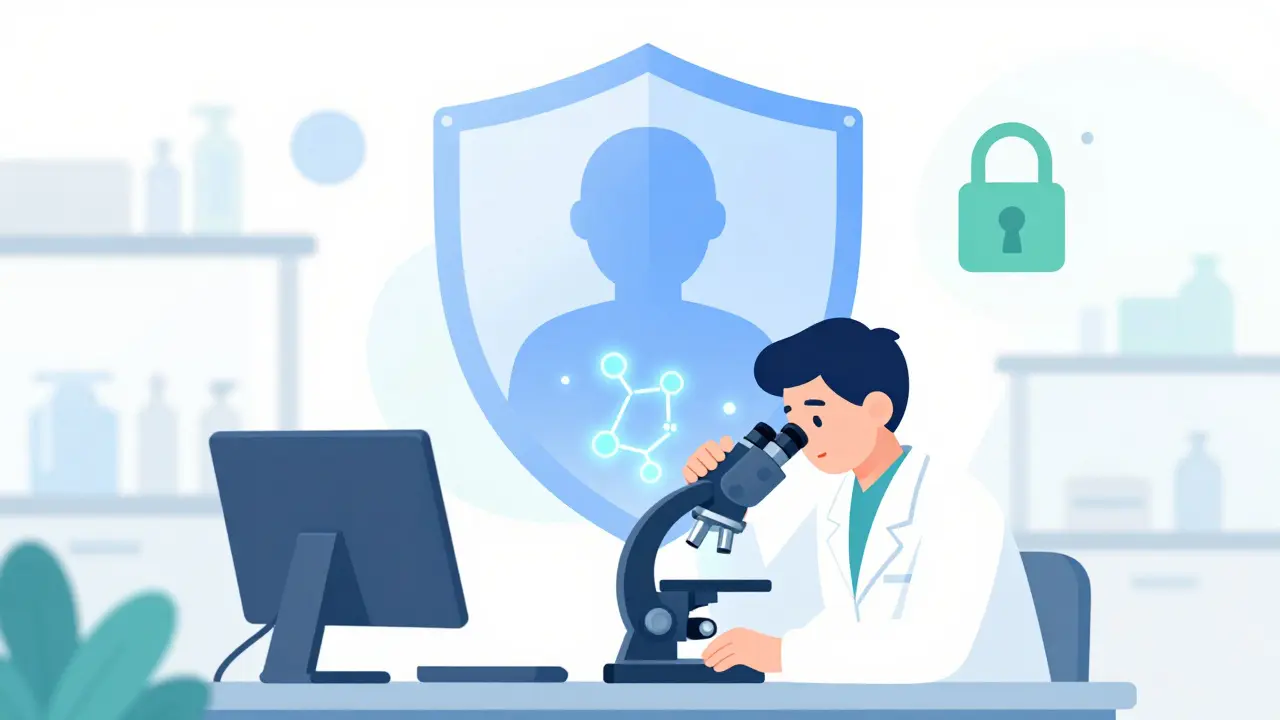
Sixty years after the tragedy began, scientists finally uncovered the precise molecular mechanism. In 2018, researchers identified that thalidomide binds to a protein called cereblon. This binding disrupts limb development in embryos by degrading specific transcription factors essential for limb formation. Understanding this explains both its teratogenic effects and its anticancer properties.
The interaction with cereblon degrades proteins that help form limbs during embryogenesis. When those proteins are gone, the baby grows without proper arms or legs. This discovery allowed scientists to design safer derivatives that retain the therapeutic benefits without the devastating side effects.
Modern Safeguards and Safety
Today, thalidomide remains one of the most potent human teratogens known. We cannot ignore its history. Consequently, modern use is strictly controlled through programs like the System for Thalidomide Education and Prescribing Safety (STEPS). This program requires mandatory contraception for women of childbearing potential. Patients must undergo regular pregnancy testing while on the medication.
Doctors must register with the scheme to prescribe it. Pharmacies must verify prescriptions carefully. While the drug offers hope to cancer patients, the protocols ensure it never returns to general practice without strict oversight. The Science Museum in London features a permanent exhibit on the subject to educate future generations about the critical importance of drug safety testing.
Frequently Asked Questions
Is thalidomide completely banned?
No, it is not banned but restricted. It is available for treating multiple myeloma and leprosy under strict safety programs.
What defines a teratogenic medication?
A teratogenic medication is any drug that causes birth defects when taken during pregnancy. Thalidomide is the most famous historical example.
How did the US avoid the thalidomide tragedy?
FDA officer Frances Oldham Kelsey refused to approve the drug due to incomplete safety data, preventing mass distribution in America.
Does thalidomide affect breastfeeding?
Yes, women are advised not to breastfeed while taking thalidomide as the drug passes into breast milk and poses high risk to the infant.
Why does thalidomide still exist if it is dangerous?
It treats serious conditions like multiple myeloma effectively. Strict safety controls minimize the risk to pregnant women while saving lives from cancer.
Recent-posts
How to Buy Cheap Generic Premarin Online Safely
Sep, 27 2025
Antibiotics and Birth Control Pills: The Truth About Drug Interactions
Jul, 16 2026
Exploring Top Alternatives to Ventolin in 2024 for Asthma Relief
Dec, 7 2024
2025 Alternatives for Prelone: A Practical Guide
Feb, 28 2025
Crossover Trial Design: How Bioequivalence Studies Are Structured
Dec, 15 2025
| 

 Medications



Victor Ortiz
March 31, 2026 AT 05:19You people clearly don't understand the pharmacology here. The data was weak because manufacturers cut corners on animal testing specifically. It isn't surprising that regulators failed to catch it given the lax laws back then. Blaming doctors is useless when the system encouraged the distribution without proper checks. The real issue lies in corporate greed disguised as healthcare innovation.
Ruth Wambui
April 1, 2026 AT 04:52Wake up and smell the chemical fog everyone. The pharmaceutical giants knew all along what that stuff did to fetuses. They buried the reports while politicians signed off on profit margins instead of lives. It is a classic case of planned obsolescence applied to human biology. History books always leave out the shady backroom deals happening in Berlin then.
Amber Armstrong
April 1, 2026 AT 22:12It truly breaks my heart to think about the mothers involved. They were trying to help themselves during pregnancy. Instead they caused unimaginable pain to their children. The statistics regarding phocomelia are absolutely devastating. We often forget the human element behind these medical cases. Every single child deserved to grow up healthy and whole. Parents watched helplessly as development stalled in critical ways. Society needs to remember this moment as a grave error. Medical science moved forward but left scars behind. Survivors lived with complex disabilities that never went away. You can see the resilience in how they navigated the world. Modern medicine owes a debt of honor to these survivors. We must ensure such a window of vulnerability never opens again. Safety regulations exist for a reason we cannot ignore today. My thoughts are with every family affected by this history.
Michael Kinkoph
April 3, 2026 AT 02:20One must observe the sheer negligence displayed. . . Truly unacceptable conduct from a clinical standpoint. Furthermore. The lack of oversight remains shocking to this day. We stand upon the shoulders of fools who ignored warning signs. . . Progress is slow when arrogance prevails.
Jonathan Sanders
April 3, 2026 AT 10:39Oh wow, another heroic FDA agent saving the day. Sure. Like we haven't heard that script before from American media outlets. Meanwhile the rest of the globe got hammered hard by a pill meant for nausea. Guess being born in America matters more than global health standards sometimes.
emma ruth rodriguez
April 5, 2026 AT 08:59The teratogenic mechanism described involving cereblon binding is scientifically accurate. Research published in recent years confirms degradation of transcription factors like SALL4. This molecular pathway explains limb malformation specificity. Clinical guidelines now mandate rigorous pregnancy prevention measures for prescribers. Adherence to STEPS protocols is mandatory for oncology treatment plans. Patient monitoring reduces fetal exposure risk significantly.
Rick Jackson
April 6, 2026 AT 14:58Regulations are built on blood. Sometimes progress requires sacrifice. But we learn from failure. Ethics matter more than speed. Safety should never be optional.
sanatan kaushik
April 8, 2026 AT 10:39Stop making excuses for big pharma companies. They killed kids for money. Now they want to sell the poison again for cancer. Nobody forgives. Nobody forgets. Keep your strict rules tight.
Debbie Fradin
April 10, 2026 AT 03:19Please tell me you aren't actually surprised by this level of incompetence. Corporate greed is the only constant in modern history lessons like this one. We pretend we learned but the same mistakes keep repeating elsewhere.
Jonathan Alexander
April 11, 2026 AT 01:15This tragedy represents a dark chapter in our collective soul. The silence of parents waiting for answers echoes through generations. We must honor the lost potential of those newborn lives forever. Such a profound loss demands deep reflection from society.
Charles Rogers
April 12, 2026 AT 00:36People focus too much on the drug itself and ignore the moral failing of humanity. Ignorance is not a defense when profit drives the decisions. We judge ourselves harshly when truth emerges late. True wisdom comes from accepting responsibility fully.
Beccy Smart
April 13, 2026 AT 20:57Huge thanks for sharing this history lesson! 😢🙏