

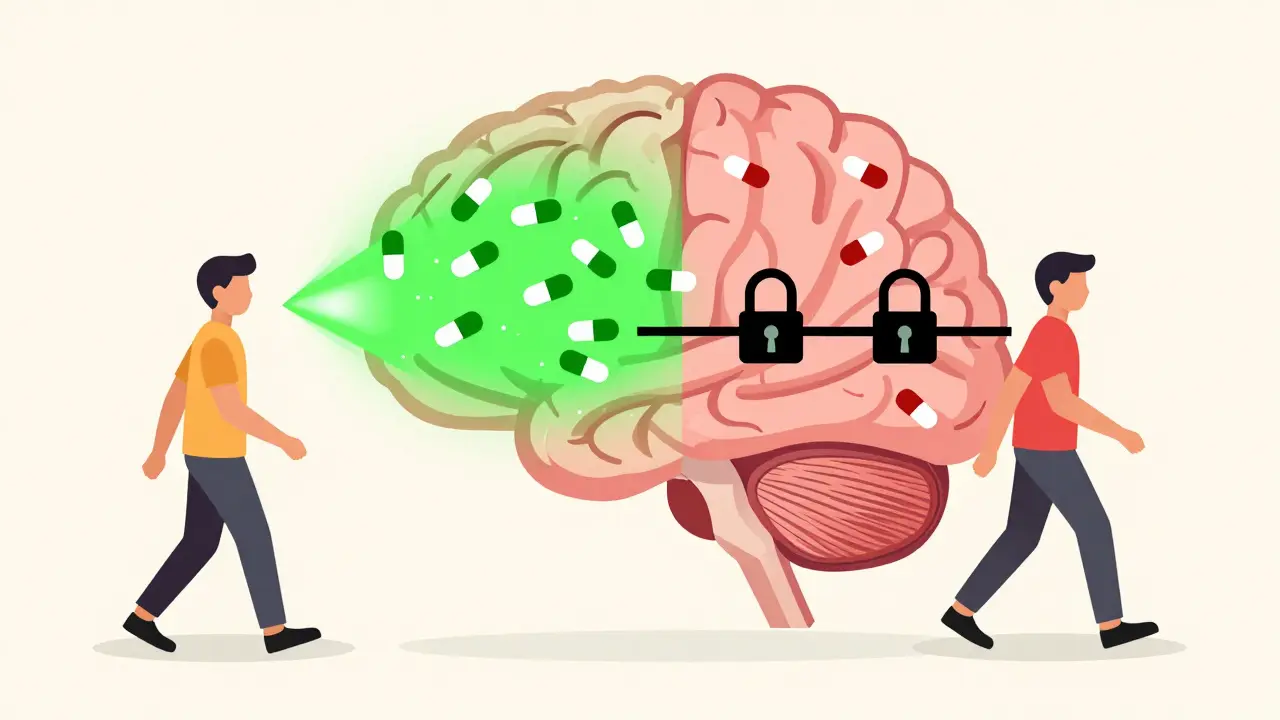
Imagine taking a medication to control your tremors, only to find your hallucinations get worse. Or taking a drug to calm your mind, only to freeze up and lose the ability to walk. This isn’t a hypothetical scenario-it’s a daily reality for thousands of people caught between two life-changing medications: levodopa and antipsychotics. They work in opposite directions on the same brain chemical: dopamine. And when they meet, the result can be dangerous, disabling, or even deadly.
Why Levodopa and Antipsychotics Collide
Levodopa is the gold standard for treating Parkinson’s disease. It doesn’t replace dopamine directly-it’s a building block your brain turns into dopamine. In Parkinson’s, the cells that make dopamine die off. Levodopa steps in to fill the gap, helping people move again. But here’s the catch: it doesn’t just boost dopamine where it’s needed. It floods the whole brain, especially as the disease progresses and the brain loses its ability to regulate the dose. Antipsychotics, on the other hand, are designed to block dopamine. They’re used for schizophrenia, bipolar disorder, and sometimes severe agitation. These drugs bind to dopamine receptors like a lock and key-except they don’t turn the key. They just block it. That’s how they reduce hallucinations and delusions. But in Parkinson’s, those same receptors are already starved for dopamine. Blocking them makes movement even harder. It’s like trying to fix a leaky pipe by turning off the water main. You stop the leak-but now nothing flows at all.What Happens When You Mix Them
When someone with Parkinson’s develops psychosis-hallucinations, paranoia, delusions-doctors face a brutal choice. Treat the psychosis, and risk making the tremors and stiffness worse. Keep the motor symptoms under control, and the person may suffer from terrifying mental experiences. Studies show that up to 40% of Parkinson’s patients will develop psychosis over time. When antipsychotics are given, motor symptoms typically worsen by 25-35% on standard movement scales. One patient might go from walking with a cane to needing a wheelchair in just a few days after starting a low dose of risperidone. That’s not rare. It’s predictable. And it goes both ways. People with schizophrenia who are accidentally given levodopa-sometimes for restless legs or misdiagnosed Parkinsonism-can have psychotic symptoms spike by 20-40%. A 1988 study found that 60% of schizophrenia patients on 300 mg of levodopa had their hallucinations return, even after years of stability. That’s not a side effect. It’s a direct pharmacological trigger.The Hidden Danger: Neuroleptic Malignant Syndrome
This isn’t just about feeling worse. It’s about life-threatening risk. Abruptly stopping levodopa-or suddenly starting a strong antipsychotic-can trigger neuroleptic malignant syndrome (NMS). This is a medical emergency. Your muscles lock up. Your body temperature soars. You become confused, then unconscious. Mortality rates range from 10% to 20%. Why does this happen? Because your brain is suddenly starved of dopamine. Levodopa withdrawal removes the only source of dopamine. Antipsychotics block the receptors that would normally respond to it. The result? A total dopamine collapse. The Cleveland Clinic and other major centers now treat NMS with dopamine agonists-not to calm psychosis, but to restart the brain’s broken signaling system.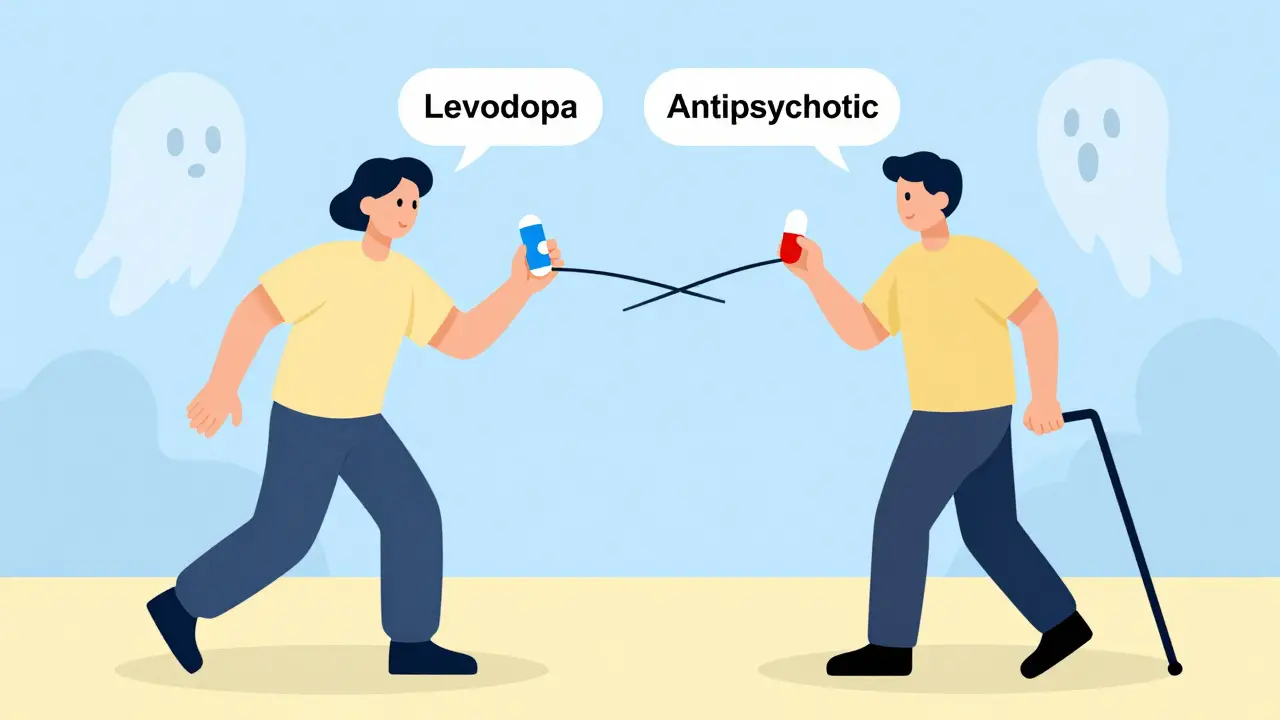
What Doctors Actually Do (And What They Avoid)
Most neurologists avoid first-generation antipsychotics like haloperidol completely. They’re too strong, too blunt. Even second-generation ones like risperidone and olanzapine can cause major motor decline. The only antipsychotic with FDA approval for Parkinson’s psychosis is pimavanserin. It doesn’t block dopamine at all. Instead, it targets serotonin receptors. That’s why it doesn’t wreck movement. But it’s not perfect. Pimavanserin is expensive. Many patients can’t access it. And even then, 30-50% of patients still report some worsening of mobility. A 2022 survey of 150 specialists found that 89% avoid typical antipsychotics. Only 42% have ever prescribed pimavanserin. That means over half of Parkinson’s patients with psychosis are left untreated-or given risky alternatives. The American Academy of Neurology recommends a 4-week washout period when switching between these drugs. But what if someone is actively hallucinating? Waiting four weeks isn’t an option. Clinics like the Cleveland Clinic now require daily motor assessments for the first two weeks after starting any antipsychotic. If movement worsens by more than 15 points on the UPDRS scale, the drug is stopped immediately.Real Stories, Real Consequences
Reddit threads from r/Parkinsons and r/schizophrenia are full of heartbreaking accounts. One user, ParkinsonsWarrior2020, wrote: “I started 0.25mg quetiapine for sleep. My tremor went from 2/10 to 8/10 in two days. I couldn’t hold a cup of tea.” Another, MindfulSchizo, said: “I took levodopa for restless legs. My hallucinations came back after two years of being stable. I ended up in the ER.” These aren’t outliers. They’re textbook outcomes. A 2021 study found that 65% of Parkinson’s patients with psychosis get no specific treatment because doctors are afraid of making things worse. That’s not care. That’s resignation.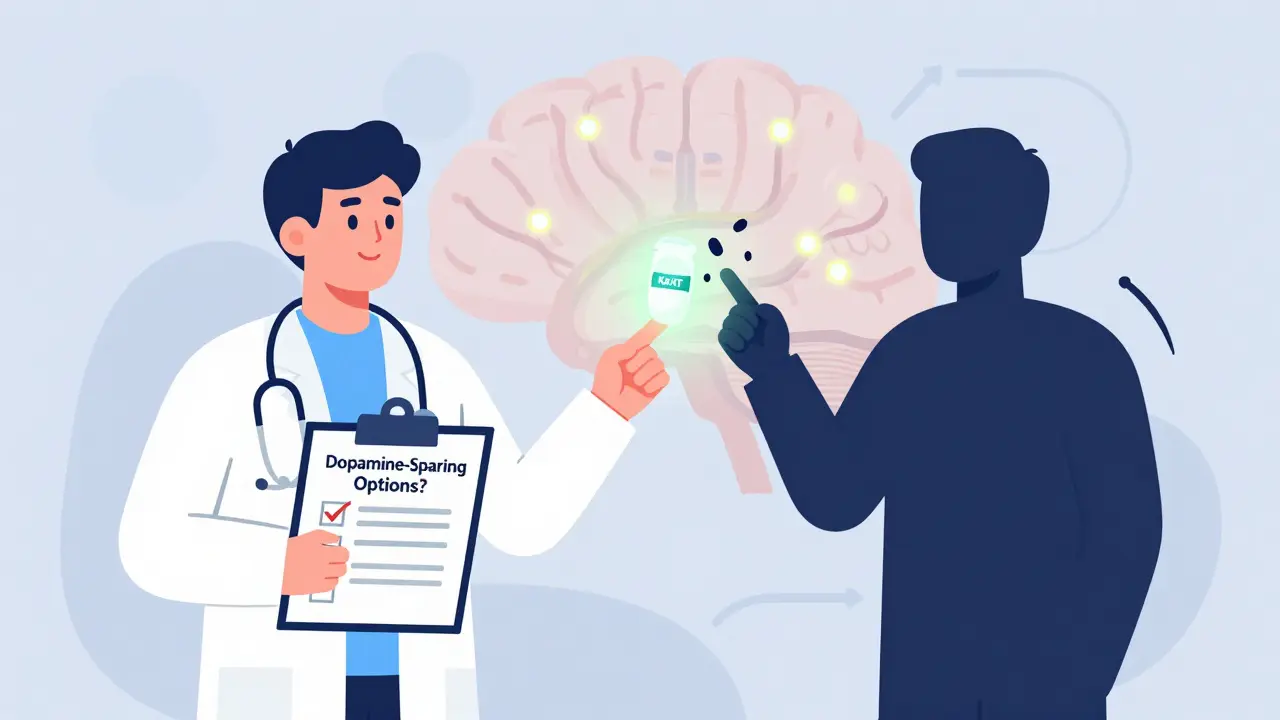
 Medications


bhushan telavane
December 20, 2025 AT 09:54Man, I saw this happen to my uncle in Delhi. Took risperidone for sleep, and next thing you know, he couldn’t stand without holding onto the wall. Doctors just shrugged and said, 'It’s Parkinson’s getting worse.' Like it wasn’t the meds.
Why don’t they test for this stuff before prescribing?
Connie Zehner
December 21, 2025 AT 23:10OMG I KNEW THIS!! 😭 I told my neurologist last year that levodopa + antipsychotics = disaster and they just laughed and said 'you’re overreacting' 😤 Now my mom’s in a wheelchair and hallucinating every night. I’m so mad. Why won’t anyone LISTEN?? 😭
holly Sinclair
December 22, 2025 AT 14:21It’s fascinating how this reflects a deeper epistemological flaw in neuropharmacology-the Cartesian dualism of mind and body that still underpins clinical decision-making. We treat Parkinson’s as a motor disorder and psychosis as a psychiatric one, but dopamine is the bridge. The brain doesn’t compartmentalize; medicine does.
This isn’t just a drug interaction-it’s a metaphysical error. We’re trying to fix a holistic system with reductionist tools. The fact that pimavanserin works precisely because it sidesteps dopamine entirely proves that the old paradigm is collapsing. We need systems biology, not symptom silos.
And yet, most clinicians still treat this like a dosing problem rather than a paradigm crisis. The inertia is terrifying. We’re still using 1950s logic to treat 21st-century biology.
mark shortus
December 23, 2025 AT 10:35THIS IS A TRAGEDY. A TRAGEDY I TELL YOU. 😱
My cousin took olanzapine for 'anxiety'-she didn’t even have Parkinson’s!-and within 72 hours, she was frozen. Like a statue. Just… staring. No speech. No movement. The ER said 'it’s probably catatonia.' CATATONIA?? NO. IT WAS THE DRUG. THE DRUG DID THIS.
And now? She’s on pimavanserin. Costs $12,000 a month. Insurance denied. We’re crowdfunding. THIS ISN’T HEALTHCARE. IT’S A ROULETTE WITH LIVES.
Someone needs to sue someone. I’m filing a petition. I’m not stopping until this is national news.
Emily P
December 25, 2025 AT 01:20Is there any data on how often this happens in elderly patients with mixed diagnoses? I’m asking because my grandma’s on both, and I’m scared to ask her doctor because he gets defensive.
Vicki Belcher
December 26, 2025 AT 14:22This is so important 💙 Thank you for writing this. I wish every doctor had to read this before prescribing.
My dad’s on pimavanserin now and he’s smiling again-no hallucinations, and he can hold my hand. I cried when he said, 'I can feel my fingers again.'
Don’t give up. There’s hope. 🌈
Jedidiah Massey
December 27, 2025 AT 03:34It’s a classic dopaminergic antagonism cascade with downstream GABAergic dysregulation and glutamatergic excitotoxicity-especially in the basal ganglia-thalamocortical loops. The fact that pimavanserin’s 5-HT2A inverse agonism avoids D2 blockade is pharmacologically elegant, but clinically underutilized due to cost-benefit misalignment in managed care systems.
Also, KarXT’s muscarinic agonism is a brilliant workaround-M1/M4 selectivity avoids peripheral cholinergic side effects. But phase 3 data is still preliminary. Don’t get your hopes up until Phase 4.
Lynsey Tyson
December 27, 2025 AT 04:16I just want to say thank you for sharing this. I’ve been so scared to bring this up with my mom’s doctor because I didn’t want to sound like I was challenging him. But now I feel like I have the words.
Maybe I’ll print this out and hand it to him. He’s a good man-he just doesn’t know this stuff.
Sarah McQuillan
December 27, 2025 AT 05:20Wow. So you’re saying the U.S. healthcare system is broken because we don’t have magic drugs? Newsflash: India doesn’t even have pimavanserin. They use haloperidol because it’s cheap. And guess what? People die. But hey, at least it’s affordable.
Maybe the real problem isn’t the drugs-it’s that rich people get fancy treatments and the rest of us get to suffer. Just sayin’.
anthony funes gomez
December 28, 2025 AT 11:52Neuroleptic malignant syndrome isn’t just dopamine depletion-it’s a catecholamine withdrawal syndrome compounded by rhabdomyolysis-induced hyperthermia and renal failure. The mortality rate isn’t 10-20% because of the dopamine crash-it’s because of delayed diagnosis. Most cases are missed until it’s too late.
And pimavanserin? It’s not perfect. It prolongs QT. There are case reports of torsades. The FDA approved it on surrogate endpoints. We’re trading one risk for another. We need biomarkers. We need PET tracers for 5-HT2A occupancy. We need better trials.
Until then, we’re just guessing.
Alana Koerts
December 29, 2025 AT 21:23So you’re telling me the solution is to not treat psychosis? That’s not a solution. That’s surrender. And pimavanserin doesn’t work for most people. The data is garbage. And KarXT? Still experimental. This whole post is just fearmongering dressed up as science.
Dikshita Mehta
December 29, 2025 AT 22:23I’m a nurse in Mumbai. We see this all the time. Families bring patients on levodopa who develop psychosis after starting antipsychotics. We don’t have pimavanserin. We use low-dose quetiapine and hope for the best. We monitor tremors daily. We tell families: 'If he can’t hold his spoon, stop the pill.'
It’s not ideal. But it’s what we’ve got.
Thank you for writing this. We need more awareness here too.
Nicole Rutherford
December 31, 2025 AT 14:29Wow. So you’re blaming doctors for being human? People with psychosis need treatment. You can’t just let them hallucinate because it might make their Parkinson’s worse. That’s not care-that’s neglect.
And why is everyone acting like pimavanserin is a miracle? It’s not. Most patients still decline. The real solution? Stop giving levodopa to elderly people. It’s overprescribed.
Mark Able
January 1, 2026 AT 00:41My brother’s neurologist just told him to 'tough it out' when his tremors got worse on quetiapine. I called the clinic. They said, 'We’re not responsible for side effects.' I’m filing a complaint. This is malpractice.