

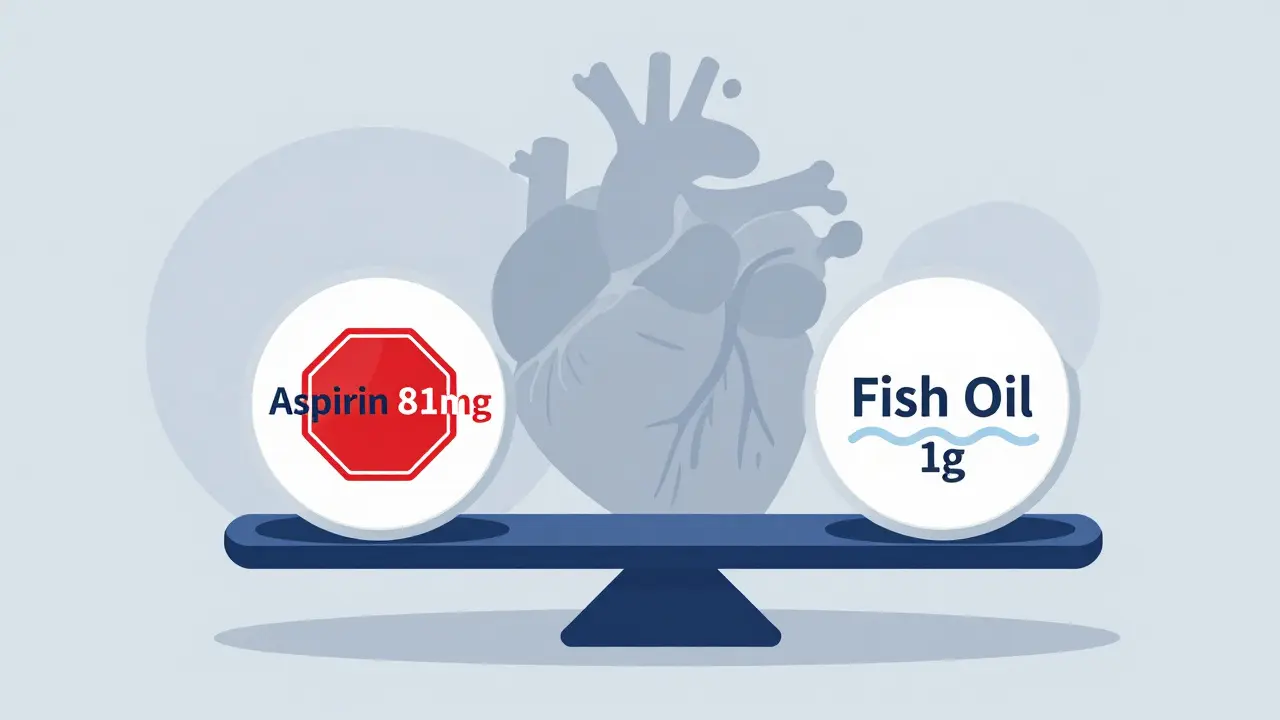
Many people take fish oil for heart health and aspirin to protect against heart attacks. But when you combine them, does the risk of bleeding go up? The answer isn’t simple - and it’s not what most supplement labels or online forums claim.
How Fish Oil and Aspirin Work
Aspirin doesn’t just relieve headaches. At low doses (usually 81mg daily), it works as a blood thinner by blocking an enzyme called COX-1 in platelets. This stops platelets from clumping together to form clots. Once aspirin hits your system, its effect lasts for the entire life of a platelet - about 7 to 10 days. That’s why doctors tell you to stop aspirin before surgery.
Fish oil, on the other hand, contains two omega-3 fatty acids: EPA and DHA. These don’t block enzymes like aspirin does. Instead, they get built into the membranes of your platelets. This makes the platelets less sticky over time. But the effect is much slower and weaker. Studies show it takes 1 to 2 weeks of daily use before you even start to see a change in platelet behavior.
Here’s the key difference: aspirin cuts platelet clumping by 70-90%. Fish oil at typical supplement doses (1g daily) reduces it by maybe 10-20%. That’s not even close to the same level of effect.
What the Big Studies Say
Large, long-term trials have looked at this exact question - and the results are clear.
The ASCEND trial (2018) followed over 15,000 people with diabetes for nearly 8 years. Half took 1g of fish oil daily; half took a placebo. The fish oil group had no more bleeding events than the placebo group. Not even slightly more. The same was true in the VITAL study (2019), which included over 25,000 people. Even at 1g daily, fish oil didn’t raise bleeding risk.
Then there’s the OPERA trial (2010), which gave cardiac surgery patients up to 8g of fish oil before and after surgery. That’s eight times the typical supplement dose. Even then, bleeding wasn’t worse than in patients who didn’t take fish oil. Chest tube output - a direct measure of bleeding - was nearly identical.
So why do some people worry? Because of small studies that looked at platelet function in labs, not real-world outcomes. Just because fish oil changes platelet behavior a little doesn’t mean it causes bleeding.

When the Combination Might Matter
There’s one group where this combo might be more relevant: people who are “aspirin insensitive.” These are the roughly 20-30% of people whose platelets don’t respond fully to aspirin. In a 2012 study of 56 diabetics, adding 4g of fish oil daily to aspirin reduced platelet clumping an extra 32% compared to aspirin alone. That’s a real effect - but it’s still not proven to prevent heart attacks or strokes.
And here’s the catch: even in that study, there was no increase in bleeding. The combination worked better on platelets - but didn’t make people bleed more.
High-dose fish oil (over 3g daily) is a different story. Prescription-strength icosapent ethyl (Vascepa), which contains only EPA, is approved for people with high triglycerides and heart disease. But even this 4g daily dose, taken with aspirin, didn’t increase bleeding in the REDUCE-IT trial - though the trial had its own controversies.
What Real People Experience
Online forums are full of stories. Some people say they’ve taken fish oil and aspirin for years with no issues. Others say they bled after dental work or surgery.
Dr. Deepak Bhatt, a leading cardiologist, says: “Over-the-counter fish oil at standard doses doesn’t meaningfully add to aspirin’s effect.” But he also says: “If someone’s taking 4g or more daily, we talk about it.”
On the other hand, Dr. William Harris, a lipid expert, believes that fish oil’s effect, while small, is real - especially in people with high triglycerides or insulin resistance. He says it’s worth considering for those at high risk.
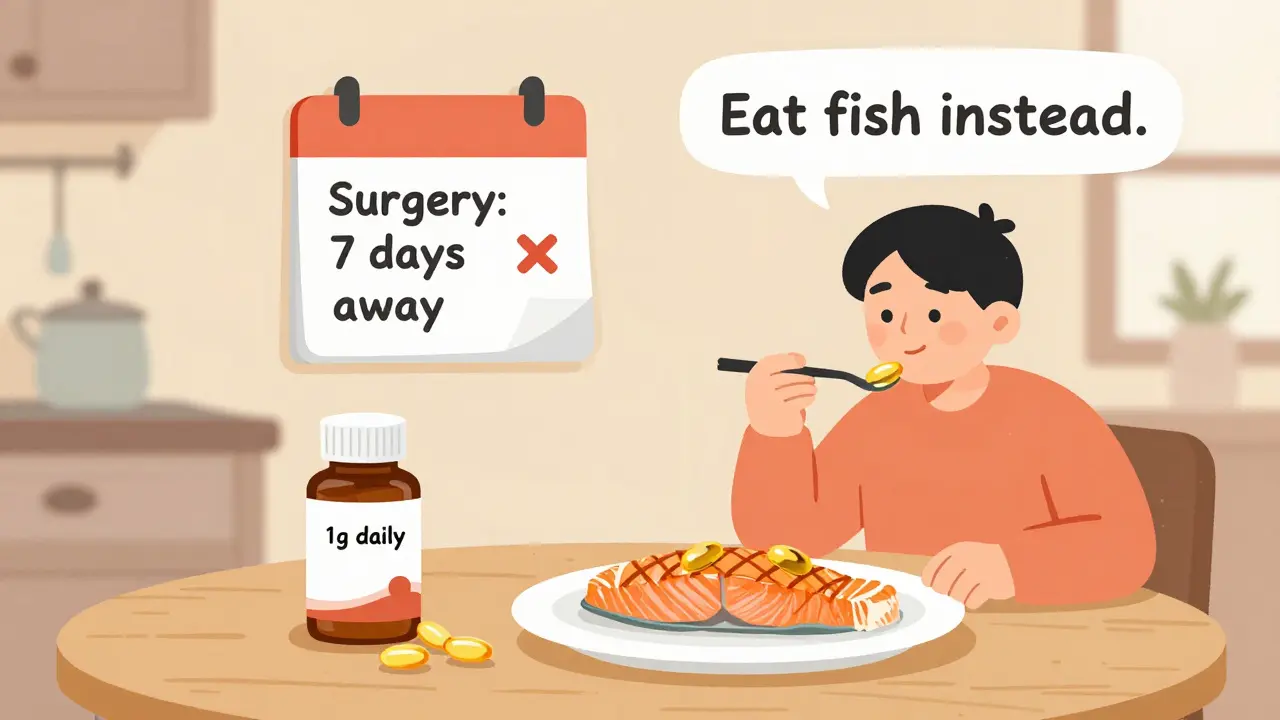
Surgeons, however, still play it safe. Most recommend stopping fish oil 7 to 10 days before surgery - not because the evidence says it’s dangerous, but because they can’t risk even a small chance of bleeding. It’s easier to say “stop it” than to explain the nuances.
What You Should Do
If you’re taking 1g or less of fish oil daily - the typical dose in most store-bought capsules - and you’re on low-dose aspirin, there’s no reason to stop. The evidence says it’s safe.
If you’re taking more than 3g daily - whether it’s from multiple capsules or a prescription - talk to your doctor. You might not need to stop, but you should be monitored.
Here’s what to ask:
- Am I on fish oil for a reason - or just because I heard it’s good for the heart?
- Is my dose based on science, or just marketing?
- Have I been tested for high triglycerides or inflammation?
Most people don’t need high-dose fish oil. The benefits are small, and the cost is high. For most, eating fatty fish twice a week is just as effective - and cheaper.
The Bottom Line
Fish oil and aspirin do not meaningfully increase bleeding risk when taken together at standard doses. That’s the consensus from the largest, best-designed studies.
But here’s what nobody tells you: most people don’t need fish oil supplements at all. If you eat salmon, sardines, or mackerel regularly, you’re getting enough omega-3s. If you don’t, a 1g daily supplement is fine - even with aspirin.
Stop taking high-dose fish oil (over 3g) unless your doctor specifically recommended it. And if you’re scheduled for surgery, always tell your surgeon about everything you’re taking - supplements included. They’ll make the call.
The science is clear. The fear isn’t.
Can I take fish oil and aspirin together safely?
Yes, if you’re taking standard doses: up to 1g of fish oil daily and 81mg of aspirin. Large studies involving over 40,000 people show no increase in bleeding risk. The effect of fish oil on platelets is too weak to add meaningfully to aspirin’s action at these doses.
Does fish oil thin your blood like aspirin?
No. Aspirin blocks a key enzyme (COX-1) and reduces platelet clumping by 70-90%. Fish oil makes platelets slightly less sticky by changing their membranes, but only reduces clumping by 10-20% at normal doses. It’s not a replacement for aspirin.
Should I stop fish oil before surgery?
Many surgeons recommend stopping fish oil 7-10 days before surgery - even though evidence doesn’t show increased bleeding risk. It’s a precaution, not a requirement. Always follow your surgeon’s advice, but know that the science doesn’t support the fear.
Is high-dose fish oil (4g+) better than aspirin for heart protection?
For most people, no. Prescription icosapent ethyl (Vascepa) at 4g daily reduces heart attack and stroke risk in high-risk patients with high triglycerides - but only when combined with statins. Over-the-counter fish oil at 4g daily hasn’t been proven to do the same. Aspirin remains the gold standard for antiplatelet protection.
Can fish oil replace aspirin if I’m allergic to it?
No. Fish oil doesn’t have the same mechanism or strength as aspirin. It can’t prevent clots in the same way. If you’re allergic to aspirin and need blood thinning, your doctor will prescribe an alternative like clopidogrel - not fish oil.
Does fish oil increase bruising?
Some people report easier bruising with high-dose fish oil (over 3g daily), especially if they’re also on blood thinners. But in clinical trials, this wasn’t statistically significant. If you notice unusual bruising, check your dose and talk to your doctor. It’s rare and usually not dangerous.
 Medications





Sarah B
February 7, 2026 AT 16:04Mary Carroll Allen
February 8, 2026 AT 09:49Mark Harris
February 10, 2026 AT 08:23Marcus Jackson
February 10, 2026 AT 13:10Natasha Bhala
February 11, 2026 AT 13:58Paula Sa
February 13, 2026 AT 07:56Jesse Lord
February 14, 2026 AT 04:04Ashley Hutchins
February 15, 2026 AT 17:17Lakisha Sarbah
February 17, 2026 AT 05:21Ariel Edmisten
February 19, 2026 AT 05:16Tola Adedipe
February 19, 2026 AT 07:15