

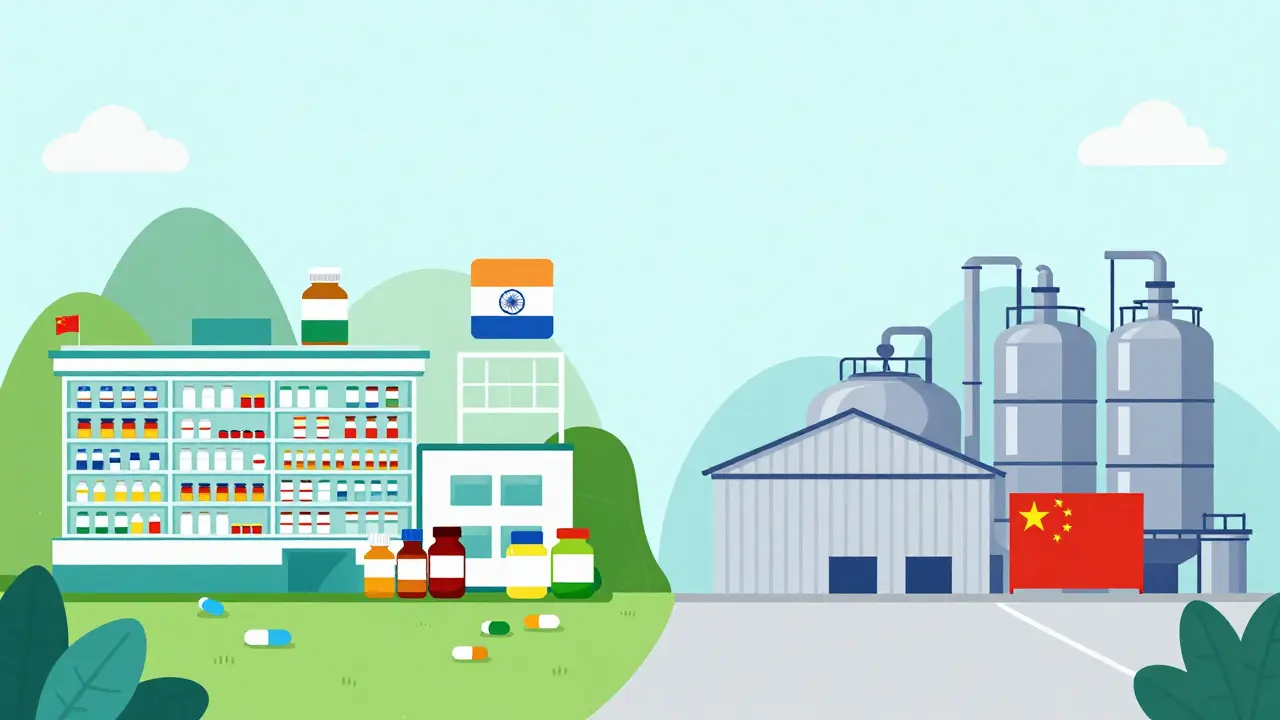
The global healthcare system effectively runs on the backs of two Asian giants. While you might not see their names on the box, Asian generic markets is the powerhouse of affordable medicine, providing the vast majority of the world's non-branded drugs and raw materials . If you've ever taken a generic antibiotic or a vaccine, there's a high probability it started its life in a factory in Gujarat or Jiangsu. But the landscape is shifting. The old narrative-India makes the pills, China makes the powder-is becoming too simple as both nations race toward high-value biologics and innovative medicine.
Key Takeaways
- India dominates the volume of finished generic drugs, supplying roughly 40% of the US generic market.
- China holds a strategic grip on the supply chain, controlling 70% of the global Active Pharmaceutical Ingredient (API) market.
- Both nations are pivoting from cheap generics toward expensive biologics and biosimilars.
- Emerging players like Vietnam and Cambodia are carving out niches in antibiotics and medical devices.
- Global buyers are moving toward dual-sourcing to avoid reliance on a single country.
The Pharmacy of the World: India's Volume Play
India didn't become a global leader by accident. Back in the 1970s, the government changed the Patents Act to allow process patenting. This meant companies could figure out a different way to make a drug and sell it cheaply. Today, the Indian pharmaceutical market is valued at over $61 billion, with a massive concentration in states like Gujarat and Maharashtra. What makes India stand out is its sheer scale in small-molecule generics. They hold a 20% global market share by volume, and when it comes to complex generics like oncology drugs, that share jumps to 35%. However, this volume comes with a trade-off. India ranks 3rd globally by production volume but only 14th by market value. They are the kings of low-margin, high-volume production.
For those sourcing from India, the experience is often a mix of efficiency and frustration. Many procurement managers find that Indian firms are incredibly responsive-often handling custom formulation requests in just 14 days. But the regulatory side can be a headache. Because enforcement varies across different states, you might face unexpected delays that you wouldn't see in a more centralized system.
China's Strategic Grip on APIs
If India is the pharmacy, China is the warehouse. Active Pharmaceutical Ingredients (API) are the raw chemical components that make a drug actually work . China controls about 70% of this global market. To put that in perspective, India-despite its massive export volume-still relies on China for 68% of its own API needs. This creates a strategic chokehold; if China slows down API production, the rest of the world's generic drug supply feels the pinch almost immediately.
China's approach is different from India's. Their market, valued at around $80.4 billion, is more diversified. While they do plenty of conventional drugs, they also lead in Traditional Chinese Medicine and are investing aggressively in biologics. Between 2020 and 2024, nearly half of all new pharmaceutical facilities in China were dedicated to biologics. They aren't just looking for volume; they are chasing value.
| Feature | India | China |
|---|---|---|
| Market Strength | Finished Generic Volume | API Raw Materials & Value |
| Global API Share | Low (Dependent on imports) | ~70% (Dominant) |
| FDA Warnings (2024) | 87 | 142 |
| Avg. Response Time | Fast (14 days) | Slower (30-45 days) |
| Primary Export Focus | Small-molecule Generics | APIs & Biologics |
The Pivot to Biologics and Biosimilars
We are witnessing a massive shift in strategy. Both nations realize that the profit margins on basic generics are shrinking. The new frontier is Biosimilars is biologically derived medications that are nearly identical to an original brand-name biologic drug . These are much harder to make than chemical pills and command much higher prices.
China is currently winning the value war here. Through its 14th Five-Year Plan, China allocated $150 billion toward innovation, with 40% of that specifically for biologics R&D. India is fighting back with the 'Pharma 2047' initiative, which puts $13.4 billion toward reducing API dependence and boosting high-tech capabilities. India's secret weapon is its people-65% of the population is under 35, providing a massive pool of young scientists and engineers to drive this transition.

Emerging Economies: The New Niche Players
While India and China grab the headlines, smaller players are stealing specific slices of the pie. Vietnam is a great example. Their pharmaceutical market has been growing at a 12.3% CAGR, focusing specifically on antibiotic intermediates. They aren't trying to out-produce India; they're just trying to be the best at one specific thing.
Similarly, Cambodia is finding success in low-cost medical device assembly. By leveraging ASEAN trade preferences, they've seen 18% annual growth in that segment. For a global company, these emerging hubs offer a way to diversify risk. Instead of putting all your eggs in the India-China basket, you can source specific components from Vietnam to keep your supply chain resilient.
The Reality of Sourcing: Quality vs. Cost
If you're a procurement officer, the choice between these markets isn't just about price-it's about risk. Sourcing antibiotics from India can save you 35-40% compared to European suppliers, but you'll likely deal with longer lead times and a need for more rigorous batch testing. China offers even lower prices on APIs, but the higher number of FDA warning letters means you have to spend more on quality audits.
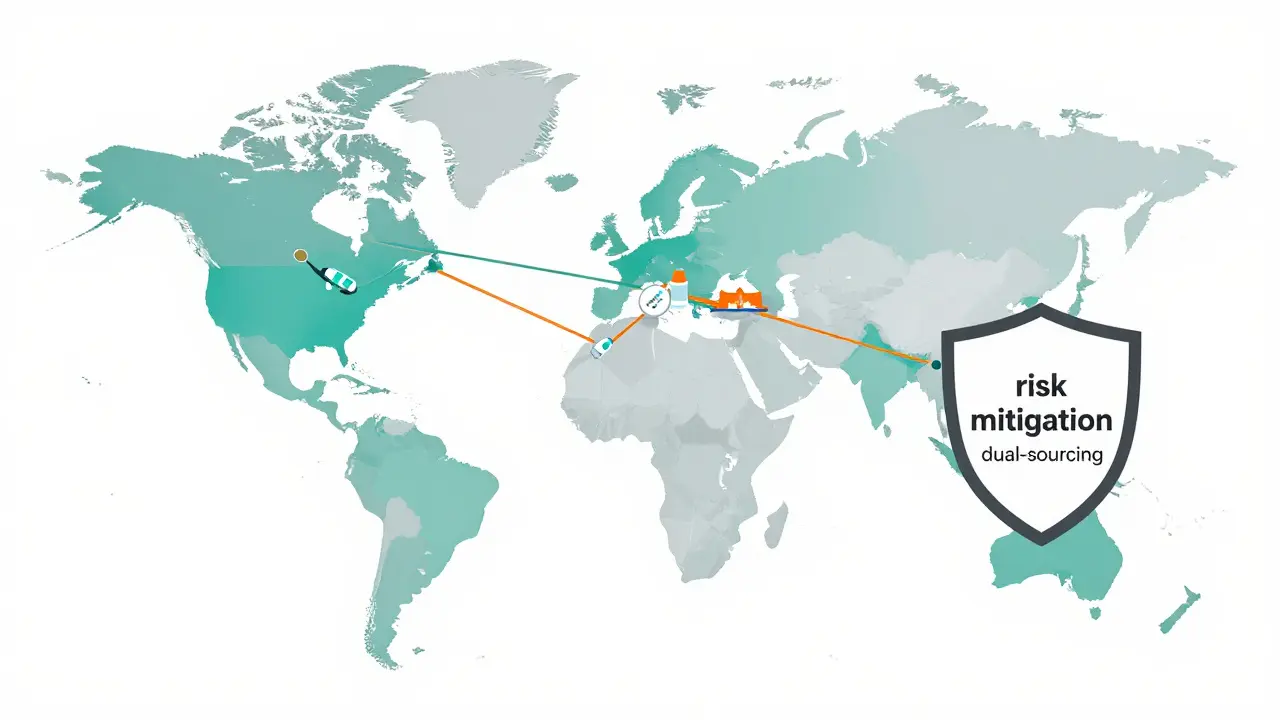
This has led to the rise of the "dual-sourcing" strategy. About 68% of major U.S. pharmacy chains now split their sourcing, taking maybe 50% from India and 30% from China. This way, if a regulatory crackdown hits one country or a geopolitical spat closes a border, the shelves don't go empty. It increases costs by about 18%, but it's a small price to pay for insurance against a total supply chain collapse.
Navigating Market Entry and Regulation
Trying to set up a shop in these markets requires two very different playbooks. In India, you'll have to navigate about 17 different federal and state regulatory bodies. It's fragmented and can take 18-24 months to get approved. However, if you set up in a Special Economic Zone (SEZ), you can get tax holidays for up to 10 years.
China's process is more streamlined-you deal with about 8 national agencies, and approvals now take only 12-18 months. The catch? You often need 51% local ownership for distribution companies. It's a more centralized system, but it requires giving up more control over your business structure.
Why is India called the "pharmacy of the world"?
India earned this title by focusing on the production of high-volume, affordable generic drugs. By amending patent laws in the 1970s to allow process patenting, they were able to manufacture essential medicines at a fraction of the cost of original brand-name drugs, eventually supplying a huge portion of the global demand for generics and vaccines.
What is the difference between a generic and a biosimilar?
A generic is a chemical copy of a brand-name drug, making it relatively easy to replicate. A biosimilar is a version of a biologic drug-which is made from living cells-and is significantly more complex to produce. Because biologics are larger and more unstable molecules, biosimilars are "highly similar" rather than exact copies.
How dependent is India on China for drug production?
Very dependent. Despite its dominance in finished pills, India imports roughly 68% of its Active Pharmaceutical Ingredients (APIs) from China. This creates a vulnerability where Indian production can be stalled if Chinese raw material exports are restricted.
Which market is better for high-value innovation?
Currently, China leads in value and innovation. About 8.5% of China's pharmaceutical exports are novel drugs, compared to only 1.2% for India. China's massive investment in biologics and its centralized government funding give it an edge in high-margin pharmaceutical development.
What are the risks of sourcing from Asian generic markets?
The primary risks are quality variance and regulatory instability. Both markets have faced FDA warning letters and WHO inspection failures. Additionally, geopolitical tensions and "Project BioSecure" in the US are forcing companies to implement costly traceability and dual-sourcing strategies to mitigate the risk of supply chain interruptions.
Next Steps for Procurement and Investment
If you're looking to enter these markets or shift your sourcing, the first step is a gap analysis of your current supply chain. Are you over-reliant on a single API source in China? If so, explore the emerging antibiotic hubs in Vietnam to diversify. For those investing in manufacturing, the hybrid model is the gold standard. Look at companies like Sun Pharma, which uses Indian labor and facilities but integrates German quality control systems. This approach allows you to keep the cost advantages of Asia while maintaining the 98%+ FDA compliance rates required by Western regulators. Finally, if you're entering India, prioritize SEZs to maximize your tax benefits, but hire local regulatory specialists who can navigate the complex state-level bureaucracy.
 Medications

lalit adesara
April 28, 2026 AT 10:30India's scale is unmatched. We provide the world's health. The West is just jealous of our efficiency. 🇮🇳
Peter Minto
April 29, 2026 AT 14:21Why the hell are we letin China control 70% of the API market?? This is a security risky. We need to bring every single pill back to US soil right now. Stop relyin on these overseas factories that can just shut us out whenever they feel like it!
prince king
May 1, 2026 AT 12:40It is truly fascinating to see how global interdependence creates a delicate balance of peace and necessity 🌿. When we rely on each other for medicine, there is a built-in incentive for stability. The shift toward biologics seems like a natural evolution of human ingenuity 🧬✨. I love how the author highlights the potential of younger generations in India to lead this charge. It's a beautiful reminder that the future is built by the youth 🌟. Maybe we should look at these trade relations as a bridge rather than a battleground. Cooperation always yields better results than competition in the long run 🤝. The emergence of Vietnam and Cambodia also shows that opportunity can bloom anywhere if the conditions are right 🌸. It's like a global garden of innovation where every country brings its own unique seed. We should embrace this diversity of production. It makes the whole system more resilient and inclusive for everyone. Truly a testament to how we can work together across borders for the common good of humanity ❤️. Let's hope the transition to higher-value medicines benefits the poorest populations too, not just the wealthy corporations. That's where the real philosophical victory would be 🌈. Keep sharing these insights!
Jarrett Jensen
May 2, 2026 AT 05:29The analysis provided is superficially adequate, yet it fails to delve into the deeper macroeconomic implications of the 'Pharma 2047' initiative. One finds it rather tedious that the discourse remains centered on volume and value without addressing the systemic inefficiency of state-level regulatory fragmentation in the Indian subcontinent. Furthermore, the juxtaposition of FDA warning letters as a metric for quality is an oversimplification of a far more complex regulatory landscape. It is quite apparent that the author lacks the nuance required to dissect the interplay between geopolitical hegemony and pharmaceutical procurement strategies. Such a cursory overview is hardly sufficient for a professional investor. I find the inclusion of Cambodia's niche growth to be an inconsequential detail that distracts from the primary tension between the two titans. The prose is pedestrian, and the conclusions are entirely predictable for anyone with a basic understanding of global trade. It is simply disappointing to see such a lack of rigor in a piece that purports to analyze strategic markets. I expected a more sophisticated treatment of the biosimilar transition. Instead, we are given a glorified summary of a balance sheet. Utterly mediocre.
Justin Crice
May 3, 2026 AT 19:30The strategic pivot toward biosimilars necessitates a rigorous evaluation of the CAPEX requirements for these new facilities. I am particularly interested in the volatility of the API supply chain when juxtaposed with the current regulatory trajectory of Project BioSecure. The idiosyncratic nature of the Indian regulatory environment seems to create a significant bottleneck in the GxP compliance pipeline. This creates a fascinating asymmetry in the risk-reward ratio for institutional investors.
Jenna Riordan
May 3, 2026 AT 22:05I wonder if the people running these factories even know how much we depend on them.
Raymond Lipanog
May 4, 2026 AT 07:55The concept of dual-sourcing is a pragmatic response to the inherent instabilities of our modern era. It is a reflection of the tension between economic efficiency and national security. One must acknowledge that while it increases costs, the preservation of public health outweighs the desire for maximum profit. It is a moral imperative to ensure that life-saving medications remain accessible regardless of political strife.
Angela Cook
May 4, 2026 AT 16:46Exactly! We can't keep letting other countries hold our health hostage! It's time to stop the handouts and start building our own plants here in the States. We have the tech, we have the money, so why are we still begging for APIs from China?! It's pathetic!
Michael Yoste
May 5, 2026 AT 17:45Now, now, let's not get too worked up! But honestly, the obsession with 'nationalism' here is just a mask for the fact that we've let our own manufacturing rot for decades. It's cute that people think a few new factories will fix a systemic collapse of domestic industry. You're all just reacting emotionally to a problem that was solved by economics years ago.