


Accommodation Eligibility Calculator
This tool helps you determine if your medication side effects might qualify for workplace accommodation under the Americans with Disabilities Act (ADA) and suggests appropriate adjustments based on your job type.
What Are Workplace Accommodations for Medication Side Effects?
When someone takes medication for a chronic condition-like epilepsy, depression, high blood pressure, or ADHD-they might experience side effects that make it harder to do their job. Drowsiness, dizziness, nausea, or trouble focusing aren’t just inconveniences. For some people, they’re real barriers to showing up, staying alert, or performing safely at work.
Under the Americans with Disabilities Act (ADA), employers are required to make reasonable accommodations for employees whose medication side effects substantially limit a major life activity. This doesn’t mean lowering performance standards or letting someone skip work. It means adjusting the work environment or schedule so the person can still do their job effectively and safely.
It’s not about the medication itself. It’s about how the individual experiences the side effects. Two people on the same drug can react completely differently. One might feel fine. Another might struggle with focus for weeks after a dosage change. The law requires employers to look at the person, not the pill.
When Does a Side Effect Qualify as a Disability?
Not every side effect triggers legal protection. The ADA doesn’t cover every uncomfortable symptom. To qualify, the side effect must:
- Be caused by a legally prescribed medication
- Substantially limit one or more major life activities-like concentrating, walking, seeing, or working
- Be documented as impacting job performance
For example, if someone on a new antidepressant feels so fatigued they can’t stay awake during a morning shift, and their doctor confirms this is a temporary but significant side effect, that’s covered. If someone takes ibuprofen and feels slightly sluggish, that’s not.
The Equal Employment Opportunity Commission (EEOC) makes it clear: employers can’t assume side effects are dangerous just because a drug has a warning label. A 2021 EEOC guidance used the example of a worker on psychiatric medication who operated machinery safely for years at a previous job. Their current employer denied accommodation based on general drug warnings-but the EEOC ruled that was illegal. The decision had to be based on that person’s actual behavior and medical evidence.
Common Accommodations That Actually Work
Most accommodations are simple, low-cost, and temporary. The Job Accommodation Network (JAN) tracks thousands of cases. Here’s what works:
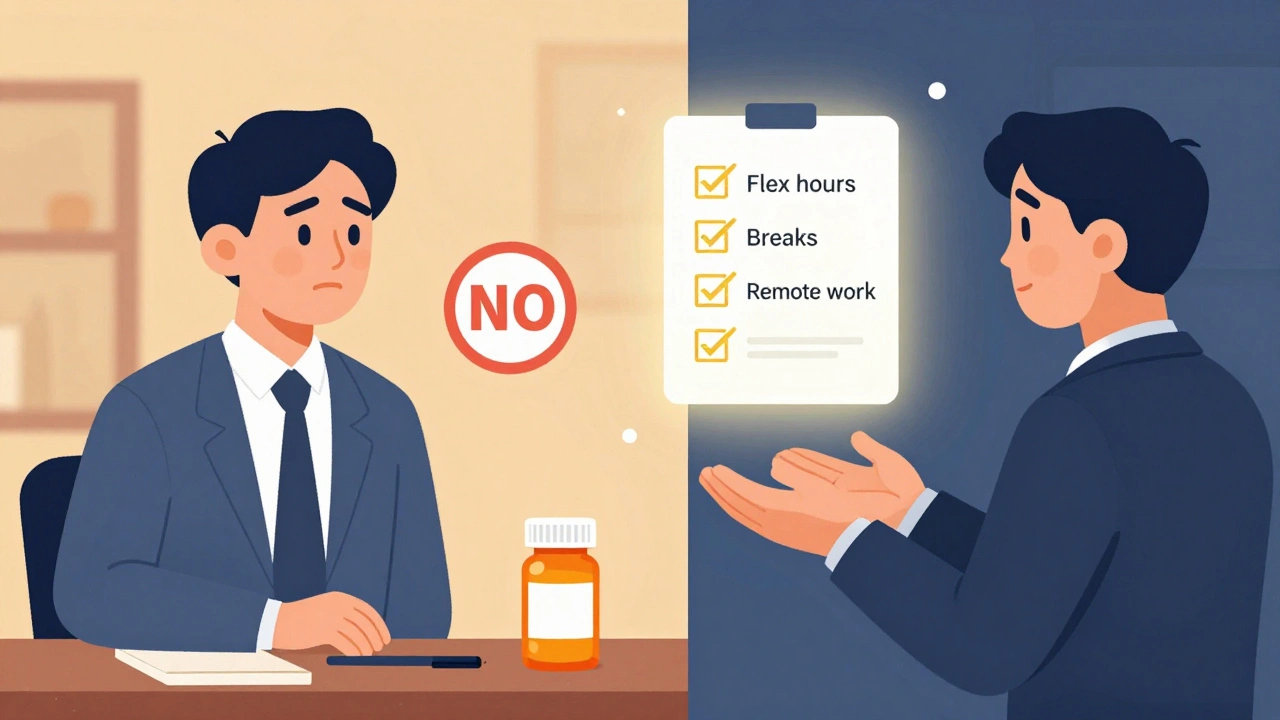
- Flexible start and end times - If medication causes morning drowsiness, shifting a shift from 7 a.m. to 10 a.m. can make all the difference. This was requested in 43.2% of successful accommodation cases in 2022.
- Modified break schedules - Need to take medication with food? Or rest after a dose? Allowing extra 10-minute breaks or permitting snacks at your desk helps. This was approved in 28.7% of cases.
- Temporary reassignment - A nurse on new epilepsy meds might be moved from night shifts to admin duties for a few weeks while their body adjusts. This happened in 12.4% of cases.
- Remote or hybrid work - Since the pandemic, 43.8% of medication-related accommodations now involve working from home part-time. This is especially helpful for people dealing with nausea or brain fog.
- Extended leave for adjustment periods - If a new medication causes severe side effects for 2-4 weeks, employers often grant a short leave so the person can stabilize. This was approved in 63.2% of cases with proper medical documentation.
These aren’t perks. They’re legal obligations when the side effects meet ADA criteria.
What Employers Can’t Do
Some managers think accommodations mean letting someone off the hook. They don’t. The ADA is clear: employers are not required to:
- Lower performance standards
- Eliminate essential job functions
- Pay for time not worked
- Excuse illegal drug use
For example, if a warehouse worker on opioids can’t lift 50 pounds-which is a core part of their job-and no accommodation can fix that, the employer isn’t obligated to keep them in that role. But they are obligated to explore alternatives: reassignment to a lighter-duty position, if one exists.
And no, employers can’t demand to know the exact name of your medication. They can only ask how your condition affects your work. You don’t have to say you’re on Prozac or Metoprolol. Just explain that you’re experiencing dizziness after taking prescribed medication and need a schedule change.

Safety-Sensitive Jobs Are Different
Not all jobs are the same. If you operate heavy machinery, drive a bus, or handle surgical tools, the rules get stricter-but not impossible.
Employers in safety-sensitive industries (like transportation, manufacturing, or healthcare) can require more evidence. But they still can’t use blanket bans. A 2023 court case, Garcia v. Costco, ruled that a warehouse worker on legally prescribed opioids had the right to accommodation-even though the job involved lifting. The employer had assumed all opioids = danger. The court said: prove it for this person.
Here’s the difference:
| Accommodation Type | Non-Safety-Sensitive Jobs | Safety-Sensitive Jobs |
|---|---|---|
| Flexible scheduling | 89.7% approved | 62.3% approved |
| Remote work | 78.1% approved | 41.2% approved |
| Average meetings to resolve request | 1-2 | 3.7 |
| Requires external medical review | 8.9% | 42% |
Employers in these fields must use objective medical evidence-not assumptions. If your doctor says you’re safe to operate a forklift on your current dose, and you’ve had zero incidents for two years, that’s the evidence that matters.
The Interactive Process: What Employers Must Do
The law doesn’t just say “accommodate.” It says: talk.
The “interactive process” is a legal requirement. It means:
- Employers must respond within 3 business days of a request.
- They must ask open-ended questions: “How does this affect your work?” “What would help?”
- They must consider all options-even if the employee didn’t suggest them.
- They can’t delay or ignore the request.
When employers do this right, 89.2% of accommodation requests succeed. When they don’t-when they shut down the conversation, demand excessive paperwork, or dismiss the issue as “just side effects”-only 56.7% of cases end well.
One nurse on Reddit shared how her manager listened. She was on a new migraine drug that made her sleepy. She asked for a two-week shift change. Her manager agreed. Within a week, her error rate dropped by 37%. That’s not charity. That’s smart management.
What Happens If an Employer Refuses?
Refusing a valid accommodation isn’t just unfair-it’s illegal. And it’s expensive.
Employers who deny accommodations without following the interactive process face:
- Average settlement costs of $68,400 per case
- 28.3% chance of punitive damages if they ignored the process
- Increased turnover-companies with formal accommodation policies see 19.3% less turnover among affected employees
TruckDriverMike on TruckersReport.com was denied flexible hours because his employer cited DOT rules. But his medication caused minimal side effects. He filed an EEOC claim-and won. The court found the employer relied on generic warnings, not his individual medical facts.
Don’t assume you’re out of options. The EEOC receives over 2,200 charges annually related to medication side effects-and more than half result in some form of relief for the employee.
How to Request an Accommodation
If you need an accommodation, here’s how to do it right:
- Know your rights - You don’t need to say “I’m disabled.” Just say: “I’m experiencing side effects from a prescribed medication that are affecting my ability to perform my job.”
- Speak to HR or your manager - Do it in writing if possible. Email is fine. “I’d like to discuss possible accommodations for side effects from my new medication.”
- Provide medical documentation - Your doctor doesn’t need to name the drug. They need to say: “This patient is experiencing [side effect], which impacts [job function], and will last approximately [timeframe].”
- Suggest options - “Could I start at 10 a.m. instead of 7 a.m.?” or “Could I have a 10-minute break after lunch to rest?”
- Follow up - If you don’t hear back in 3 days, send a polite reminder.
Most requests are resolved in under two weeks. JAN’s data shows 78.6% of medication-related accommodations are approved.
Why This Matters Beyond the Law
This isn’t just about legal compliance. It’s about keeping good employees.
Over half of Americans take at least one prescription drug. That means chances are, someone on your team is managing side effects right now. If they feel forced to hide it, they’ll burn out. Or quit. Or show up tired, anxious, and disengaged.
Companies that handle this well don’t just avoid lawsuits. They build trust. They reduce turnover. They keep institutional knowledge. And they show they care about people, not just productivity.
As the National Alliance on Mental Illness predicts, requests for mental health medication accommodations will rise 15.2% annually through 2026. The future of work isn’t about ignoring side effects. It’s about adapting to them-wisely, fairly, and humanely.
Frequently Asked Questions
Can my employer force me to take a drug test because I’m on medication?
No. Employers cannot require drug tests solely because you’re taking prescribed medication. They can only test if there’s a legitimate safety concern tied to your job (like operating heavy machinery) and if the test is part of a consistent policy applied to everyone. Even then, they must allow you to provide proof of a legal prescription. A 2021 EEOC guidance made it clear: requiring disclosure of medication names without justification violates privacy rights under the ADA.
What if my side effects are temporary?
Temporary side effects still qualify. If you’re adjusting to a new medication and feel dizzy or fatigued for a few weeks, you’re still protected. The ADA covers short-term impairments if they’re severe enough to limit major activities. Many accommodations-like a two-week schedule shift-are designed exactly for this. JAN data shows 63.2% of temporary accommodation requests are approved when supported by medical documentation.
Can my boss ask why I’m on medication?
No. Employers can’t ask for the name of your medication or your diagnosis. They can only ask how your condition affects your ability to do your job. For example, they can ask: “Are you experiencing drowsiness that impacts your work?” But they can’t ask: “Are you on antidepressants?” That’s a violation of the ADA. Medical information must be kept confidential and separate from your personnel file.
What if my job requires me to be alert at all times?
Safety-sensitive roles have higher scrutiny, but they’re not automatic denials. Employers must prove a “direct threat” based on objective medical evidence-not assumptions. If you’ve been on the same medication for years with no incidents, and your doctor says you’re safe, that’s strong evidence. Courts have consistently ruled against blanket policies. The key is individual assessment, not blanket bans.
I’m afraid to ask. What if I get punished?
Retaliation for requesting an accommodation is illegal under the ADA. If you’re written up, demoted, or pushed out after asking, you have legal recourse. Document everything: your request, their response, any changes in treatment. The EEOC received over 2,200 charges in 2022 related to medication accommodations-and many of those involved retaliation. You’re not alone. Most requests are handled fairly when done properly.
 Medications





Chad Kennedy
December 2, 2025 AT 20:21Siddharth Notani
December 4, 2025 AT 12:29Cyndy Gregoria
December 5, 2025 AT 18:26Akash Sharma
December 6, 2025 AT 01:00Justin Hampton
December 6, 2025 AT 08:42Pooja Surnar
December 7, 2025 AT 11:48Sandridge Nelia
December 7, 2025 AT 12:25Mark Gallagher
December 7, 2025 AT 19:34Wendy Chiridza
December 9, 2025 AT 15:12