

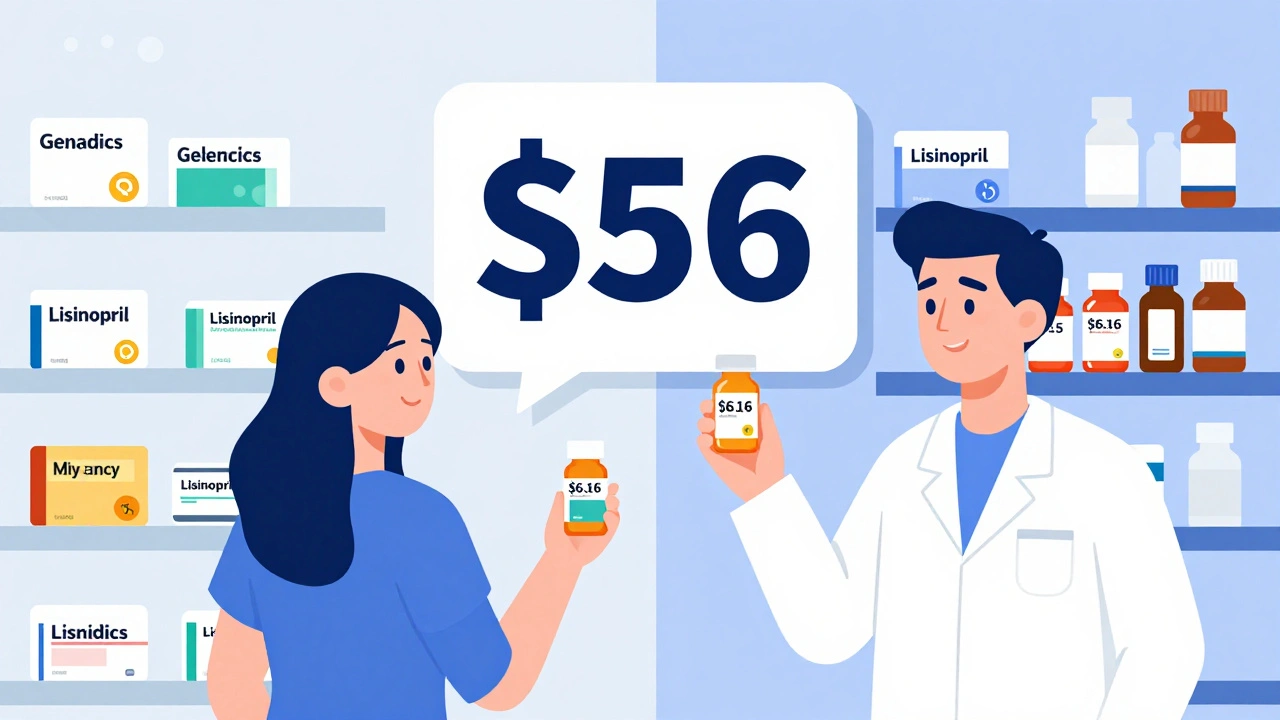
When you walk into a pharmacy in the U.S. and see a $6.16 copay for a 30-day supply of generic lisinopril, it’s easy to think you’re getting a deal. And you are-compared to most other countries. But if you’re handed a $56 bill for a brand-name drug like Jardiance, it’s harder to feel like the system works. The truth about U.S. drug prices isn’t simple. It’s not all expensive. It’s not all cheap. It’s generic drugs that surprise most people-and brand-name drugs that break the bank.
Generics in the U.S. Are Cheaper Than Almost Everywhere Else
Here’s the counterintuitive fact: the United States pays less for generic drugs than most developed countries. According to a 2022 RAND Corporation study, U.S. prices for unbranded generics were 33% lower than in 33 other OECD nations. That means if a generic version of metformin costs $10 in Germany, you’ll likely pay around $6.70 in the U.S. In France and Japan, where drug prices are tightly controlled, generics still cost more than they do here.
Why? Three big reasons. First, the U.S. uses generics for 90% of all prescriptions-far more than the 41% average in other rich countries. That volume gives buyers serious leverage. Second, when two or three companies start making the same generic drug, prices drop fast. The FDA found that with just two competitors, prices fall to 35-40% of the brand’s cost. With three or more, they crash to 15-20%. Third, public programs like Medicare Part D and Medicaid negotiate hard. They don’t pay list prices. They pay net prices after rebates, and those net prices are often lower than what other countries pay upfront.
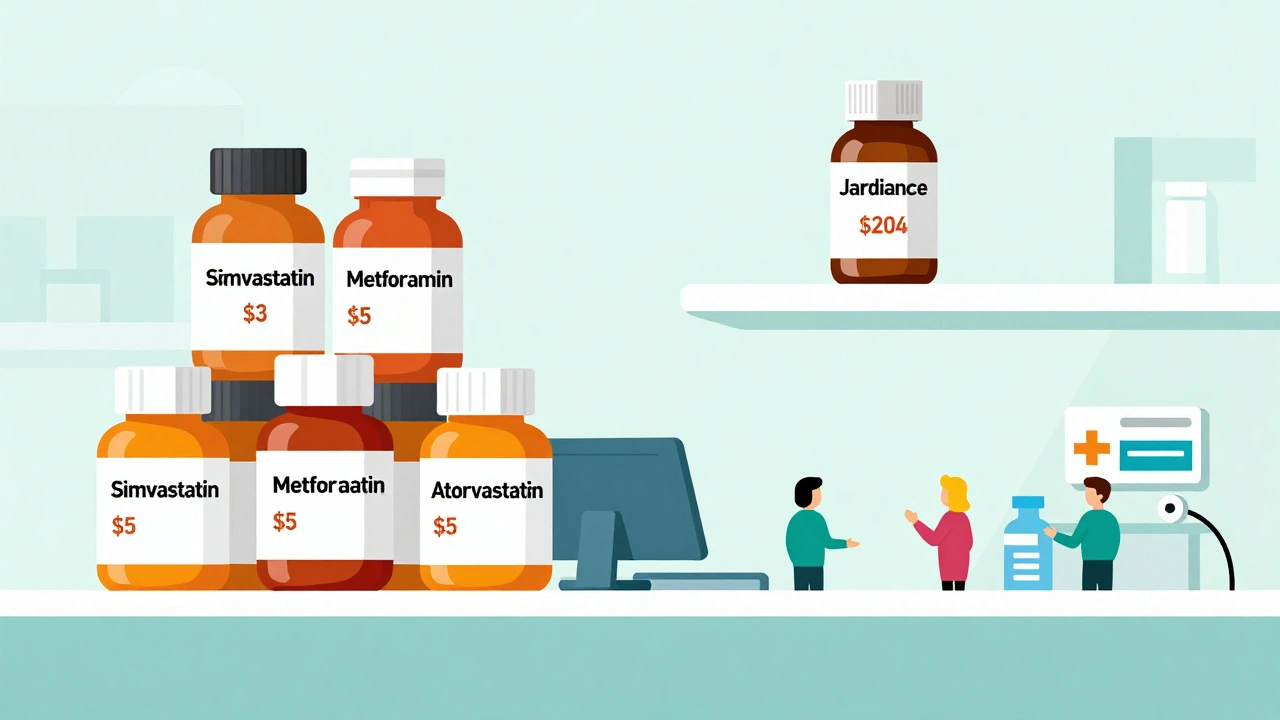
That’s why the average generic copay in the U.S. is $6.16. And 93% of generic prescriptions cost under $20. Compare that to Canada or the U.K., where even generics often cost $15-$30 for the same supply. In Australia, a 30-day supply of generic atorvastatin can run $25. In the U.S.? $5.
Brand-Name Drugs Are Where the U.S. Pays the Most
But here’s the flip side: if you need a brand-name drug, you’re paying nearly four times what someone in Japan or France pays. The same RAND study showed U.S. brand-name drug prices were 422% higher than the OECD average. That’s not a typo. For every $1 spent on a brand-name drug abroad, Americans pay $4.22.
Take Jardiance, a diabetes drug. Medicare negotiated a price of $204 per month. In Japan, the same drug costs $52. In Australia, it’s $48. Stelara, used for psoriasis and Crohn’s, costs $4,490 in the U.S. under Medicare’s deal. In Germany, it’s $2,822. The Health System Tracker found that in nine out of ten cases, the U.S. paid more than other countries-even after Medicare’s negotiations.
This isn’t about quality. It’s about how the system works. In most countries, governments set or cap prices before a drug even hits the market. In the U.S., drugmakers set the initial price, and insurers fight back with rebates. But those rebates don’t help patients at the pharmacy counter. They go to insurers and pharmacy benefit managers. You still pay the full list price unless you have good coverage.
The Hidden System: List Price vs. Net Price
Why do some reports say U.S. drug prices are high, while others say they’re low? It’s because they’re measuring different things.
List price is what’s printed on the drug’s sticker. It’s the price before any discounts. This is what you see in headlines and what drugmakers use to brag about revenue.
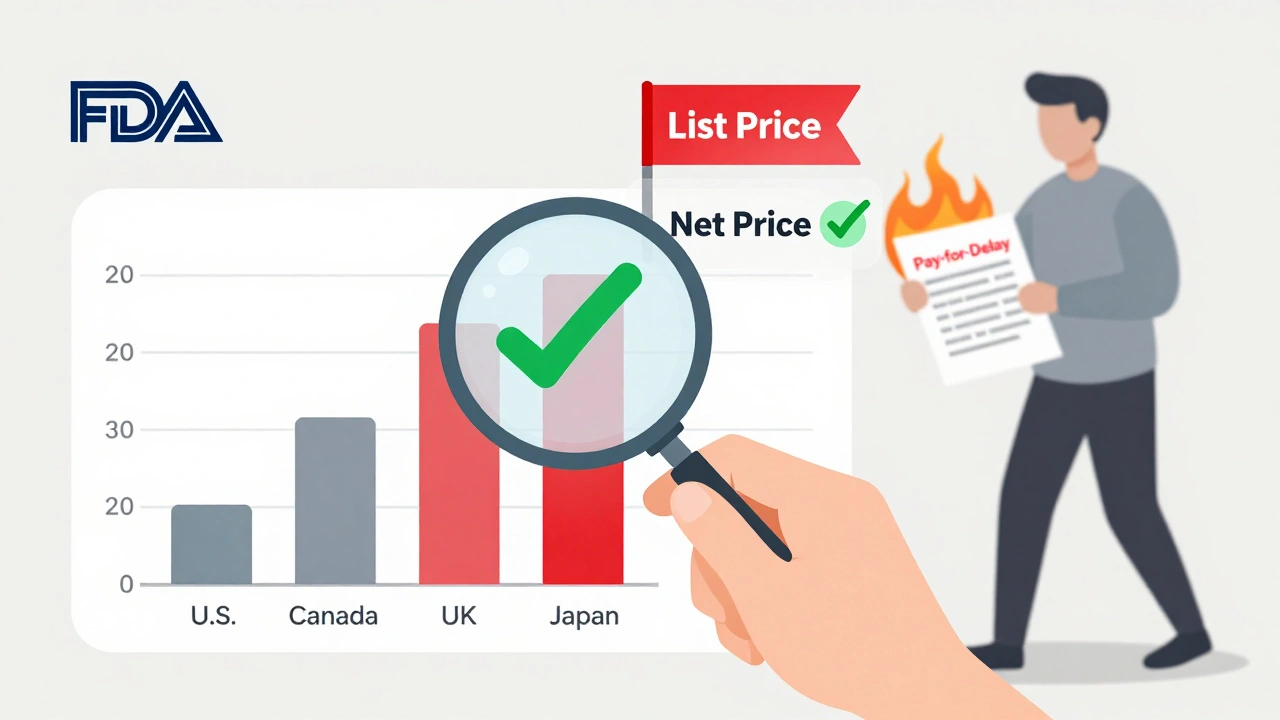
Net price is what actually changes hands after rebates, discounts, and negotiations. This is what Medicare, Medicaid, and big insurers pay. A 2024 University of Chicago study found that U.S. net prices for public-sector prescriptions were 18% lower than in Canada, Germany, the U.K., France, and Japan.
Here’s how it works: A drugmaker sets a $1,000 list price for a brand-name drug. The insurer says, “We’ll cover it if you give us a 60% rebate.” So the drugmaker nets $400. The patient pays $30 in coinsurance. The list price looks outrageous. The net price? Not so bad. But here’s the catch: if you’re uninsured or underinsured, you pay the full $1,000. That’s why people still go bankrupt over prescriptions.
Why Are U.S. Generic Prices So Low?
It’s not magic. It’s competition-and a lot of it.
The FDA approves hundreds of generic drugs every year. In 2023 alone, 773 generic applications were approved. Each new competitor slashes prices further. When only one company makes a generic, it might sell for 60% of the brand’s price. When five companies make it? Down to 10-15%. That’s what happened with the cholesterol drug simvastatin. When five generics hit the market, the price dropped from $120 to $3 per month.
But there’s a dark side. Sometimes, too few companies make a generic. Or one company buys out the others. Then prices spike. In 2013, a generic version of the antibiotic doxycycline jumped from $20 to $1,850 per bottle after just two manufacturers remained. The FTC had to step in. These cases are rare, but they happen-and they hurt.
That’s why the FDA tracks how many manufacturers are making each generic. They know that more competition = lower prices. That’s why they push to fast-track approvals. Every extra generic approved saves billions.
What This Means for You
If you’re on generics, you’re getting one of the best deals in global healthcare. You’re paying less than people in nearly every other developed country. Use it. Ask your doctor if a generic is available. Ask your pharmacist if there’s a cheaper version. Switch to mail-order pharmacies-many offer generics for $5-$10 a month.
If you’re on brand-name drugs, you’re in the expensive half. The system doesn’t help you unless you have good insurance. Medicare’s new negotiation program helps a little, but even the negotiated prices are still higher than in Japan or Australia. If you’re struggling, look into patient assistance programs. Drugmakers often have them. Nonprofits like NeedyMeds can help you find them.
And if you’re thinking about traveling abroad for cheaper meds-don’t. The U.S. is one of the few countries where you can legally import generics from Canada or Mexico. But most people don’t need to. The real savings are already here, in the form of generics.
What’s Changing in 2025 and Beyond
The U.S. is starting to change. The Inflation Reduction Act let Medicare negotiate prices for the first time. Ten drugs were selected in 2024. More will be added in 2025 and 2026. But even these negotiated prices are still higher than what other countries pay. That’s because Medicare can’t set prices as low as Canada or Japan can-they’re still bound by U.S. market rules.
Meanwhile, the Biden administration is pushing to speed up generic approvals. The FDA is also cracking down on “pay-for-delay” deals, where brand-name makers pay generic makers to stay off the market. These deals used to delay competition for years. Now they’re illegal.
But here’s the real question: if U.S. drugmakers charge high prices to fund innovation, why do other countries pay so little and still get new drugs? The answer is complex. But one thing’s clear: Americans are paying more for the same pills. And for the 90% of prescriptions that are generics, they’re paying less than anyone else. That’s the real story.
Why are generic drugs cheaper in the U.S. than in other countries?
The U.S. has far more generic drug manufacturers competing for the same products-often five or more-driving prices down. With high prescription volume and strong public program negotiations, generics in the U.S. typically cost 15-20% of the brand-name price. In countries like Canada or the U.K., fewer manufacturers enter the market, and government pricing rules often set higher floors.
Are U.S. brand-name drug prices really that much higher?
Yes. For brand-name drugs, the U.S. pays 3 to 4 times more than most other developed countries. For example, Medicare’s negotiated price for Jardiance is $204 per month, while Japan pays $52. The reason is that other countries set price caps before drugs launch. The U.S. lets manufacturers set the initial price, and insurers negotiate discounts after the fact-discounts that don’t always reach patients at the pharmacy.
Can I save money by buying drugs from Canada or Mexico?
It’s possible, but rarely necessary. Generic drugs in the U.S. are already cheaper than in Canada and Mexico. For brand-name drugs, prices abroad can be lower-but importing them is legally risky and often not worth the hassle. Most patients are better off using U.S.-based patient assistance programs or switching to generics.
Why do some generic drugs suddenly become very expensive?
When only one or two companies make a generic, they can raise prices. Sometimes, manufacturers exit the market due to low profit margins, leaving a monopoly. In 2013, doxycycline jumped from $20 to $1,850 per bottle because only two companies made it-and one stopped. The FTC later intervened. These cases are rare but highlight how fragile generic markets can be.
Does Medicare negotiation lower drug prices enough?
Medicare’s negotiated prices are lower than the original list prices, but still higher than what most other countries pay. For example, Medicare pays $4,490 for Stelara, while Germany pays $2,822. The program helps, but it doesn’t fix the root problem: the U.S. still lets drugmakers set the initial price. True price alignment would require U.S. regulators to set caps before launch, like other countries do.
How can I find the cheapest price for my generic medication?
Use free tools like GoodRx or Blink Health to compare prices across pharmacies. Many local pharmacies offer $4 generic programs. Mail-order pharmacies often have the lowest prices for 90-day supplies. Always ask your pharmacist if a different generic manufacturer is available-some cost half as much as others, even for the same drug.
 Medications

Steve Sullivan
December 5, 2025 AT 00:44ian septian
December 6, 2025 AT 02:30Andrea DeWinter
December 6, 2025 AT 17:51Elliot Barrett
December 7, 2025 AT 17:33George Taylor
December 8, 2025 AT 23:07Evelyn Pastrana
December 10, 2025 AT 00:08Chris Marel
December 11, 2025 AT 13:40Nikhil Pattni
December 12, 2025 AT 03:29Arun Kumar Raut
December 13, 2025 AT 08:51precious amzy
December 14, 2025 AT 10:49Carina M
December 15, 2025 AT 11:09William Umstattd
December 17, 2025 AT 00:04