
Metronidazole Neuropathy Risk Calculator
Enter your current dosing regimen to calculate total exposure and compare it against the critical safety threshold.
Results Analysis
Total Cumulative Dose:
0 g
Equivalent to 0 pills
Progress to Threshold (42g):
Key Statistics
Disclaimer: This tool is for educational purposes only and does not constitute medical advice. Always consult your healthcare provider before changing medication regimens.
Imagine taking an antibiotic for a common infection, only to wake up weeks later with your feet feeling like they’re wrapped in thick wool. You can’t feel the floor properly. A slight touch feels like burning fire. This isn’t just discomfort; it’s metronidazole neuropathy, a serious but often overlooked side effect of one of the world’s most prescribed antibiotics.
If you are experiencing unexplained numbness or tingling while on long-term treatment, this guide explains what is happening to your nerves, why it occurs, and exactly what steps you need to take right now to prevent permanent damage.
What Is Metronidazole Neuropathy?
Metronidazole is a nitroimidazole antibiotic widely used to treat anaerobic bacterial and protozoal infections such as bacterial vaginosis, trichomoniasis, and amoebiasis. It has been a staple in medicine since its approval in 1963. However, when taken in high doses or for extended periods, it can attack the peripheral nervous system.
This condition, known clinically as metronidazole-induced peripheral neuropathy is a progressive sensory nerve damage characterized by symmetric distal numbness, paresthesia (tingling), and severe neuropathic pain, typically starts in the lower extremities. It follows a "stocking-glove" distribution, meaning it begins in the toes and feet, slowly moving up the legs, and eventually affecting the hands and fingers if left unchecked.
The danger lies in its stealth. Many patients assume these sensations are unrelated to their medication or attribute them to age or other health issues. By the time the connection is made, significant nerve degeneration may have already occurred.
The Critical 42-Gram Threshold
You might wonder why some people develop this condition while others do not. The answer largely comes down to cumulative dose. Research indicates a stark difference in risk based on total exposure.
| Cumulative Dose | Incidence Rate | Risk Level |
|---|---|---|
| ≤ 42 grams | 1.7% | Low |
| > 42 grams | 17.9% | High (10.5x increased risk) |
A meta-analysis published in 2017 highlighted that patients receiving more than 42 grams of metronidazole faced a 10.5-fold higher risk of developing neuropathy compared to those staying below this threshold. For context, 42 grams is roughly equivalent to taking standard 500mg tablets three times daily for about four weeks. While short courses are generally safe, prolonged therapy pushes you into the danger zone.
Symptoms usually emerge after 4 to 6 months of continuous treatment, though cases have been documented after as little as 10 days with high-dose regimens. If you are on a long-term regimen, tracking your total intake is crucial.
Recognizing the Early Warning Signs
Early detection is your best defense against permanent disability. Do not ignore subtle changes in sensation. Here are the primary symptoms to watch for:
- Paresthesia: Abnormal tingling, prickling, or "pins and needles" sensations, usually starting in the soles of the feet.
- Numbness: A loss of sensation where light touches feel distant or muted.
- Burning Pain: Intense, heat-like pain that often worsens at night, disrupting sleep.
- Hypersensitivity: Normal stimuli, like bed sheets or socks, feeling painful or irritating.
- Autonomic Features: In rare but severe cases, temperature dysregulation in the extremities, requiring ice water for relief.
These symptoms are distinct from general muscle aches. They are neurological signals indicating axonal damage. If you notice any of these signs while taking metronidazole, do not wait for your next scheduled appointment. Contact your healthcare provider immediately.
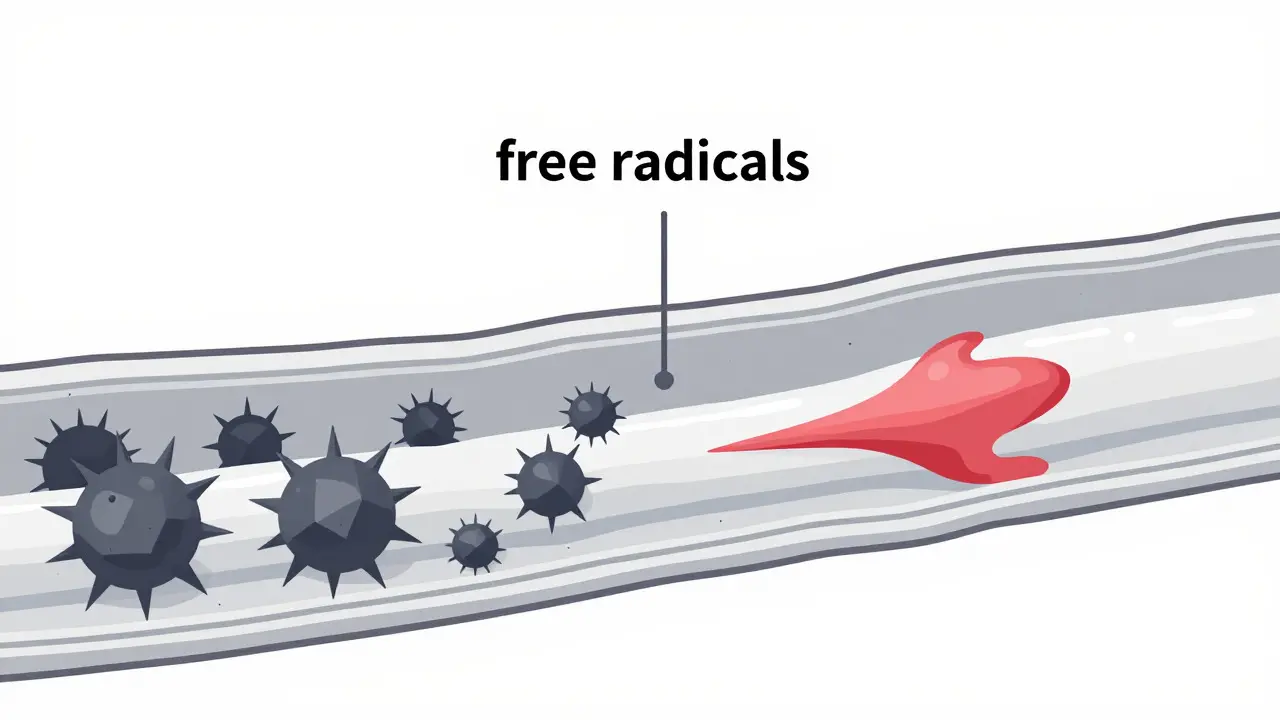
Why Does This Happen? The Biological Mechanism
Understanding the mechanism helps explain why stopping the drug is urgent. Metronidazole works by entering bacterial cells and disrupting their DNA. Unfortunately, it also crosses the blood-brain barrier and enters human neuronal tissue.
Inside the neurons, the drug’s nitro group undergoes reduction, generating reactive oxygen species and free radicals. These unstable molecules cause oxidative stress, leading to neuronal swelling and eventual degeneration of the axons-the long projections that transmit signals. This process results in an axonal sensorimotor polyneuropathy, confirmed by electrophysiological studies showing reduced sensory nerve action potentials.
Unlike some chemotherapy drugs that cause permanent structural destruction, metronidazole toxicity is often reversible if caught early. However, the window for complete recovery closes rapidly once symptoms manifest.
Differentiating From Other Conditions
One of the biggest hurdles in treating this condition is misdiagnosis. Clinicians may initially attribute these symptoms to diabetic neuropathy, vitamin B12 deficiency, or chemotherapy-induced nerve damage. This delay can be costly.
Key differences include:
- Reversibility: Approximately 94% of metronidazole neuropathy cases show complete or partial recovery upon discontinuation. In contrast, vincristine-induced neuropathy often causes permanent damage.
- Onset Pattern: The symmetric, ascending "stocking-glove" pattern is characteristic of toxic neuropathies like metronidazole, whereas diabetic neuropathy may present differently depending on disease duration.
- Autonomic Involvement: Metronidazole can uniquely affect autonomic nerves, causing temperature regulation issues, which is less common in typical diabetic neuropathy.
An electromyography (EMG) test is recommended for definitive diagnosis. However, clinical suspicion should prompt immediate discontinuation even before testing results return. Delaying cessation risks turning a temporary issue into a lifelong disability.

Immediate Action Plan: What To Do Now
If you suspect you have metronidazole neuropathy, follow these steps without delay:
- Stop the Medication: Consult your doctor to discontinue metronidazole immediately. Most patients begin to see improvement within weeks of stopping.
- Seek Neurological Evaluation: Request an EMG/Nerve Conduction Study to assess the extent of nerve damage. This provides a baseline for monitoring recovery.
- Start Physical Rehabilitation: Aggressive physical therapy significantly accelerates functional recovery. Studies show patients receiving structured therapy regain normal gait 37% faster than those with standard care.
- Manage Pain: Prescription medications like gabapentin or pregabalin may help manage neuropathic pain during the recovery phase.
- Monitor Progress: Recovery timelines vary. Some improve in two weeks; others, like the adolescent case reported by Duke University, required six months of rehabilitation for full resolution.
Remember, in about 6% of cases, symptoms may persist despite cessation. Early intervention is the single most effective factor in preventing this outcome.
Prevention and Future Directions
As antimicrobial stewardship programs push for narrower-spectrum antibiotics like metronidazole over broader agents, awareness of this risk must grow. Institutions like Mayo Clinic are implementing hard stops in electronic medical records to prevent ordering beyond 28 days without infectious disease consultation.
For patients, prevention means asking questions. Before starting a long course, ask your doctor: "What is my cumulative dose limit?" and "Should I be monitored for neurological side effects?" Using standardized questionnaires like the Total Neuropathy Score can help detect early changes with 89% sensitivity.
Research is ongoing into neuroprotective agents. A phase II trial is investigating whether alpha-lipoic acid can reduce neuropathy incidence in patients requiring extended therapy. Meanwhile, the FDA has updated labeling to prominently display the 42-gram threshold, reinforcing the need for vigilance.
Your nerves are resilient, but they need you to act fast. Don’t let silence mask the warning signs. Recognize the numbness, report the tingling, and protect your long-term health.
How long does it take for metronidazole neuropathy to resolve?
Recovery timelines vary significantly among patients. Some individuals notice improvement within 2 weeks of discontinuing the drug, while others may require 6 months or more of rehabilitation for complete resolution of symptoms. Early discontinuation leads to faster recovery rates.
Is metronidazole neuropathy permanent?
In approximately 94% of cases, metronidazole-induced neuropathy is reversible with complete or partial recovery after stopping the medication. However, in about 6% of cases, symptoms may persist despite cessation, potentially leading to permanent disability if not addressed promptly.
What is the safe maximum dose of metronidazole?
The critical threshold identified in clinical studies is 42 grams of cumulative exposure. Exceeding this amount increases the risk of peripheral neuropathy by 10.5 times. Standard dosing of 500mg three times daily reaches this limit in approximately 4 weeks.
Can metronidazole cause brain damage?
Yes, metronidazole can cause central nervous system toxicity known as encephalopathy, presenting with confusion, ataxia, and dysarthria. This is distinct from peripheral neuropathy but can occur concurrently, especially with very high doses exceeding the 42-gram threshold.
How is metronidazole neuropathy diagnosed?
Diagnosis involves clinical evaluation of symptoms combined with electromyography (EMG) and nerve conduction studies. These tests reveal reduced sensory nerve action potentials, confirming axonal sensorimotor polyneuropathy. Clinical suspicion should prompt immediate discontinuation even before testing.
Are there alternative antibiotics to avoid this risk?
For certain anaerobic infections, alternatives like clindamycin or carbapenems may be considered, depending on the specific pathogen and patient history. Consult your infectious disease specialist to weigh the benefits of metronidazole against the neuropathy risk for your specific condition.
Does alcohol interact with metronidazole to increase nerve damage?
While alcohol primarily causes a disulfiram-like reaction (nausea, vomiting) with metronidazole, chronic alcohol use itself is a major risk factor for peripheral neuropathy. Combining alcohol consumption with metronidazole therapy may exacerbate neurological symptoms and complicate diagnosis.
Can physical therapy speed up recovery?
Yes, aggressive physical rehabilitation has been shown to accelerate functional recovery. Patients receiving structured therapy regimens regained normal gait 37% faster than those with standard care alone, making it a crucial component of the treatment plan.
 Medications