

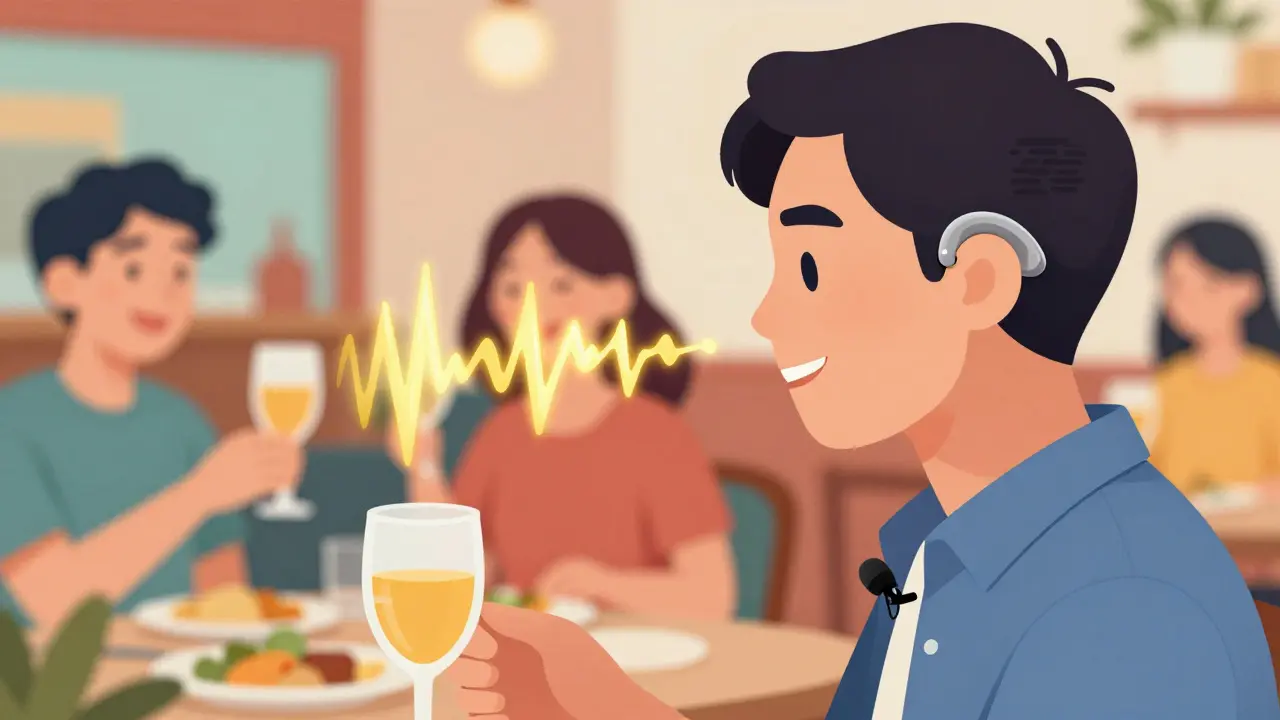
Imagine sitting at a busy restaurant, laughter and clinking glasses all around, trying to follow a conversation with a friend. Your hearing aids are on, but you catch only fragments. Then, your friend clips a tiny microphone to their shirt. Suddenly, their voice cuts through the noise like a clear signal in static. That’s the power of remote microphone systems.
These aren’t sci-fi gadgets. They’re proven, FDA-cleared medical devices designed for people with hearing loss who struggle in noisy places. And they work by solving a problem most people don’t even realize exists: how sound fades with distance. Every time you move just a few feet away from someone talking, the speech signal drops by about 6 decibels. In a noisy room, that’s the difference between hearing clearly and hearing nothing at all.
How Remote Microphone Systems Actually Work
At its core, a remote microphone system has two parts: a small wireless mic worn by the speaker, and a receiver that connects to your hearing aid or cochlear implant. The mic picks up speech just 6 to 8 inches from the speaker’s mouth - right where the sound is loudest and clearest. Then, it sends that signal directly to your device using a 2.4 GHz radio signal. No background noise. No echo. Just the voice you want to hear.
This bypasses the natural physics of sound. Traditional hearing aids try to boost everything - speech and noise alike. But remote microphones don’t amplify the room. They deliver the speaker’s voice straight to your ears, like a private radio channel. Modern systems like Phonak’s Roger Focus II and ReSound Multi Mic use adaptive frequency hopping to avoid interference from Wi-Fi, Bluetooth, or other devices. That’s a big upgrade from old FM systems, which could crackle or drop out near radios or fluorescent lights.
Real-World Performance: Numbers That Matter
Studies don’t just say these systems help - they show how much. In a 2019 study by Dr. Linda M. Thibodeau, people using Roger Select improved speech recognition by 61% compared to using hearing aids alone in 75 dBA noise - the level of a busy restaurant. Another analysis from AudiologyOnline found users gained up to 19.5 dB in speech-to-noise ratio. That’s not a small tweak. It’s the difference between guessing what someone said and understanding every word.
For kids in classrooms, the numbers are even more striking. A 2023 report from Gallaudet University found 75% of school-aged children with hearing loss use these systems. Why? Because without them, they miss up to 40% of classroom instruction. Adults aren’t far behind. In a 2023 survey of 1,247 hearing aid users, 87% said listening in restaurants became “significantly easier.” One Reddit user, u/HearingHelp123, shared that after using Roger Select, their understanding at family dinners jumped from 20% to 85%.
Types of Systems and What Sets Them Apart
Not all remote microphones are the same. There are three main types:
- Directional systems like the Phonak Roger Select and ReSound Multi Mic: These automatically focus on the person speaking and ignore noise from behind or beside them. They’re ideal for group settings.
- Fixed omnidirectional systems like the Roger Pen: These pick up sound from all directions. They’re simpler to use but don’t filter noise as well.
- Adaptive-gain systems: These adjust volume based on how loud the background noise is. Research shows they offer 16% better speech recognition than fixed-gain models in noisy environments like restaurants.
Digitally modulated (DM) systems - the kind released after 2015 - outperform older FM systems by 22-28% in high-noise situations. The reason? They’re smarter. They adjust in real time, avoid interference, and connect seamlessly to modern hearing aids via Bluetooth Low Energy or proprietary 2.4 GHz links.

Who Makes Them and What’s New
Phonak leads the market with 38% share, thanks to its Roger line. ReSound holds 22%, Oticon 18%, and Starkey follows closely. But the biggest shift isn’t just in brands - it’s in integration.
In 2023, Phonak released the Roger Focus II, which can connect to multiple microphones at once. That’s huge for group conversations. If you’re at a dinner table with three people talking, each can wear a mic, and the system blends their voices into one clear stream. A 2023 field study showed this improved speech recognition by 45% over hearing aids alone in multi-talker settings.
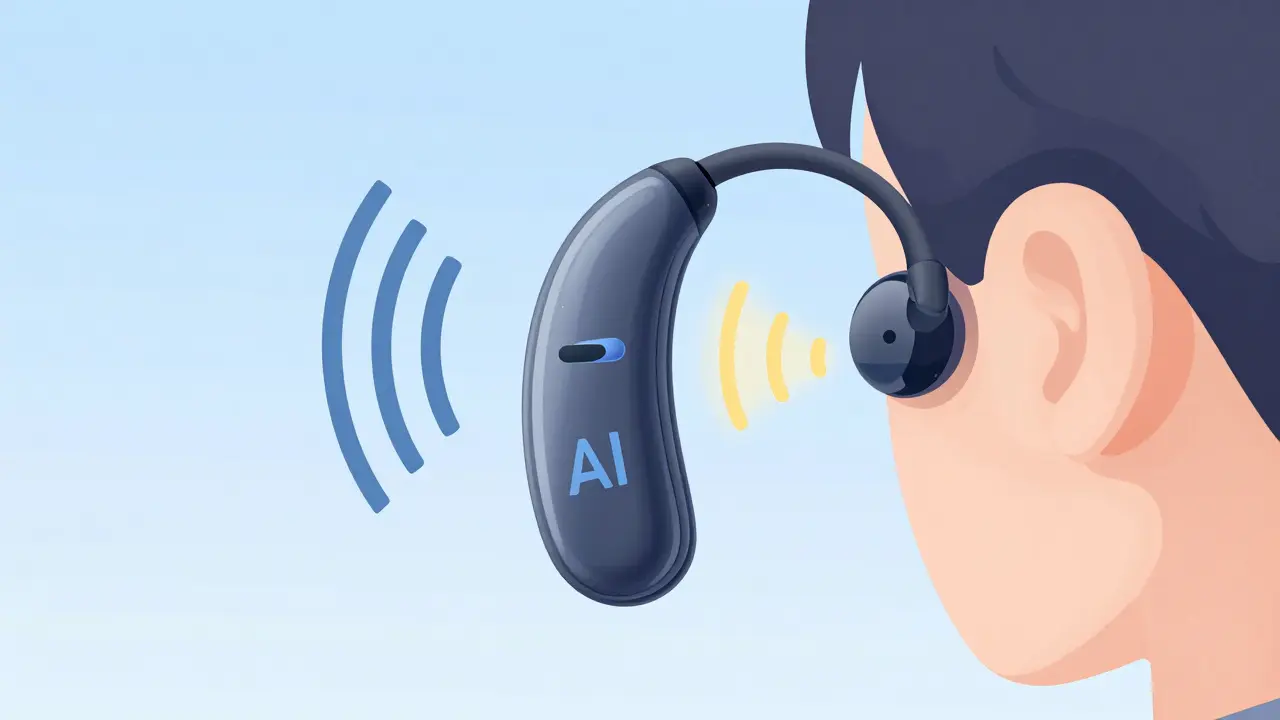
By 2024, Phonak introduced Roger X with AI-powered noise separation. It doesn’t just reduce background noise - it isolates speech patterns using machine learning. Early data shows a 9% further improvement in crowded rooms. Starkey’s upcoming Evolv AI platform, set for late 2024, will embed this same tech directly into hearing aids. And Oticon’s 2024 More hearing aid already has Roger technology built in. That means no separate receiver. Just one device doing it all.
Cost, Insurance, and Real Barriers
Here’s the hard truth: these systems work - but they’re expensive. Prices range from $499 for a basic ReSound Multi Mic to $799 for the advanced Roger Select. Most people pay out of pocket. Medicare covers only 15% of the cost for qualifying users. Private insurance rarely covers them at all. That’s why 42% of negative Amazon reviews cite price as the main reason for not buying.
There’s also a social hurdle. Some users report people think they’re recording conversations when they ask someone to wear the mic. One Trustpilot reviewer said, “People think I’m recording them at meetings.” That stigma is real. But for many, the trade-off is worth it. One nurse on Reddit said her Roger Pen “added five years to my working life.”
Getting Started: What You Need to Know
You can’t just buy one online and plug it in. These systems require professional fitting. You’ll need at least two to three visits with an audiologist:
- Testing to confirm you’re a good candidate.
- Fitting the receiver to your hearing aids and programming the mic settings.
- Training on how to use the mic, switch modes, and manage battery life.
Most users get comfortable within 2-4 weeks. Tips that help: keep the mic 6-8 inches from the speaker’s mouth, use a lanyard so it doesn’t slip, and always carry a spare battery. Systems like Roger Select last 8-12 hours on a charge - enough for a full day. But if you’re at a long meeting or dinner, you’ll need to recharge.
Support matters too. Phonak offers 24/7 tech help with 95% customer satisfaction. Smaller brands often only support you during business hours. If you’re buying, ask about warranty and support before you commit.
What’s Next? The Future Is Built-In
The trend is clear: remote microphones are moving from add-ons to standard features. By 2027, the Hearing Industries Association predicts 60% of new hearing aids will have this tech built in. That’s a game-changer. It means no extra device to carry, no separate charging, and eventually, lower prices thanks to economies of scale.
Right now, you’re choosing between a separate mic and receiver - or waiting for the next generation of hearing aids that do it all. If you’re struggling in noise today, don’t wait. The technology is here. It works. And for many, it’s not a luxury - it’s the difference between staying connected and withdrawing from life.
Do remote microphone systems work with all hearing aids?
No. They only work with hearing aids that support wireless connectivity via Bluetooth Low Energy or proprietary 2.4 GHz protocols. Most major brands - Phonak, ReSound, Oticon, and Starkey - offer compatible models. If your hearing aids are older than 2018, they likely don’t support these systems. Check with your audiologist to confirm compatibility.
Can I use a remote microphone system without a hearing aid?
Not directly. The receiver must connect to a hearing aid or cochlear implant to deliver the signal. However, some systems, like the Roger Pen, come with a separate speaker option that can be used with headphones or a personal amplifier. But for people with hearing loss, the best results come from direct integration with hearing devices.
Are these systems covered by insurance?
Most private insurance plans and Medicare do not cover remote microphone systems fully. Medicare covers only about 15% of the cost for qualifying individuals. A few state Medicaid programs offer partial coverage. Some employers offer flexible spending accounts (FSAs) or health savings accounts (HSAs) that can be used to pay for them. Always check with your provider before purchasing.
How long do the batteries last?
Most modern remote microphones last 8 to 12 hours per charge, depending on usage. The Roger Select, for example, lasts up to 12 hours with continuous use. Battery life drops if you’re using multiple microphones or streaming audio. Always keep a spare battery or portable charger handy - especially if you’re traveling or attending all-day events.
Can I use these systems in group settings?
Yes, but only with newer models. The Roger Focus II and Roger X can connect to up to four microphones at once, blending voices from multiple speakers. This is especially useful in meetings or family dinners. Older systems only work with one mic at a time, so you’d need to pass the mic around - which isn’t practical in group conversations.
What’s the difference between Roger Select and Roger Pen?
The Roger Select is adaptive - it automatically switches between directional and omnidirectional modes based on noise levels. It’s ideal for changing environments like restaurants or meetings. The Roger Pen is fixed omnidirectional - it picks up sound from all directions. It’s simpler, cheaper, and great for one-on-one conversations, but less effective in noisy group settings. Studies show the Select improves speech recognition by 16% more than the Pen in challenging noise.
 Medications




Natanya Green
February 23, 2026 AT 11:52OH MY GOSH, I JUST TRIED THIS THING AT DINNERS WITH MY FAMILY-AND IT’S LIKE A MIRACLE!! 🤯 I USED TO JUST NOD AND SMILE, BUT NOW I CAN ACTUALLY JOIN THE CONVERSATION?! I CRIED THE FIRST TIME I HEARD MY DAD SAY ‘I LOVE YOU’ WITHOUT YELLING ACROSS THE TABLE. THIS ISN’T JUST A DEVICE-IT’S A LIFELINE. THANK YOU FOR SHARING THIS!!
Ashley Johnson
February 24, 2026 AT 03:43wait a minute. are you telling me the government and big hearing aid companies are secretly pushing these so they can track your conversations? i mean, why would they need a 2.4ghz signal? that's the same freq as wifi routers and baby monitors. someone's listening. i've had my mic on for 3 weeks and my smart tv keeps turning on at 3am. coincidence? i think not. 🤔
Lillian Knezek
February 25, 2026 AT 15:00you think that's bad? 😳 i got a call from my insurance saying they're 'reviewing my usage patterns' after i bought the roger select. now they want my 'audio logs' to 'assess risk.' i'm not even kidding. next they'll charge me extra for 'excessive speech exposure.'
Dominic Punch
February 26, 2026 AT 22:25Let me just say this: if you’re struggling in noise, don’t wait. I’ve coached dozens of folks through this, and the hesitation is always the same: ‘It’s too expensive,’ ‘I’m embarrassed,’ ‘What will people think?’ But here’s the truth-you’re not asking for a favor. You’re asking for dignity. This tech isn’t magic. It’s math. And math doesn’t care how you look. It just works. Get fitted. Try it. You’ll thank yourself in 3 months.
Brooke Exley
February 28, 2026 AT 16:21OMG YES. I work in a hospital cafeteria and before this, I’d eat alone in my car. Now? I’m laughing with nurses during lunch. I used to think I was just ‘bad at small talk’-turns out, I was just deaf to the noise. This thing didn’t just fix my hearing. It fixed my soul. 🙌 I even bought one for my mom. She’s 82. She cried. I cried. We both ate pizza with our hands and didn’t miss a single bite.
Cory L
March 1, 2026 AT 22:12bro i got the roger pen for my dad. he’s 78, hates tech, refuses to use his phone. but he puts on that mic like it’s a crown. last week he said, ‘i heard my grandkid say ‘i love you’ for the first time.’ no joke. i’m not crying. you’re crying.
William James
March 2, 2026 AT 01:55it’s wild to think that for centuries, we’ve accepted that hearing is just… a matter of luck. you’re born with it, or you lose it, and that’s it. but now? we’re hacking physics. we’re bending sound to our will. this isn’t just a hearing aid-it’s a redefinition of human connection. we’re not fixing broken ears. we’re restoring broken moments. and that? that’s beautiful.
Joanna Reyes
March 2, 2026 AT 19:17I’ve been using the Roger Focus II for 11 months now, and I need to say something that doesn’t get talked about enough: the emotional labor of asking people to wear a mic. It’s not just about the device-it’s about asking someone to be part of your survival. I’ve had coworkers roll their eyes. I’ve had family members say, ‘Can’t you just lean closer?’ But here’s the thing: I’m not asking for special treatment. I’m asking for equity. And when I finally explained how the 6-decibel drop works, the room went silent. Then my boss said, ‘I’ll wear it every day.’ And he did. That’s when I knew: this isn’t just tech. It’s a conversation starter about inclusion. And I’m here for it.
Stephen Archbold
March 4, 2026 AT 04:48just got my first roger mic last week-so simple to set up! my audiologist was a legend. i was nervous, but he said, ‘it’s like putting on glasses for your ears.’ and honestly? that’s it. i’m at work now, and i can hear my colleague’s joke from across the room. no one even knows i’m using it. it’s like a secret superpower. also-spare batteries are a must. i forgot one and nearly cried. lol.
Nerina Devi
March 4, 2026 AT 13:09In India, hearing loss is still deeply stigmatized. Many people think it’s a sign of old age or weakness. But my sister, who’s 34, used this system after her diagnosis-and now she’s leading team meetings, traveling alone, even teaching yoga. This tech isn’t just changing how she hears-it’s changing how the world sees her. We need more awareness here. Not just devices. But dignity.
Dinesh Dawn
March 5, 2026 AT 20:41i used to think these were for rich people. then i saw my uncle use one at a temple festival. he was laughing so hard he snorted. i didn’t realize how much i’d missed until then. it’s not about the price. it’s about the joy.
Vanessa Drummond
March 7, 2026 AT 13:32you people are acting like this is a miracle cure. newsflash: it’s still a $700 gadget that only works if you beg strangers to wear a mic on their shirt. and let’s be real-half the time, people just say ‘sure’ and then forget to turn it on. i’ve had 3 people do it. 3. and now i feel like a burden. so yeah, it ‘works’-but at what cost? my social life? my pride? i’m not grateful. i’m exhausted.