


Most people assume that when they switch from a brand-name drug to a generic, they’re getting the exact same medicine. And for the most part, they’re right - the active ingredient is identical. But here’s something most patients don’t realize: inactive ingredients can be completely different. And for some people, those differences matter a lot.
What Are Inactive Ingredients?
Inactive ingredients, also called excipients, are the parts of a pill that aren’t meant to treat your condition. They don’t cure your infection, lower your blood pressure, or ease your pain. But they do everything else: hold the pill together, help it dissolve in your stomach, make it easier to swallow, give it color, or even mask a bitter taste. In some pills, more than 90% of the weight comes from these fillers. That means if you take five pills a day, you’re swallowing mostly stuff that’s not medicine at all.Why Do Generic Drugs Have Different Inactive Ingredients?
The FDA requires generic drugs to have the same active ingredient, strength, dosage form, and route of administration as the brand-name version. They must also prove they’re bioequivalent - meaning your body absorbs them at the same rate and to the same extent. That’s why generics work just as well for most people. But when it comes to inactive ingredients? The rules are looser. Generic manufacturers can use any FDA-approved excipient they want. They don’t have to match the brand-name version. That’s because the FDA considers these ingredients safe for the general population. But safety for most doesn’t mean safety for all.What Inactive Ingredients Can Cause Problems?
Some of the most common troublemakers include:- Lactose - found in about 20% of all oral medications. If you’re lactose intolerant, this can cause bloating, gas, or diarrhea.
- Gluten - present in some pills as a binder. Even tiny amounts can trigger reactions in people with celiac disease.
- Dyes - especially FD&C Red No. 40 or Yellow No. 5. These have been linked to skin rashes and flare-ups in sensitive individuals.
- Bisulfites - used as preservatives. Can cause asthma attacks in people with severe allergies.
- FODMAP sugars - like lactose, fructose, or sorbitol. These are in over half of all medications and can trigger IBS symptoms.
- Peanut oil - rare, but used in some liquid or topical formulations. Manufacturers are required to label this, but it’s still a risk.
And here’s the kicker: you won’t know these are in your pill unless you dig deep. The label on your bottle won’t list all the excipients. The pharmacy won’t tell you unless you ask. And your doctor probably doesn’t know either.
Real People, Real Reactions
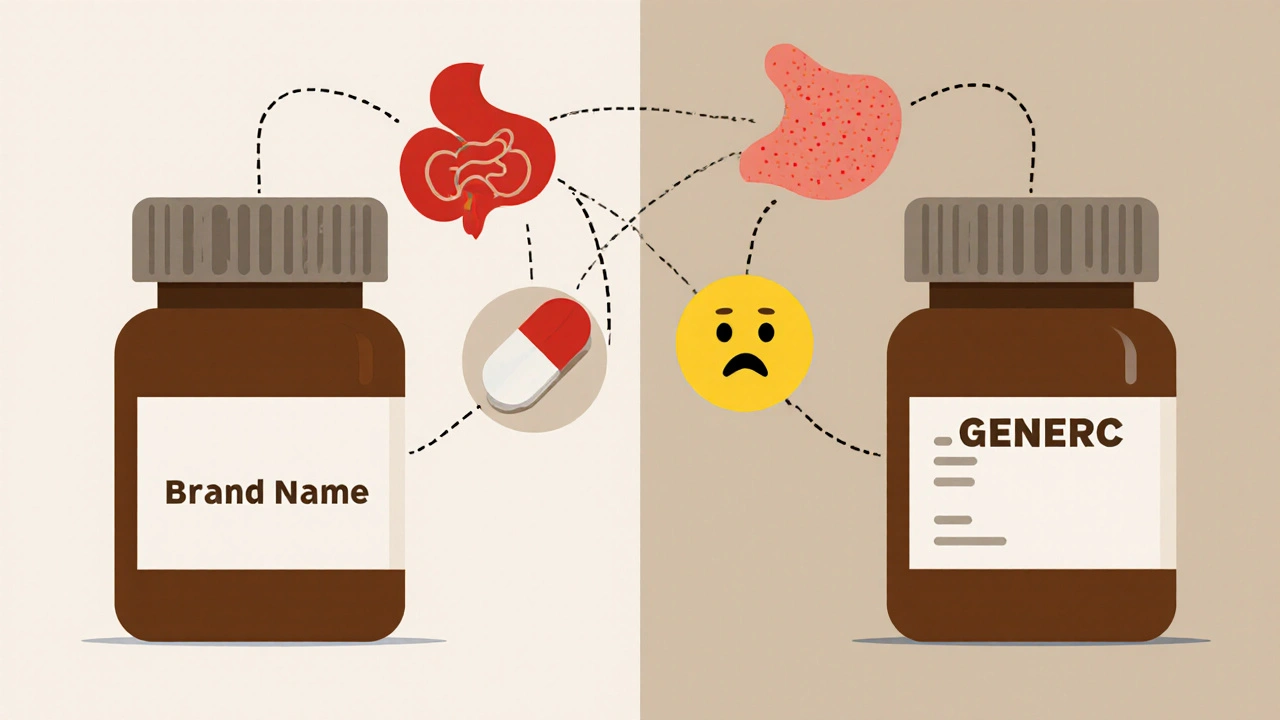
Patients aren’t imagining this. On Reddit’s r/pharmacy, dozens report sudden stomach cramps, rashes, or fatigue after switching to a generic. One woman switched from Synthroid to generic levothyroxine and developed severe digestive pain. The symptoms vanished when she went back to the brand. Another man with celiac disease got sick every time he took a new generic version of his blood pressure med - until he found one labeled gluten-free. A 2022 survey by MedShadow found that 27% of people who switched to generics reported new side effects. Of those, 68% blamed the inactive ingredients. The FDA’s own adverse event database has hundreds of reports linking reactions to fillers like lactose, dyes, and preservatives.But Are Generic Drugs Safe?
Yes - for most people. The vast majority of patients switch to generics without any issues. Express Scripts says the chance of a reaction to fillers is very small. The FDA insists that both brand and generic drugs meet the same quality standards. And generics save the U.S. healthcare system an estimated $300 billion a year. But safety isn’t just about statistics. It’s about your body. If you have allergies, autoimmune conditions, IBS, or celiac disease, you’re not part of the “most people.” You’re part of the group that needs more information.What You Can Do
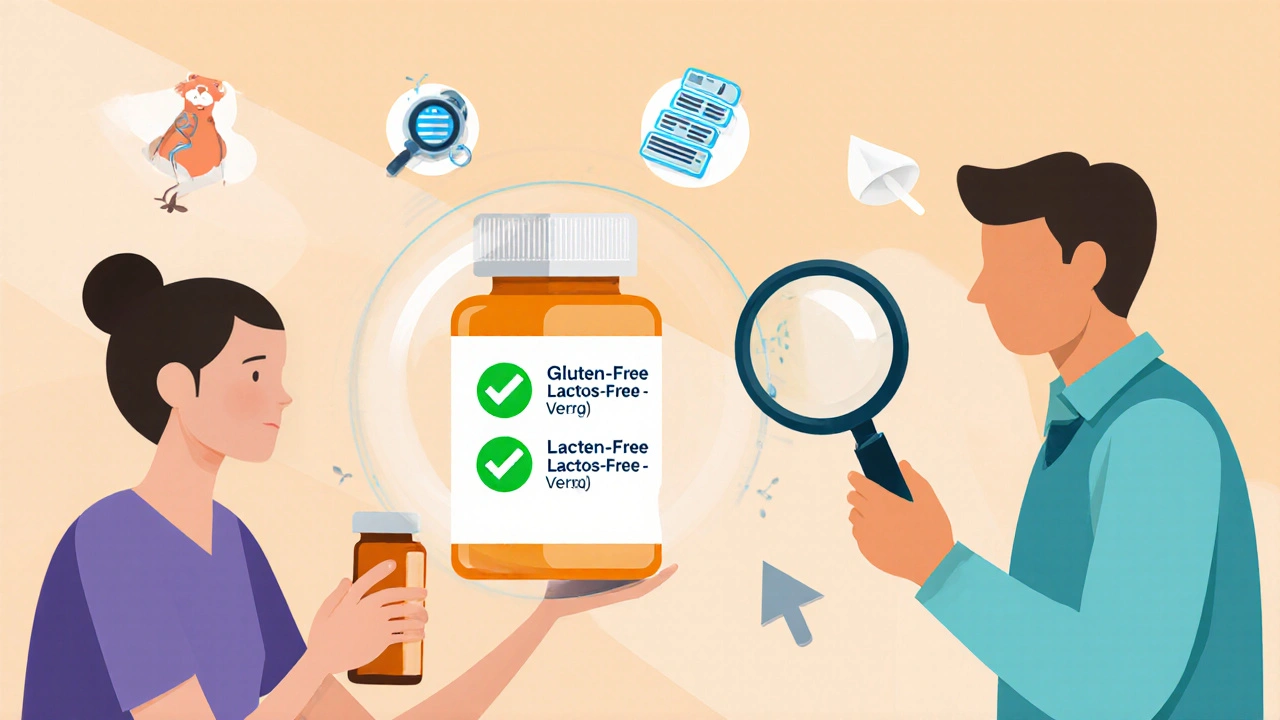
If you’ve had unexplained symptoms after switching to a generic, don’t ignore them. Here’s what to do:- Check the label. Look for the list of ingredients on the bottle. If it’s not there, ask your pharmacist for the full list. They can pull up the manufacturer’s package insert.
- Ask about the manufacturer. Different companies make generics for the same drug. One might use lactose; another might use cornstarch. Ask if you can stick with the same brand of generic.
- Request a gluten-free or lactose-free version. Some manufacturers make versions without common allergens. They’re not always advertised, but they exist.
- Use the FDA’s Inactive Ingredient Database. It’s not user-friendly, but you can search by drug name and see what excipients are approved. Your pharmacist can help you navigate it.
- Ask your doctor to write “Do Not Substitute” on the prescription. This forces the pharmacy to give you the brand-name version - though it may cost more.
 Medications

tushar makwana
November 30, 2025 AT 12:43Wow, I never thought about what’s inside these pills. I’ve been switching generics forever and never had issues, but now I’m wondering if my weird stomach stuff is from lactose. Thanks for laying this out so simply.
My mom has celiac and she just found out last year that her generic blood pressure med had gluten. She cried. Not because of the cost, but because no one told her.
Pharmacists should just hand out a sheet with the fillers. It’s not that hard.
linda wood
December 1, 2025 AT 02:22Oh please. So now we’re supposed to micro-manage every single pill we swallow? Next you’ll tell me to check the dye in my Tylenol because I might be allergic to Red 40.
Also, your ‘real people’ stories are just anecdotes. The FDA has data on millions of prescriptions. You’re one weird stomach ache away from being a viral post.
Sohini Majumder
December 1, 2025 AT 10:37OMG I KNEW IT!!!
I switched to generic levothyroxine and started having panic attacks, bloating like I ate a whole pumpkin pie, and my hair started falling out in clumps. I thought I was going crazy.
Then I found out the generic had lactose AND FD&C Yellow No. 5. I went back to Synthroid. My dermatologist cried when I told her. I’m not ‘just being dramatic’-I’m surviving.
Also, why is this even a debate?? My body is not a lab rat.
PS: The pharmacist laughed when I asked for the ingredient list. LAUGHED. I almost threw my bottle at her.
PPS: I’m not paying $400/month for brand. I’m paying $20 for the right generic. But no one tells you which one that is. #PharmaConspiracy
LINDA PUSPITASARI
December 2, 2025 AT 14:55As a pharmacist, I see this every day 😔
Most patients don’t know that the same drug from different manufacturers can have completely different fillers. I have a patient with IBS who gets wrecked by sorbitol in every generic metformin until we found one with mannitol. Took 3 months. 5 pharmacies. 2 angry calls to the manufacturer.
Pro tip: Ask for the “package insert” - it’s not on the bottle, but it’s in the box. And yes, we can order you a gluten-free or lactose-free version - they exist, just not always in stock.
Also, the FDA database is a nightmare. I use it daily. I’ll DM you a link to a better tool if you want 😊
Richard Thomas
December 4, 2025 AT 04:52The assertion that inactive ingredients constitute a significant clinical risk for the general population is not substantiated by epidemiological data. While individual case reports are compelling, they do not constitute evidence of a systemic failure in pharmaceutical regulation. The FDA’s bioequivalence standards are rigorous and empirically validated. The anecdotal narratives presented herein reflect confirmation bias rather than causal inference.
Furthermore, the commercialization of patient anxiety regarding excipients-often amplified by social media-risks undermining the cost-effective, life-sustaining utility of generic pharmaceuticals. One must ask: is the pursuit of perfect, zero-risk medication compatible with a functional healthcare economy?
Transparency is desirable, but not at the expense of accessibility.
gerardo beaudoin
December 6, 2025 AT 02:18Bro, I’m Nigerian and we don’t even have generics most of the time. We get expired meds or fake ones. But I’ve seen people here get sick from the fillers too.
My aunt took a generic for malaria and broke out in hives. Turned out it had peanut oil. No label. No warning.
This isn’t just a US problem. We need global standards. Not just for allergies, but for people with diabetes, kidney disease, anything.
And yes, it’s expensive to make clean generics. But it’s cheaper than ER visits. Trust me.
Let’s fix this. Not just for you. For everyone.
Sullivan Lauer
December 6, 2025 AT 07:54I’ve been on 7 different meds for 15 years. Every time I switch generics, I feel like a new person. Sometimes better. Sometimes worse. One time I was so tired I couldn’t get out of bed for a week. Turned out it was the dye. I didn’t even know dyes could do that.
Now I keep a spreadsheet. Drug name. Generic maker. Fillers. How I felt. I’ve saved myself from 3 bad switches.
It’s annoying. It’s tedious. But it’s my body. I’m not risking it.
And if your pharmacist rolls their eyes? Find a new one. There are good ones out there. I found mine after 12 tries. Worth it.
Joy Aniekwe
December 7, 2025 AT 19:55Oh so now it’s the fillers? Funny how every time someone gets a bad reaction, it’s never the drug itself. It’s always the ‘mystery filler’.
Let me guess-you also think your coffee is giving you anxiety because of the ‘chemicals’ in the beans? Or maybe your yoga mat is made of demonic latex?
Go ahead. Spend your life reading tiny print on pill bottles. Meanwhile, the rest of us will be alive and saving money.
Also, I’m lactose intolerant. I take generic ibuprofen. I’m fine. So maybe your body is the problem, not the pill.
Mary Kate Powers
December 9, 2025 AT 01:54I love how this post doesn’t say ‘avoid generics’-it says ‘know what’s in them’. That’s the real win.
My son has celiac and we found a generic version of his seizure med that’s certified gluten-free. It took 8 months. We called 17 pharmacies. We emailed 3 manufacturers.
But we got it. And now he’s seizure-free and not bloated.
If you’re struggling-don’t give up. Ask. Ask again. Ask louder. Someone out there has the answer. You’re not alone.
Latika Gupta
December 10, 2025 AT 16:12Do you think… maybe… the reason I get migraines after switching generics… is because I’m just stressed about it?
I mean… I read this whole thing and now I’m paranoid. What if my birth control has soy? What if my vitamin D has corn? What if…
…I just need to breathe?
…but also… can you send me that FDA database link?
Matthew Higgins
December 10, 2025 AT 19:18Just had a guy in the pharmacy ask me if his generic Adderall had ‘witchcraft’ in it. Said he felt ‘soul-sucked’ after switching.
I didn’t laugh. I pulled up the ingredients. It had FD&C Blue No. 1.
Turns out he’s allergic to artificial dyes. He cried. I cried. We ordered a dye-free version.
People are scared. They’re not crazy. They just don’t know where to look.
Thanks for making it easier.
Sara Shumaker
December 10, 2025 AT 19:30What does it mean to be ‘safe’? Is safety just the absence of death? Or is it the presence of dignity?
If I have to choose between a $3 pill that makes me sick and a $120 pill that lets me sleep, eat, and live without fear-I choose the latter.
And if the system forces me to gamble with my health to save money… then the system is broken.
This isn’t about generics being good or bad.
It’s about whether we value people enough to give them real choices.
And if we don’t… then what are we even saving for?
Peter Lubem Ause
December 11, 2025 AT 13:39My mom’s on 12 meds. All generics. She’s 78. She’s had 3 ER trips because of ‘mystery’ reactions. Turns out, 4 of them had lactose. 2 had gluten. 1 had sorbitol.
We found a pharmacy that tracks fillers. Now she’s fine.
Don’t ignore this. It’s not ‘overthinking’. It’s survival.
And if your doctor doesn’t get it? Find one who does.