

FDA Archive Finder
Find the Right FDA Archive Resource
Select your research criteria to determine which FDA archive resource will best answer your question.
Recommended FDA Resource
The U.S. Food and Drug Administration (FDA) doesn’t just approve drugs and medical devices - it tracks what happens after they reach millions of people. When something goes wrong, the FDA issues safety communications. These aren’t just press releases. They’re official, legally grounded alerts that change how doctors prescribe, how patients use medications, and sometimes even lead to products being pulled from shelves. If you’re researching a drug’s history - maybe you’re a patient, a student, a journalist, or a healthcare provider - the FDA Safety Communications Archive is your most reliable source. But it’s not simple to navigate. There are multiple systems, gaps in coverage, and layers of history you need to understand.
What’s in the FDA Safety Communications Archive?
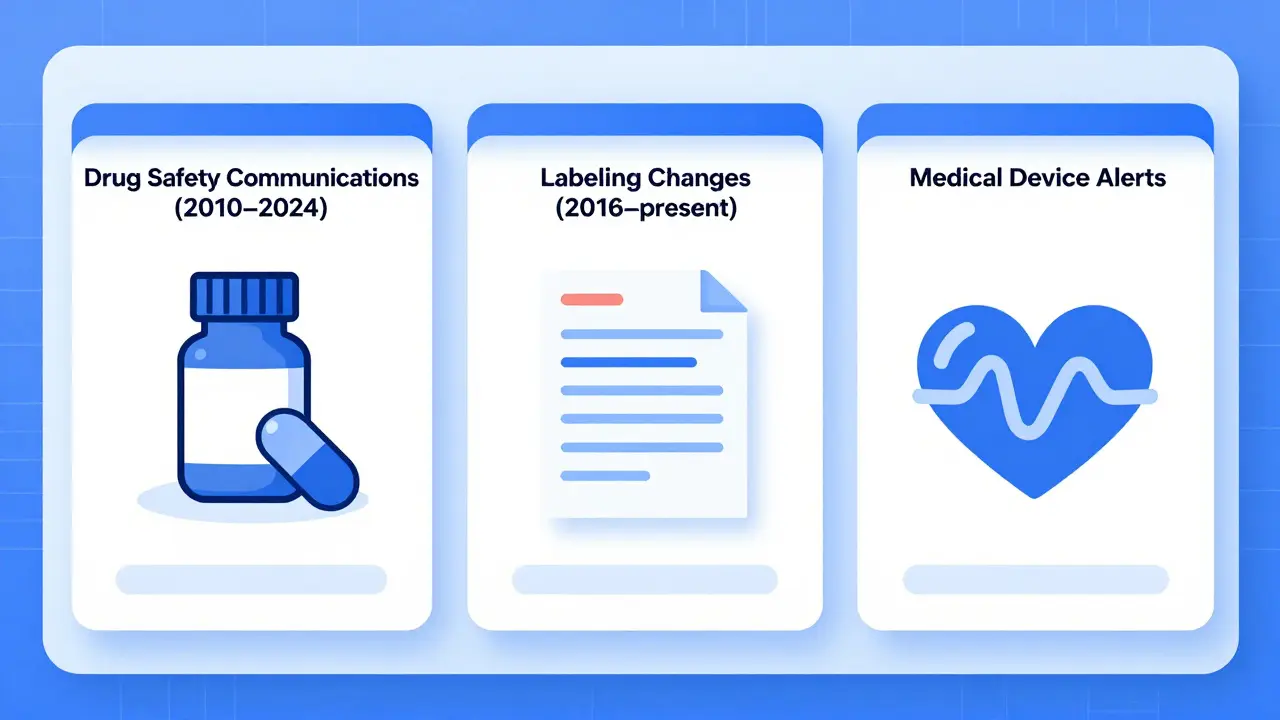
The archive isn’t one single database. It’s three separate, but connected, systems. First, there are the Drug Safety Communications (DSCs). These started being formally archived in 2010. Before that, the FDA issued safety notices, but they weren’t systematically stored online. From 2010 to 2024, every DSC is preserved. If a newer alert replaces an older one - say, a warning about a blood thinner was updated after new data came in - the old version is still there, labeled as “archived.” You can see how the agency’s understanding evolved over time. Second, there’s the Drug Safety-related Labeling Changes (SrLC) Database. This one started in January 2016. It doesn’t just tell you there was a warning - it shows you exactly what text was added or changed in the official drug label. That includes updates to the Boxed Warning (the strongest FDA warning), Contraindications, Warnings and Precautions, and even Patient Counseling Information. If you want to know when a drug first got a warning about liver damage or interactions with grapefruit juice, this database gives you the exact wording changes. Third, there’s the Medical Device Safety Communications system. Unlike drugs, where labeling changes are tracked in one place, medical device alerts are more varied. They include Early Alerts - issued when the FDA believes a device might cause serious harm - and recall notices. As of September 29, 2025, the FDA expanded this system to cover all medical devices, not just high-risk ones. That means you can now find alerts for everything from pacemakers to glucose monitors.How far back does the archive go?
For drugs, the official digital archive starts in 2010. But if you’re looking for warnings from the 1990s or early 2000s, you’re not out of luck. The FDA’s Archive.gov lets you view old versions of web pages that are no longer live. You can search for a drug name and a year - say, “Vioxx 2004” - and sometimes find the original alert page as it appeared back then. For even older history - think 1950s to 1970s - you need to go offline. The National Archives in Philadelphia holds FDA records from 1906 to 1978. These include handwritten reports, internal memos, and letters from manufacturers. One famous example: Dr. Harvey Washington Wiley’s “Poison Squad” experiments in the early 1900s led to the 1906 Pure Food and Drug Act. His reports on food additives and patent medicines are part of that collection. If you’re doing deep historical research, this is where you’ll find the roots of modern safety warnings.What’s missing - and why it matters
There’s a big gap: before 2016, there was no centralized database for labeling changes. The SrLC Database only covers changes made after January 2016. So if you’re studying how a diabetes drug’s warning about heart failure evolved from 2008 to 2015, you can’t just pull it up. You have to dig through archived DSCs, compare old package inserts, and sometimes even request documents through FOIA. It’s time-consuming. Another issue: not all warnings have the same impact. A 2012 study found that some FDA alerts caused doctors to stop prescribing immediately. Others had little to no effect. Why? It depends on how clear the message was, who received it, and whether the risk was easy to understand. A warning buried in a 20-page document might be ignored. A simple alert sent directly to prescribers? That gets attention. The FDA acknowledged this in October 2023, when it announced a new resource to help researchers collect historical drug approval data. This isn’t just about warnings - it’s about understanding the full lifecycle of a drug. That includes when it was approved, what studies were required, and what safety issues came up over time.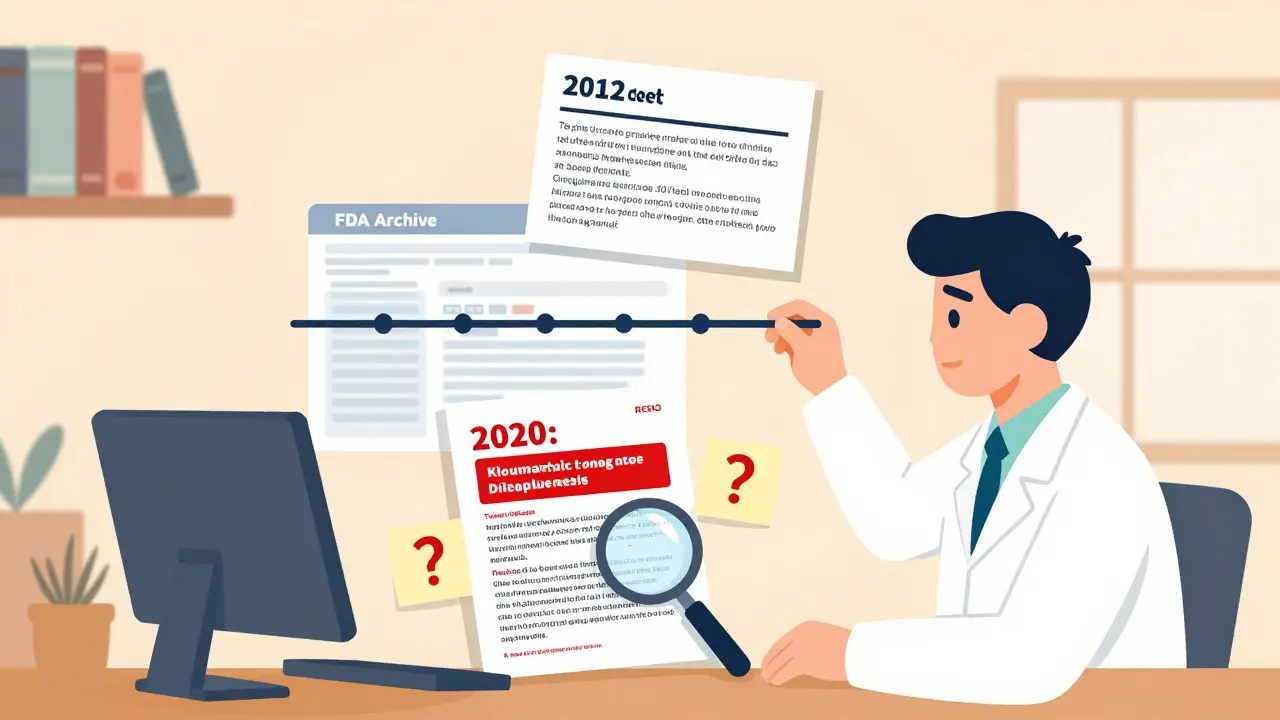
How to use the archive effectively
Start here: go to the FDA’s Drug Safety and Availability page. From there, click on “Drug Safety Communications.” You’ll see a list of years from 2010 to 2024. Click on a year, then search by drug name, condition, or keyword. If you’re looking for labeling changes, go to the SrLC Database. You can filter by drug, change type (e.g., “Added Boxed Warning”), or date. For medical devices, use the Medical Device Safety Communications page. Look for “Early Alerts” - these are the most urgent. You can also search by device type, like “insulin pump” or “hip implant.” If you hit a dead end - say, you can’t find a warning from 2012 - try the FDA Archive. Type the drug name and year into the search bar. Sometimes the old page is still there, even if it’s not linked from the current site. For pre-digital history, contact the National Archives. Their Record Group 88 includes FDA correspondence from 1906-1978. You can request copies of reports on early antibiotics, hormone treatments, or even the first warnings about asbestos in medical gauze.How does this compare to other countries?
The European Medicines Agency (EMA) issues safety alerts too, but their archive isn’t as clean. Before 2015, their system was messy - alerts were scattered across different pages, sometimes in PDFs with no searchable text. The FDA’s system, by contrast, is structured: one place for drug alerts, one for device alerts, one for labeling changes. That makes research faster. Health Canada has a single “Recalls and Safety Alerts” page. It’s simpler, but less detailed. You won’t find the exact wording changes to a drug label there. The FDA’s separation of drug and device communications gives you more precision.
Who uses this archive - and why?
Patients use it to understand why their doctor switched their medication. A woman researching her blood thinner might find a 2017 DSC that explains why her old drug was pulled - not because it was dangerous, but because a safer alternative became available. Researchers use it to study trends. Did warnings about antidepressants and suicide risk lead to fewer prescriptions? Did the 2019 alert on certain diabetes drugs reduce hospitalizations for heart failure? The archive lets you track those patterns. Lawyers and regulators use it to build cases. If a drug company knew about a risk in 2012 but didn’t update the label until 2017, the SrLC Database proves it. Even journalists rely on it. When a new safety concern emerges, they go back to see if the FDA flagged it before - and if so, why it wasn’t acted on sooner.What’s next for the FDA archive?
The agency is working on better integration. Right now, drug and device alerts live in separate systems. That makes cross-referencing hard. If a device contains a drug - like a drug-eluting stent - you have to check two places. Future updates may merge these. Search tools are also improving. Right now, you have to know the exact drug name. In the future, the FDA plans to add semantic search - so typing “heart rhythm drug” might return alerts for amiodarone, sotalol, and dofetilide, even if you didn’t know the brand names. Most importantly, the FDA is trying to make warnings more effective. They’re testing new formats - shorter summaries, visual icons, plain-language explanations - to make sure people don’t just read the alert, but understand it.What to do if you can’t find what you need
Still stuck? Call the FDA’s Division of Drug Information. Their number is (855) 543-3784. Or email [email protected]. They don’t give medical advice, but they can point you to the right archive or document. Don’t rely on Google or Wikipedia. Those sources often miss critical details or misrepresent the original alert. The FDA archive is the primary source. Everything else is secondary.Can I find FDA safety warnings for drugs approved before 2010?
Yes, but not in the official Drug Safety Communications archive. For warnings before 2010, use the FDA Archive to view old web pages or contact the National Archives in Philadelphia for paper records from 1906 to 1978. Some older alerts may still exist as PDFs or internal memos that were never digitized.
What’s the difference between a Drug Safety Communication and a labeling change?
A Drug Safety Communication is a public alert - it tells you something is wrong. A labeling change is the official update to the drug’s prescribing information. The communication might say, “This drug may cause liver injury.” The labeling change shows the exact new text added to the WARNINGS section of the drug’s official package insert.
Is the SrLC Database free to use?
Yes. The SrLC Database, Drug Safety Communications, and Medical Device Safety Communications are all free public resources on the FDA website. No login, subscription, or fee is required.
Why do some drug warnings have no impact on prescribing habits?
Research shows that the way a warning is written matters. If it’s too technical, buried in a long document, or doesn’t clearly state the risk level, doctors may overlook it. Effective warnings are direct, use plain language, and are sent directly to prescribers - not just posted online.
Can I use the FDA archive to check if my medication is safe?
You can see past warnings, but the archive doesn’t give current medical advice. Always talk to your doctor or pharmacist before making changes. The archive helps you understand history - not make treatment decisions.
Are medical device recalls included in the archive?
Yes. The Medical Device Safety Communications system includes Early Alerts and recall notices for all devices, as of September 2025. You can search by device type, manufacturer, or problem type - like “malfunction” or “infection.”
 Medications



Joy F
January 3, 2026 AT 15:45The FDA's archive is a masterpiece of bureaucratic inertia wrapped in a velvet glove. You think you're getting transparency, but it's just a meticulously curated museum of failures. Every archived DSC is a ghost of a decision that should've been acted on sooner. The SrLC Database? A post-hoc autopsy report with no coroner. They document the death, but never explain why the patient was left unattended for years.
And don't get me started on the 'early alerts' for devices. Half of them are buried under marketing-speak about 'risk mitigation'-code for 'we knew, but we didn't want to panic the market.' This isn't public safety. It's damage control with a thesaurus.
Meanwhile, patients are Googling 'is my pacemaker going to kill me?' while the FDA's semantic search prototype is still in beta. We're living in a post-truth medical ecosystem, and the archive is the only evidence we have that someone, somewhere, once cared enough to write it down.
The real tragedy? The system works perfectly-for the lawyers, the regulators, the pharmaceutical lobbyists. Not for the person swallowing the pill.
They don't need better archives. They need accountability.
And accountability doesn't live in a database. It lives in jail cells.
Haley Parizo
January 5, 2026 AT 04:15Let’s be real: this archive isn’t about safety. It’s about liability containment. The FDA doesn’t warn you because they care about your liver-they warn you because someone got sued and the paperwork caught fire.
That 2012 study on warning impact? It’s not about clarity. It’s about power. The agencies that control the narrative control the medicine. And the narrative is written in legalese so dense, even the doctors who prescribe these drugs don’t fully understand it.
The real question isn’t how to navigate the archive-it’s why the archive exists at all. If the system worked, we wouldn’t need archives. We’d need prevention.
They turned medicine into a forensic science. We’re just the witnesses.
Ian Detrick
January 5, 2026 AT 14:13Man, this is actually one of the most useful resources I’ve found in years. I’m a med student and I’ve spent hours digging through old DSCs to trace how warnings evolved on anticoagulants. Seeing the shift from vague language to concrete risk percentages? That’s how science actually progresses.
It’s not perfect, but it’s the best we’ve got. And yeah, the pre-2016 gap is brutal-but at least we know it’s there. That’s half the battle.
Pro tip: Use the SrLC Database with a spreadsheet. Copy-paste the label changes side-by-side. You’ll start seeing patterns-like how every major cardiac drug got a new warning around 2014. Coincidence? I think not.
Keep digging. The truth’s in the footnotes.
Kerry Howarth
January 7, 2026 AT 04:02Always verify with the primary source. The FDA archive is authoritative, free, and meticulously maintained. No substitute.
Tiffany Channell
January 8, 2026 AT 14:09Of course they archived everything. That’s how you cover your ass when the lawsuits start rolling in.
They don’t want you to find the 2008 warning about liver toxicity on that diabetes drug. They want you to find the 2017 version that says 'rare cases.' That’s not transparency. That’s obfuscation with a user interface.
And don’t tell me about the National Archives. Those paper files? Half of them were lost in a 1980s fire. The rest are in a basement in Philly with mold growing on the original memos from the Vioxx era.
This isn’t research. It’s archaeology. And we’re digging through the ruins of a system that never wanted to be found.
Angela Fisher
January 9, 2026 AT 15:33Y’all know the FDA is just a front for Big Pharma, right? They don’t want you to know this, but the archive is a trap.
Every time you look up a drug, they’re tracking you. Your IP. Your search terms. Your time spent. That data? Sold to the drug companies so they can adjust their marketing. If you search 'Xanax heart risks' too much, guess what? You’ll start getting ads for a new SSRI that’s 'safer'-but costs $800 a month.
And the 'National Archives' thing? That’s a decoy. Those papers were destroyed in '98. The ones you see? Fabricated. I know because my cousin works in Records Management at the VA. He told me they use AI to regenerate old documents with fake signatures.
They don’t want you to find the truth. They want you to think you’re finding it.
And the 'semantic search' they’re building? It’s already being used to bury warnings under irrelevant results. You type 'depression' and it returns results about antidepressants from 2020-ignoring the 1997 study that linked them to suicidal ideation in teens.
They’re not fixing the system. They’re weaponizing it.
Don’t trust the archive. Trust your gut. And maybe keep a tin foil hat handy.
Neela Sharma
January 10, 2026 AT 01:05India has no such archive. We get press releases. Sometimes. If the drug is expensive enough.
Here, a woman died from a reaction to a generic blood pressure pill. The doctor didn’t know. The pharmacy didn’t know. The government didn’t know.
I cried reading this. Not because it’s perfect. Because it’s possible.
Someone, somewhere, tried.
That’s more than we have.
Maybe one day we’ll build something like this. Not for lawyers. Not for corporations.
For the woman who can’t afford to die twice.
One day.
Shruti Badhwar
January 10, 2026 AT 23:13While the FDA's archival systems are indeed comprehensive, the structural fragmentation between drug and device safety communications remains a significant operational inefficiency. Cross-referencing co-administered pharmacological and medical device interventions is currently an arduous, manual process that introduces latency into clinical decision-making. The proposed integration of these databases is not merely a technological upgrade but a necessary evolution toward systems-based pharmacovigilance.
Furthermore, the absence of pre-2016 labeling change metadata represents a critical data gap in longitudinal pharmacoeconomic analyses. Researchers must rely on fragmented sources, including FOIA requests and institutional archives, which introduces selection bias and undermines reproducibility.
It is imperative that federal funding be allocated to digitize legacy labeling documents and implement standardized metadata tagging across all historical records.
Brittany Wallace
January 12, 2026 AT 22:46I love that this exists. I’m a nurse and I’ve used this archive to explain to patients why their meds changed-not just what changed, but why. That 2017 DSC on the blood thinner? I printed it out. Showed the patient the before and after. They felt heard. That’s the power of transparency.
Yeah, it’s messy. Yeah, it’s incomplete. But it’s real. And real matters.
My grandma took a drug in the 90s that got pulled. She never knew why. If this archive had been around then, she’d have had answers.
Keep fighting for better systems. But don’t forget: even this imperfect archive saved lives today.
Thank you, FDA. I mean it.
Michael Burgess
January 13, 2026 AT 04:46Just spent 3 hours digging through the SrLC Database for a patient’s old diabetes med. Found the exact line added in 2014 about heart failure risk. Printed it. Gave it to her. She cried.
Turns out her doctor never told her the warning was added after she’d been on it for 5 years. She thought it was always there.
This archive? It’s not just data. It’s justice.
Also-yes, the search sucks. But the info? Pure gold.
PS: I used the Archive.gov link from the post and found the original 2012 alert for her drug. It had a typo in the risk percentage. They fixed it in 2014. That’s why you need the archive. Because humans make mistakes. And the archive remembers them all.
TL;DR: This is the closest thing we have to medical truth. Use it. Share it. Fight for it.
Liam Tanner
January 13, 2026 AT 23:31For anyone new to this: start with the Drug Safety Communications page. Filter by year and drug name. Then cross-reference with SrLC if you need exact label wording. Don’t skip the archived versions-they show how the FDA’s understanding evolved.
And if you’re stuck, email [email protected]. They respond within 2-3 days. No joke.
This isn’t just for researchers. It’s for anyone who’s ever taken a pill and wondered, 'Why did they change this?'
You deserve to know.
Palesa Makuru
January 15, 2026 AT 03:19Look, I get it-you think this archive is some noble public service. But let’s be honest. The FDA is a corporate puppet. They don’t care about you. They care about stock prices.
And the fact that you’re so impressed by a database that took 15 years to become semi-functional? That’s the real tragedy.
You’re applauding a broken system because you’ve never seen a good one.
Meanwhile, in Germany, they have real-time adverse event reporting linked to electronic prescriptions. Here? We’re still digging through PDFs from 2011 like it’s 1999.
Stop romanticizing bureaucracy.
It’s not transparency. It’s delay.
Hank Pannell
January 15, 2026 AT 23:38Think about this: every archived DSC is a moment when the system almost failed. And yet, we’re still here. Still prescribing. Still trusting.
That’s not just data. That’s collective faith.
The FDA doesn’t get to decide when a drug is safe. We do. Every time we fill a prescription, we’re making a choice. The archive doesn’t tell us what to do. It just tells us what happened when others made different choices.
So when I read about a 2013 warning on a drug I’m about to prescribe, I don’t just see text. I see the ghost of someone who didn’t make it. And I ask myself: am I honoring them by being careful? Or am I just checking a box?
The archive doesn’t save lives.
It reminds us why we have to.
Philip Leth
January 16, 2026 AT 14:13Man, I just found the 2009 alert about that heart drug my dad took. He died in 2011. They didn’t warn us until 2015. This archive? It’s the only thing that proves I’m not crazy for thinking they knew.
Thanks for sharing this. I’m gonna send it to my lawyer.
Joy F
January 17, 2026 AT 02:39And yet, the same agency that archived the warning on Vioxx in 2004? They didn’t pull it until 2005. That’s not transparency. That’s a delayed execution.
You think the archive is about truth? It’s about legal defensibility. Every entry is written by a team of lawyers who know exactly how much to say-and how much to hide.
Don’t mistake documentation for justice.
Angela Goree
January 17, 2026 AT 07:25USA! USA! We have the best archive in the world-better than the EMA, better than Health Canada! We don’t need your socialist European data systems! We have our own! And it’s FREE! And it’s LEGAL! And it’s AMERICAN!
Also, why are we still using the National Archives? We should digitize everything with AI and blockchain! And put it on a satellite! So China can’t hack it!
Also, the FDA is the only agency that doesn’t take bribes. Period. End of story. 🇺🇸