


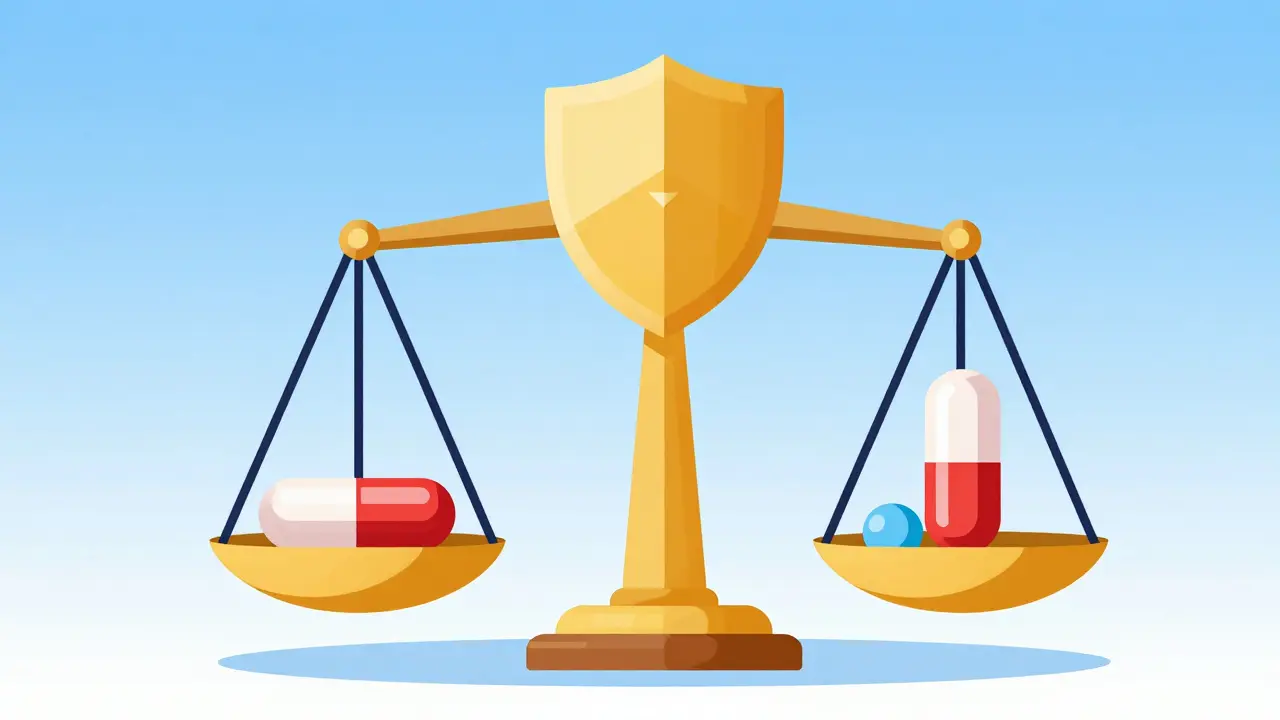
When you pick up a prescription at the pharmacy, you might notice two options: the name-brand pill you see on TV commercials and the cheaper box sitting right next to it. We've all asked the same question at some point-does saving money mean losing effectiveness? This worry is understandable given that we put our health in the hands of chemistry every single day. The science behind generic medication approval relies heavily on a specific type of check called bioequivalence testing.
This testing isn't just a box-ticking exercise. It is the scientific proof that ensures a generic medicine behaves exactly like the original product once it enters your body. Without these standards, the market would be flooded with unverified alternatives, and patient safety would be compromised. Understanding what these tests actually measure helps separate fact from fear.
The Definition of Bioequivalence
At its core, bioequivalence is about comparing how quickly and how much of a drug gets into your bloodstream. Regulatory bodies like the U.S. Food and Drug Administration (FDA) define it precisely. For a generic to be approved, there must be no significant difference in the rate and extent of availability at the site of action compared to the brand-name reference listed drug. In simpler terms, if you take the generic and the brand, your body should absorb them in essentially the same way.
This concept wasn't always standard practice. It became formalised through legislation like the Hatch-Waxman ActDrug Price Competition and Patent Term Restoration Act of 1984. This law created a pathway for manufacturers to get approval without repeating the massive clinical trials required for new drugs. Instead, they submit an Abbreviated New Drug Application (ANDA) relying on bioequivalence data to prove their version works just as well as the original.
The logic is sound because the active ingredient-the part that actually treats the condition-is identical in both versions. The main goal of bioequivalence testing is to bridge the gap between preclinical tests and real-world clinical outcomes without needing thousands of sick patients to trial the generic repeatedly.
Understanding the Numbers Behind Approval
You cannot rely on intuition when approving life-saving medicines; you need hard numbers. The FDA requires that the generic drug falls within a strict statistical range compared to the brand name. Specifically, regulators look at the 90% confidence interval for the ratio of population geometric means. This sounds complicated, but here is the practical takeaway:
The generic drug must deliver the same amount of medication over time (known as AUC) and reach peak levels in the blood at the same speed (known as Cmax). Both of these metrics must fall within a range of 80% to 125%. If a generic drug performs significantly outside this window, it is not considered equivalent. For example, if the brand drug releases 100 units of medicine into the system, the generic must release somewhere between 80 and 125 units under normal variation. This margin accounts for natural biological differences between people rather than manufacturing faults.
| Parameter | Brand-Name Requirement | Generic Requirement |
|---|---|---|
| Active IngredientChemical substance causing the therapeutic effect | Mandatory Standard | Must be Identical |
| Dosage Strength | Fully Tested | Must Match Exactly |
| Absorption Rate (Cmax) | Established Baseline | Within 80%-125% |
| Total Absorption (AUC) | Established Baseline | Within 80%-125% |
These parameters focus primarily on systemic exposure. This means they measure the drug in the blood to predict what happens at the target site. While this works perfectly for most oral tablets, it introduces complexities for other delivery methods. The European Medicines Agency (EMA) maintains similar standards, defining bioequivalence as pharmaceutical products having similar bioavailabilities such that their effects on safety and efficacy are expected to be essentially the same.
How the Study is Conducted
To gather the data required for that 80% to 125% range, researchers run controlled studies. Unlike the multi-year trials needed for brand-new medicines, bioequivalence studies are shorter and more focused. Typically, a study involves 24 to 36 healthy volunteers. These individuals are not necessarily patients suffering from the disease the drug treats. They serve as clean systems to isolate the performance of the medication itself.
The design usually follows a crossover model. This means the same person takes both the generic and the brand-name version at different times. There is a washout period in between doses to ensure the first drug has left their system before the second one is administered. Participants usually fast before taking the medication to prevent food interactions from skewing results.
Throughout the study, nurses collect blood samples at predetermined intervals. This allows scientists to plot a curve showing exactly when the drug appears in the bloodstream and how long it stays there. This data feeds directly into the calculations for AUC and Cmax. Because the same person serves as their own control, variability is reduced, making the comparison highly precise. Once the study shows compliance, the manufacturer submits the data alongside Good Manufacturing Practices (GMP) documentation for review.

Regulatory Oversight and Market Trust
Who decides if the study is good enough? In the United States, the FDA maintains the Electronic Orange Book. This official resource lists all approved drug products and assigns therapeutic equivalence ratings. If a generic receives a rating indicating therapeutic equivalence, doctors and pharmacists know the swap is safe. The agency inspects roughly 1,200 domestic and foreign facilities annually to ensure consistent quality.
In the United Kingdom and Europe, the role falls largely to the EMA and national bodies like the MHRA. They adhere to guidelines set by the International Council for Harmonisation (ICH). These global efforts help harmonise standards, ensuring a generic approved in the UK meets the same rigorous thresholds as one approved in the U.S. or Japan.
The impact of these rules is massive. Approximately 90% of prescriptions dispensed in the United States are generic medications. Despite this high volume, they represent only a fraction of total spending. This shift saves healthcare systems billions annually, proving that the bioequivalence pathway is economically efficient without sacrificing patient care. However, efficiency does not mean perfection. There are still limitations that experts track closely.
When Bioequivalence Gets Complicated
Most generic drugs are simple pills that dissolve easily in the stomach. But what about inhalers for asthma or creams for skin conditions? Traditional blood tests don't work well for these products because the drug acts locally rather than circulating through the whole body. Measuring concentration in the blood for an inhaler tells us little about how much medicine actually reached the lungs.
For complex generics, like modified-release formulations or topical dermatological products, regulators require specialized studies. Dr. Jerry Avorn, a Professor of Medicine at Harvard Medical School, noted that while bioequivalence works for most drugs, sophisticated testing is needed for narrow therapeutic index drugs. These are medications where even small changes in dosage can cause harm. In these cases, the acceptable window might be tighter than the standard 80% to 125%.
The FDA released specific guidance documents for these challenging categories, such as the development of topical products for generic submissions. They also look at pharmacodynamic endpoints-measuring the physiological effect rather than just blood concentration. This evolution ensures that as drug designs become more complex, the testing methods evolve alongside them.
Patient Experiences and Real-World Data
Data tells one story, but user experience tells another. In a 2022 survey by Consumer Reports involving 1,200 adults, 87% reported no difference in effectiveness between generic and brand-name drugs. Only 4% felt the generic worked less effectively. Online discussions on platforms like Reddit often highlight isolated incidents, but the broad consensus among pharmacists supports the reliability of the testing.
Why do some patients feel differently? Often, the issue isn't the active ingredient. It's the inactive ingredients-fillers, dyes, or binders-that distinguish a generic from a brand. A change in a binder might alter how the pill dissolves slightly faster than you expect, leading to minor side effects like nausea, even if the drug is working correctly. These experiences are often mistaken for efficacy issues when they are actually individual sensitivity issues.
Despite this, myths persist. Some people believe generics take longer to act or are less potent because of outdated memories from decades ago when manufacturing standards were looser. Today's oversight, driven by the GDUFA program, keeps approval timelines strict while maintaining quality. Modern facilities undergo regular audits, and any deviation in production quality can halt approvals immediately.
Looking Ahead in 2026
We are currently moving toward more advanced modelling techniques. By early 2026, agencies have begun integrating physiologically based pharmacokinetic (PBPK) modeling. This computer-based approach simulates how a drug moves through the body without needing as many human subjects. It complements traditional studies rather than replacing them entirely.
This shift aims to speed up access for patients needing complex therapies. With the global generic market projected to reach nearly $800 billion by 2030, balancing rapid innovation with safety is critical. The fundamental principle remains unchanged: whether tested by blood draw or simulation, the requirement is that the generic performs identically to the brand in the body.
Are generic drugs exactly the same as brand-name drugs?
They contain the exact same active ingredient in the same strength and dosage form. However, inactive ingredients like colourings or binders may differ, which is legally required to distinguish them visually.
What is the 80% to 125% bioequivalence rule?
This is the accepted statistical range for how much drug enters the bloodstream. A generic must perform within this window compared to the brand to ensure therapeutic similarity.
Do inhalers follow the same testing rules as pills?
Not always. Because inhalers deliver medicine to the lungs directly, standard blood tests don't work. They require pharmacodynamic studies measuring the actual lung response instead of blood levels.
Can I switch between brands and generics freely?
Yes, generally speaking. Regulators confirm they are therapeutically equivalent. However, if you have very sensitive reactions to fillers, discuss it with your pharmacist to ensure consistency.
How long does it take to approve a generic drug?
The review process typically takes 10 to 12 months from submission. The bioequivalence studies themselves usually take 6 to 8 months to complete prior to submission.
 Medications



tyler lamarre
March 27, 2026 AT 08:20People claim they care about cost until they realize the savings come from cutting corners elsewhere. The regulatory framework is essentially a glorified checklist designed to appease bureaucrats. Real pharmacists know that bioavailability is just theory versus actual practice. We pretend these studies mean something but nobody tracks failure rates properly. Money talks louder than any statistical significance ever could. I doubt the average voter understands how much lies behind those percentages. It creates a false sense of security for the masses who just follow the script. One wonders why anyone would believe a government agency has your best interest in mind. They serve the industry that funds their existence. The definition of success is merely meeting the minimum threshold required. We should question everything about modern healthcare delivery systems. Blindly accepting generic swaps is ignorance dressed up as frugality. Most doctors do not want to deal with angry patients who blame the drug.
Tony Yorke
March 27, 2026 AT 09:06costs are rising for everyone so saving pennies matters. i dont care about the politics just the results. health is wealth after all. trust the process enough to keep moving forward.
Debra Brigman
March 28, 2026 AT 17:43We walk into pharmacies trusting that the white box is magic. It feels strange to reduce healing to mere statistics. Science demands numbers but life demands feelings. The chemical formula is identical yet the spirit changes. Fillers are not just dust but they change the texture of trust. When you swallow a pill you ingest history too. Brand names carry legacy while generics carry efficiency. This balance is delicate like walking a tightrope above water. Safety margins protect us from the worst outcomes mostly. But the human body reacts to subtle vibrations we ignore. Trust is the real active ingredient in every prescription. If the patient believes in the cure the biology follows suit. Placing faith in regulators is an act of courage daily. We need to see the invisible work done behind glass walls. True quality is felt before the tablet dissolves in the throat. Understanding this helps me sleep better at night finally.
Sophie Hallam
March 30, 2026 AT 04:05That was a beautiful way to put it honestly. It is comforting to read a perspective that values the human element alongside the science. Many people overlook the psychological impact of medication choices in daily life. Finding peace with the testing requirements takes time for most folks. Appreciation for the effort put into safety checks is always important.
Jeannette Kwiatkowski Kwiatkowski
March 31, 2026 AT 06:05The analysis provided in this post lacks depth regarding narrow therapeutic index drugs. Most readers will miss the nuance because the explanation is too simplified. We see complacency creeping into public discourse when regulations loosen standards. It is disheartening to witness such naive optimism surrounding medical approvals. The economic argument overrides clinical rigor in almost every decision made recently. Patients are treated as data points rather than complex biological entities requiring individual care.
Poppy Jackson
April 1, 2026 AT 07:11oh my god its so much scarier over here in the uk too. nhs struggles constantly to maintain stock consistency. i understand your concern about complexity levels completely. but panic does nothing for anybody really. lets hope standards stay high everywhere please.
Aaron Olney
April 2, 2026 AT 02:55OMG THIS IS SCARY!!! i cant beleive doctors swap them now!! i worry about my heart constantly. i feel so unsafe reading abt the 80% rule. its not fair! it would be better if they tested on sick ppl instead. my grandma had issues last year too.
Devon Riley
April 2, 2026 AT 22:59Hey I get that fear is real but try to remember the stats show safety. Millions take meds without issues everyday. Your grandma case was likely unique sensitivity. You deserve to feel safe in treatment. Keep asking questions though because knowledge helps.
Philip Wynkoop
April 4, 2026 AT 01:24Totally agree with the data here :D