

Starting a new medication can feel overwhelming. You’ve got a prescription in hand, maybe a bottle with tiny print, and a list of things you’re supposed to do - but nothing feels clear. What if you take it at the wrong time? What if you mix it with something else? What happens if you miss a dose? These aren’t just nervous thoughts - they’re real risks. Every year, over 1.3 million people in the U.S. end up in the emergency room because of medication mistakes. The good news? Most of these errors are preventable. You don’t need to be a doctor to stay safe. You just need to know what to look for, what to ask, and how to build simple habits that keep you protected.
Know the Six Rights of Medication Safety
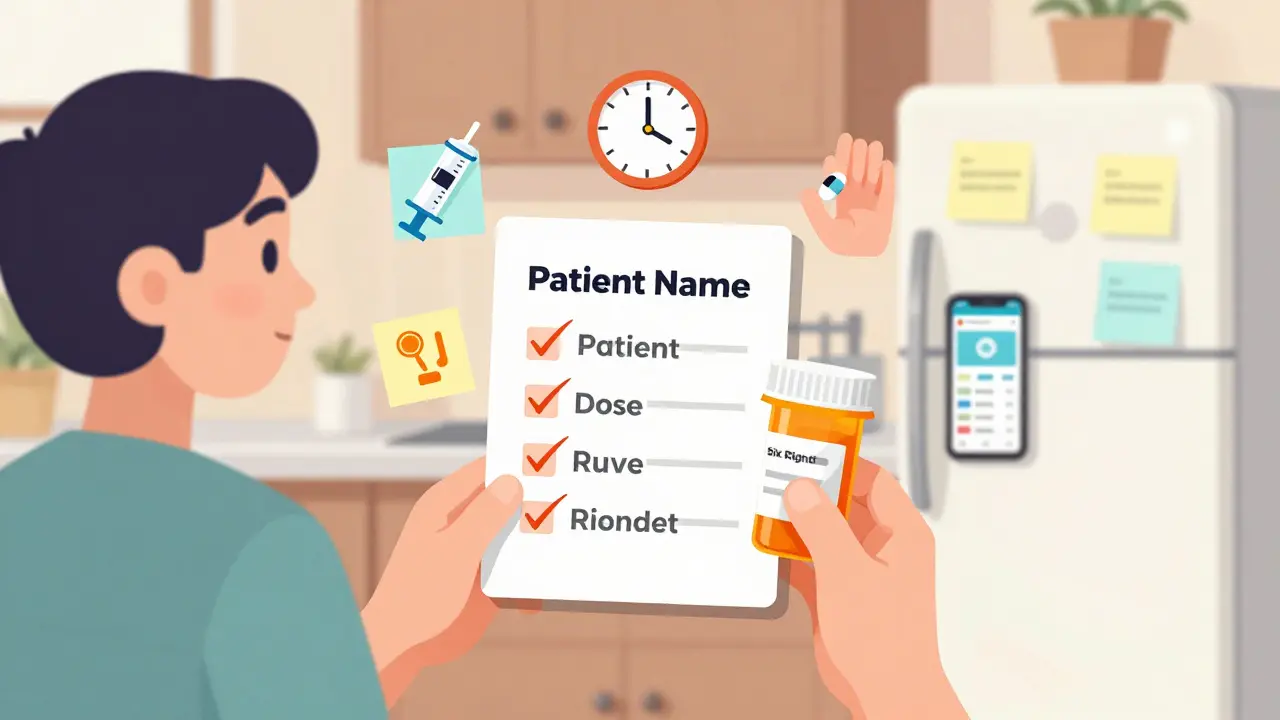
The foundation of safe medication use isn’t complicated. It’s built on six simple checks, called the Six Rights. These aren’t just hospital rules - they’re your personal safety checklist, whether you’re taking pills at home or getting an injection at the clinic.- Right patient: Make sure the name on the bottle matches yours. Always confirm with your ID or date of birth if you’re picking up meds at the pharmacy.
- Right medication: Double-check the drug name. If it looks different from last time - even if it’s the same brand - ask your pharmacist. Generic versions often change color or shape.
- Right indication: Know why you’re taking it. Don’t assume. Ask: “What condition is this for?” If you’re on multiple meds, this helps avoid confusion.
- Right dose: Never use kitchen spoons. A teaspoon varies by 25-50% in volume. Use the measuring cup, syringe, or dosing spoon that came with the bottle.
- Right route: Is it meant to be swallowed, placed under the tongue, or applied to the skin? Taking a cream orally or a pill topically can be dangerous.
- Right time: Some meds need to be taken with food. Others must be taken on an empty stomach. Some work best in the morning, others at night. Ask your pharmacist about timing.
Write these down. Keep them on your fridge or phone. Use them every single time you take a pill. It takes less than 10 seconds - but it could save you a hospital trip.
Keep a Complete Medication List
Most people think they remember what they’re taking. They don’t. A 2022 study found that patients who kept a full, written list of everything they took - prescriptions, over-the-counter drugs, vitamins, supplements, even herbal teas - had 27% fewer medication errors.Your list should include:
- Drug name (brand and generic if different)
- Dose (e.g., 10 mg, 500 mg)
- How often (e.g., once daily, twice a day)
- Why you’re taking it (e.g., “for high blood pressure”)
- When you started
- Who prescribed it
Don’t rely on memory. Use a notebook, a notes app, or even a photo of your pill bottles. Bring this list to every doctor’s visit, every pharmacy pickup, and every ER trip. If you’re admitted to the hospital, they’ll ask for it. If you don’t have it, they’ll guess - and guessing kills.
Never Take Someone Else’s Medicine
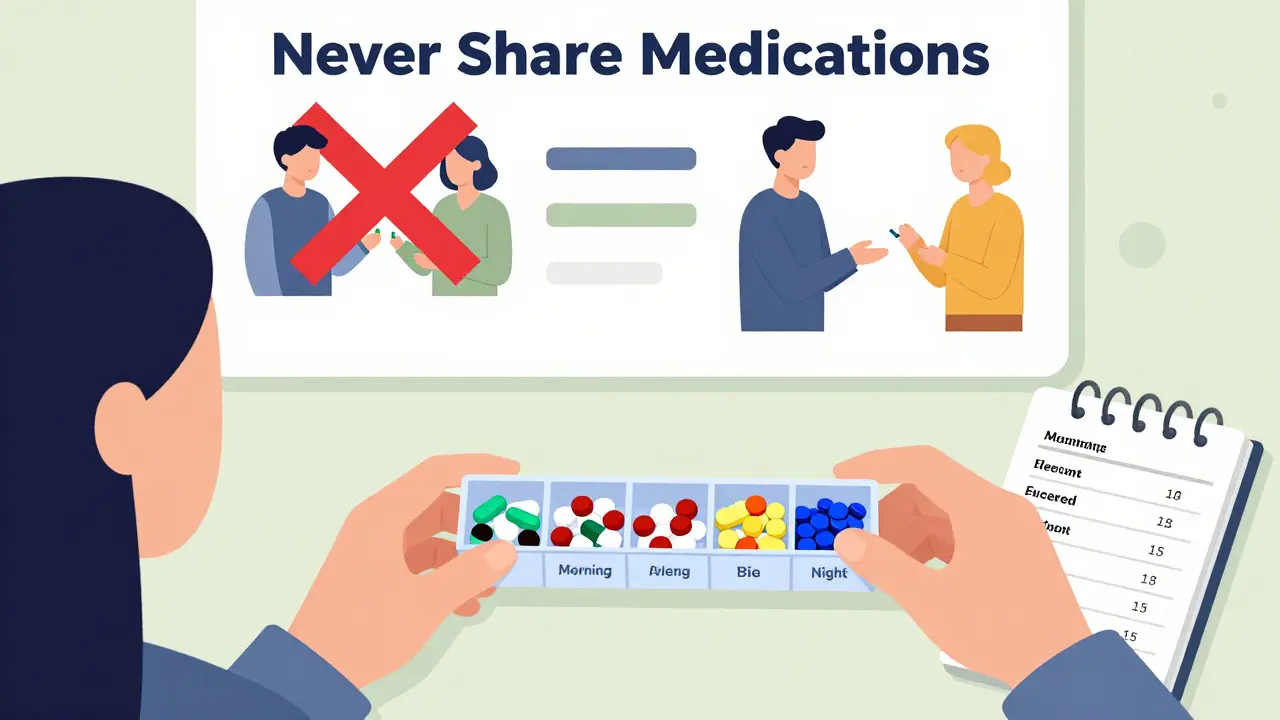
It’s tempting. Your friend says their headache pill worked wonders. Your neighbor swears by their sleep aid. Don’t do it. The FDA says sharing medications causes about 8% of emergency visits for drug reactions. Why? Because what’s safe for one person can be deadly for another.Even if you have the same symptom - say, back pain - the cause could be different. One person might need an anti-inflammatory. Another might have a nerve issue that needs a different drug. Your body’s chemistry, allergies, other meds, and health history are unique. Taking someone else’s pill is like driving a car you’ve never seen before - you don’t know where the brakes are.
Store Medications Properly
Your meds aren’t just sitting there. They’re changing. Heat, moisture, and light can make them weaker - or even toxic.- Insulin: Must be refrigerated (36-46°F) until opened. After opening, it can stay at room temperature (below 86°F) for up to 28 days.
- Most pills: Keep in a cool, dry place. The bathroom cabinet is a bad idea - steam ruins them. A bedroom drawer or kitchen cabinet away from the stove works better.
- Liquid antibiotics: These degrade fast. Some need refrigeration. Check the label. If it says “discard after 14 days,” throw it out - even if there’s some left.
- Controlled substances: Like opioids or sedatives - lock them up. Not just for safety, but to prevent theft or accidental use by kids or pets.
Expired meds? Toss them. A Merck report found that 18% of medication errors come from using expired drugs - especially antibiotics and liquid forms. They lose strength. Worse, they can break down into harmful chemicals. Don’t flush them unless the label says to. Use a drug take-back program or drop box at your local pharmacy.
Ask the Right Questions at the Pharmacy
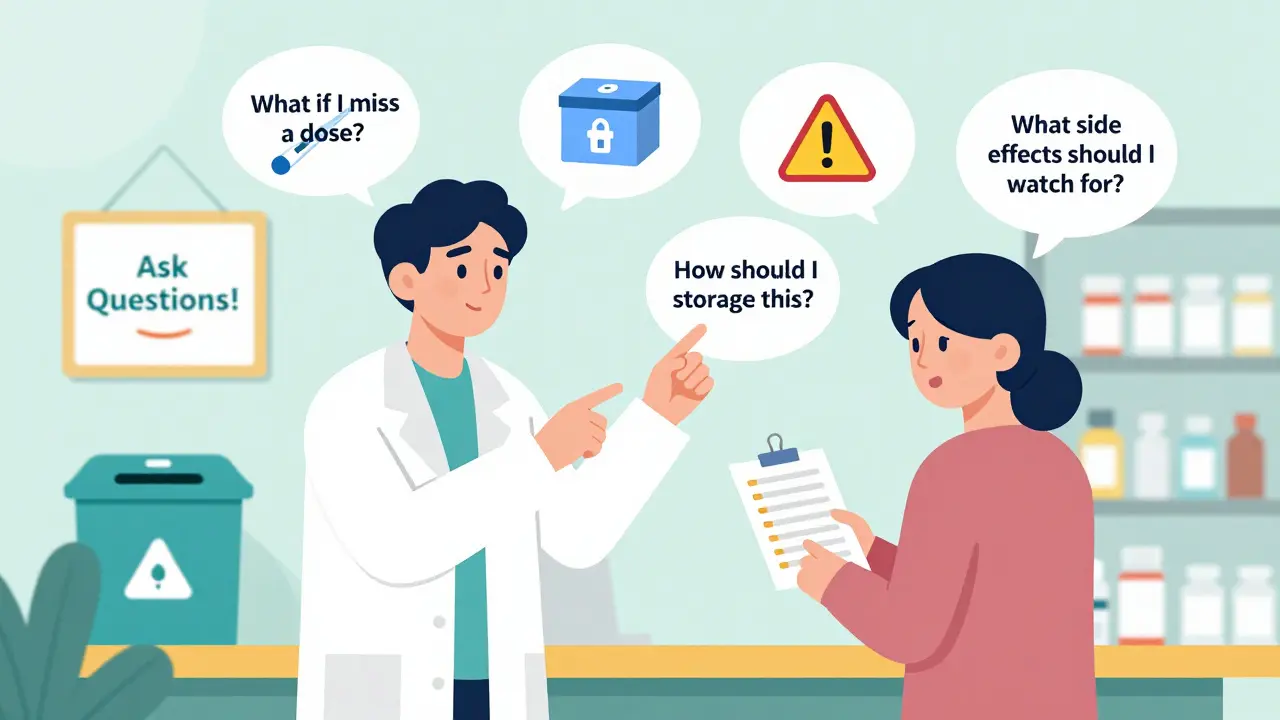
Pharmacists are your best friend when you’re new to meds. But most people don’t ask enough. A 2022 study showed patients who asked three or more questions had 34% fewer side effects in their first month.Here are the three most important questions to ask every time you get a new prescription:
- “What should I do if I miss a dose?” - Only 22% of patients ask this. The answer changes depending on the drug. Some you take as soon as you remember. Others you skip entirely. Getting it wrong can cause harm.
- “How should I store this?” - 40% of medications have special storage needs. If you don’t know, you risk making the drug useless or unsafe.
- “What side effects should I watch for?” - Only 65% of pharmacy consultations cover this. Know the red flags: rash, swelling, trouble breathing, confusion, chest pain, or sudden mood changes. Don’t wait for them to get worse.
Also ask: “Is this the same as the last one I took?” and “Are there any foods, drinks, or other meds I need to avoid?”
Use Tools to Stay on Track
Forgetting a dose is common - especially when you’re juggling multiple meds. A 2022 study found that first-time users take their meds correctly only about 60% of the time without help.Use simple tools:
- Alarm reminders: Set two alarms on your phone - one for morning, one for night. Label them clearly: “AM: Blood Pressure Pill” or “PM: Pain Med.”
- Medication apps: Apps like Medisafe or MyMeds let you scan your pill bottle’s barcode. They show you what it is, when to take it, and warn you about interactions. They also send alerts if you miss a dose.
- Pill organizers: Buy one with compartments for morning, afternoon, evening, and night. Fill it once a week. It’s visual. You’ll know if you’ve taken it.
Don’t overcomplicate it. Start with one tool. Stick with it for two weeks. That’s how long it takes to build the habit, according to a University of Michigan study.
Watch for Changes - Even Small Ones
Your body will tell you if something’s off. But you have to listen.Generic drugs are used in 90% of prescriptions. They work the same as brand names - but they often look different. A pill that was white and oval last time might now be blue and round. That doesn’t mean it’s wrong. But it does mean you should check.
If your pill looks different, ask your pharmacist: “Is this the same medicine?” Don’t assume. Don’t guess. If they say yes, ask: “Will it work the same way?” If they say no, ask why.
Also watch for new symptoms. A mild headache, nausea, or dizziness might seem normal. But if it’s new - and started after you began the med - it could be a reaction. Don’t ignore it. Call your doctor or pharmacist. Better safe than sorry.
Be Extra Careful During Transitions
One of the most dangerous times for medication errors is when you move between care settings - like leaving the hospital or switching doctors.Studies show 22% of medication mistakes happen during these transitions. Why? New prescriptions get added. Old ones get stopped. Instructions get lost.
When you’re discharged from the hospital:
- Ask for a written list of all your meds - including changes.
- Compare it to your personal list. Do they match?
- Ask: “What’s new? What’s been stopped? What’s changed?”
- Don’t leave until you understand every change.
Same goes for seeing a new doctor. Bring your list. Don’t let them guess what you’ve been taking.
It Gets Easier - But Never Skip the Basics
The first few weeks are the hardest. You’re learning names, times, side effects, storage rules. It’s a lot. But after 2-3 weeks, it becomes routine. You won’t need to think about it anymore.But don’t let familiarity make you lazy. Medication safety isn’t a one-time lesson. It’s a lifelong habit. Even if you’ve been on the same meds for years, things change. Your body changes. New drugs come out. New warnings get issued.
Stay alert. Stay curious. Stay in charge. You’re not just taking pills - you’re managing your health. And no one else can do that for you.
What If I’m Still Confused?
If you’re unsure - even a little - don’t guess. Call your pharmacist. They’re trained for this. Most pharmacies offer free 10-minute consultations. Some even offer telepharmacy visits if you live in a rural area. In 2023, 62% of rural patients said telepharmacy helped them understand their meds better.You’re not being a burden. You’re being smart.
 Medications



Georgia Brach
December 23, 2025 AT 15:31The Six Rights are a nice theoretical framework, but in practice, pharmacies routinely mislabel medications. I’ve seen generic metoprolol labeled as lisinopril three times. The pharmacist shrugged and said, 'It’s close enough.' This isn’t patient negligence-it’s systemic failure.
Payson Mattes
December 25, 2025 AT 03:29Did you know the FDA secretly approves 'placeholder' generics that are 40% less effective? Big Pharma pays them off so they can sell the same pill under a different color. That’s why your 'new' pill doesn’t work like the old one. And don’t get me started on the microchips they put in opioids to track you. Your phone alarm? It’s probably sending your data to a server in Texas.
Steven Mayer
December 26, 2025 AT 23:13The pharmacokinetic variability between brand-name and generic formulations is non-trivial, particularly with narrow-therapeutic-index agents like warfarin or levothyroxine. Bioequivalence thresholds (80–125% AUC) are statistically permissible but clinically suboptimal for polypharmacy patients. Additionally, excipient heterogeneity-particularly in fillers like lactose or cellulose-can induce idiosyncratic reactions in metabolically compromised individuals. Documentation protocols remain insufficiently standardized across care transitions.
Usha Sundar
December 27, 2025 AT 18:23My aunt took someone else’s blood pressure pill. Died in her sleep. Don’t do it.
Harsh Khandelwal
December 28, 2025 AT 04:41Y’all act like this is rocket science. I just toss my pills in a mason jar and take ‘em when I feel like it. Been on 7 meds for 12 years. Still alive. Maybe the real problem is overmedicating? They got us all hooked on chemicals just so Big Pharma can keep raking it in. My grandma took aspirin and whiskey for everything. She lived to 98.
Spencer Garcia
December 29, 2025 AT 22:38Use a pill organizer and set alarms. That’s it. Start there. No need to overthink it. The rest? You’ll learn as you go. If you’re unsure, call your pharmacist. They don’t bite. Seriously, just do the two things. It changes everything.
Abby Polhill
December 30, 2025 AT 12:20As someone who grew up in a household where meds were stored in the medicine cabinet above the sink (hello, humidity), I didn’t realize how much heat and moisture degrade drugs until I moved to a dry climate. Now I keep everything in a sealed container in my bedroom drawer. Small change, huge difference.
John Pearce CP
December 31, 2025 AT 09:05While the author’s recommendations are superficially reasonable, they presuppose a level of institutional trust and access to healthcare infrastructure that is fundamentally incompatible with the reality of American medicine. The notion that pharmacists are reliable stewards of safety is a myth perpetuated by bureaucratic propaganda. The real solution lies in self-reliance, constitutional liberty, and the rejection of pharmaceutical hegemony. Do not trust the system. Verify everything. Archive every label. Document every interaction. The state does not care if you live or die-you must protect yourself, because no one else will.