

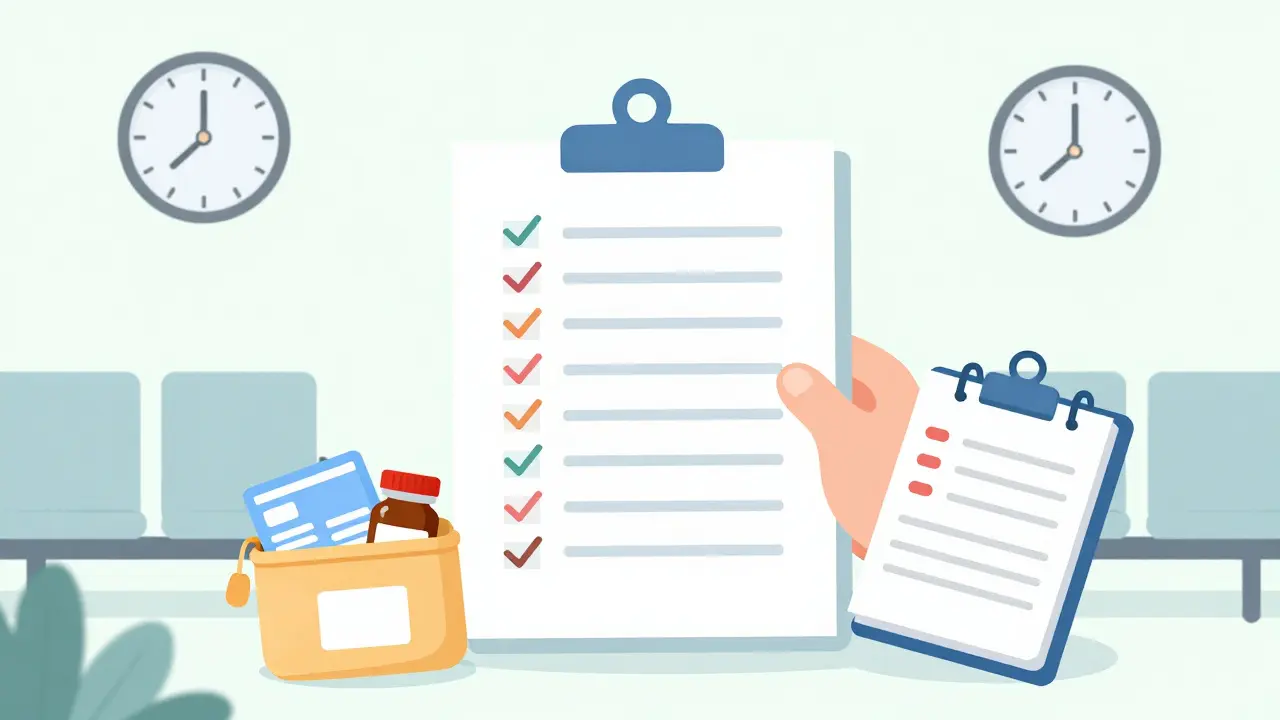
Doctor Appointment Prep Checklist
Preparation Guide
Get ready for your next doctor visit by completing this checklist. This tool helps you organize your medical information and ensure you cover everything important during your appointment.
What to Bring
What to Discuss
Your Prepared Checklist
Walking into a doctor’s appointment without being prepared is like showing up to a job interview without a resume. You might get through it, but you’re leaving important things unsaid, misunderstood, or forgotten. In the UK, where GP appointments are often short and busy, being ready can make the difference between a quick check-up and a real conversation that leads to better care.
What to Bring to Your Appointment
You don’t need to carry everything you own, but there are a few key things that every patient should have on hand. First, your medication list. Not just the names - write down the exact dose, how often you take it, and why. For example: Metformin 500mg, twice daily, for type 2 diabetes, prescribed by Dr. Patel, started 2022. Many patients think they remember their meds, but studies show nearly half get at least one detail wrong. A 2022 audit by Mayo Clinic found that patients who brought a written list had 37% fewer medication errors during visits.
Bring your health insurance card and a form of photo ID. Even if you’ve been with the same GP for years, they need to verify your details in the system. If you’ve recently switched practices or had a referral, bring any letters or test results from other doctors. Don’t assume they’ve received them - delays happen.
Also, bring your family health history. Not just “my dad had a heart attack.” Be specific: My mother was diagnosed with breast cancer at age 52. My paternal grandfather had type 2 diabetes and died of a stroke at 68. This helps your doctor spot patterns that could affect your risk. Some clinics now use digital tools to build family trees from your answers, but not all do - so don’t rely on it.
If you use any supplements, vitamins, or over-the-counter drugs - even aspirin or herbal teas - list them too. People often forget these, but they can interact with prescriptions. For example, St. John’s Wort can reduce the effectiveness of birth control and blood thinners. Your doctor needs to know.
What to Discuss - Beyond the Symptoms
Most people go in with one main concern: “My knee hurts,” or “I’m always tired.” But the best appointments cover more. Start by writing down 3-5 things you want to talk about, ranked by importance. You won’t get through everything, so prioritize.
Ask these five questions - they’re simple but powerful:
- Why are you recommending this test or treatment?
- What are the possible side effects?
- What happens if I don’t do anything?
- Are there cheaper or simpler options?
- What would you do if this were your parent or child?
These aren’t just polite questions - they’re evidence-based. Research from St. Joseph Hospital Bangor shows patients who ask 3-5 focused questions resolve 89% of their main health issues, compared to just 63% for those who don’t prepare.
Don’t skip lifestyle topics, even if they feel embarrassing. Your doctor needs to know:
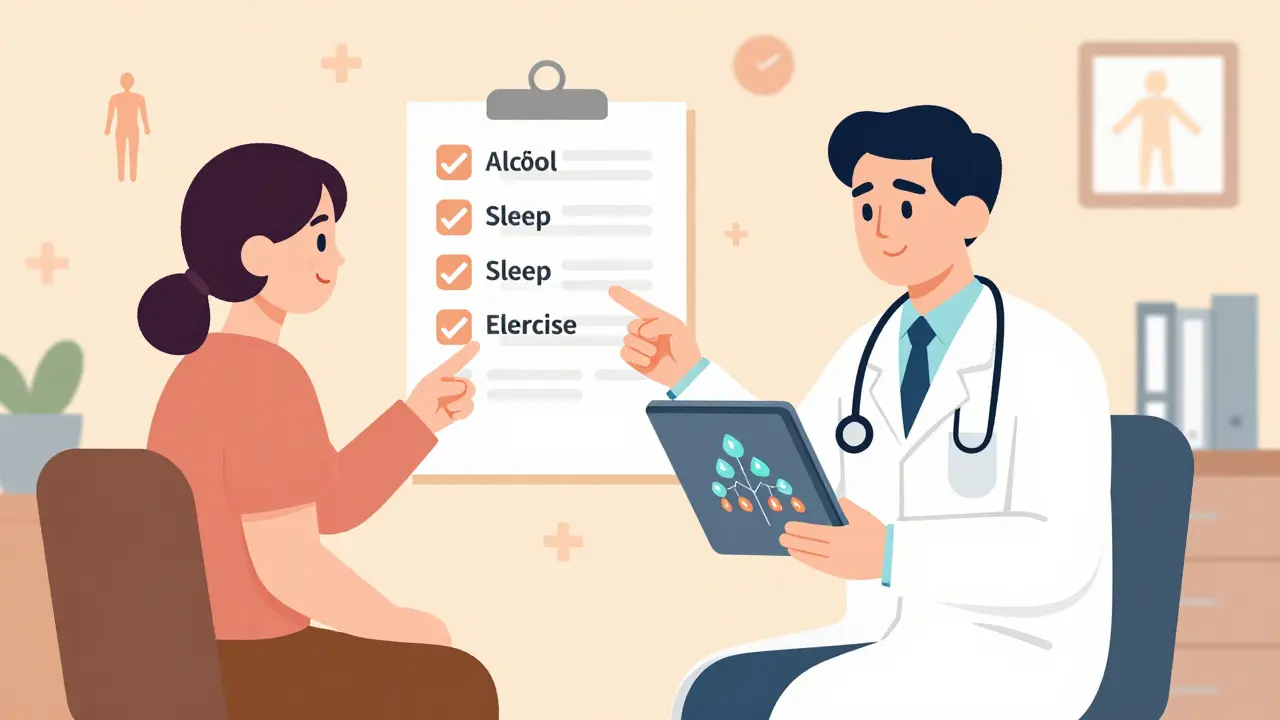
- How much alcohol you drink per week (be specific: “2 glasses of wine on weekends”)
- How often you exercise and for how long (“I walk 20 minutes, three times a week”)
- Whether you smoke or use tobacco - even if it’s just once a week
- If you’ve used recreational drugs, even once
These aren’t judgment calls - they’re risk factors. A 2022 study from AdventHealth found that 68% of patients underreported alcohol or smoking habits during first visits. That means doctors miss clues to liver disease, high blood pressure, or cancer risk.
Track your symptoms before you go. Don’t say “I’ve had headaches.” Say: “I’ve had dull, constant pain on the right side of my head for three weeks. It started after I changed my sleep schedule. It gets worse when I’m stressed, and ibuprofen helps a little.” Include intensity on a scale of 1-10. This helps your doctor spot patterns and rule out serious causes.
What to Do Before the Appointment
Don’t wait until the day of your appointment. Start preparing at least 48 hours ahead.
- Check your pharmacy’s app or website. Many now let you download a printable list of all your current prescriptions.
- Use Apple Health or Google Fit to pull your recent activity and sleep data. Bring a screenshot if your doctor doesn’t have access to it.
- Fill out any forms your clinic sent ahead of time. If they asked for a symptom tracker or family history form, complete it. Skipping this adds time to your visit - time you could be talking.
- Write down your questions. Put them in order. Put the most important one at the top.
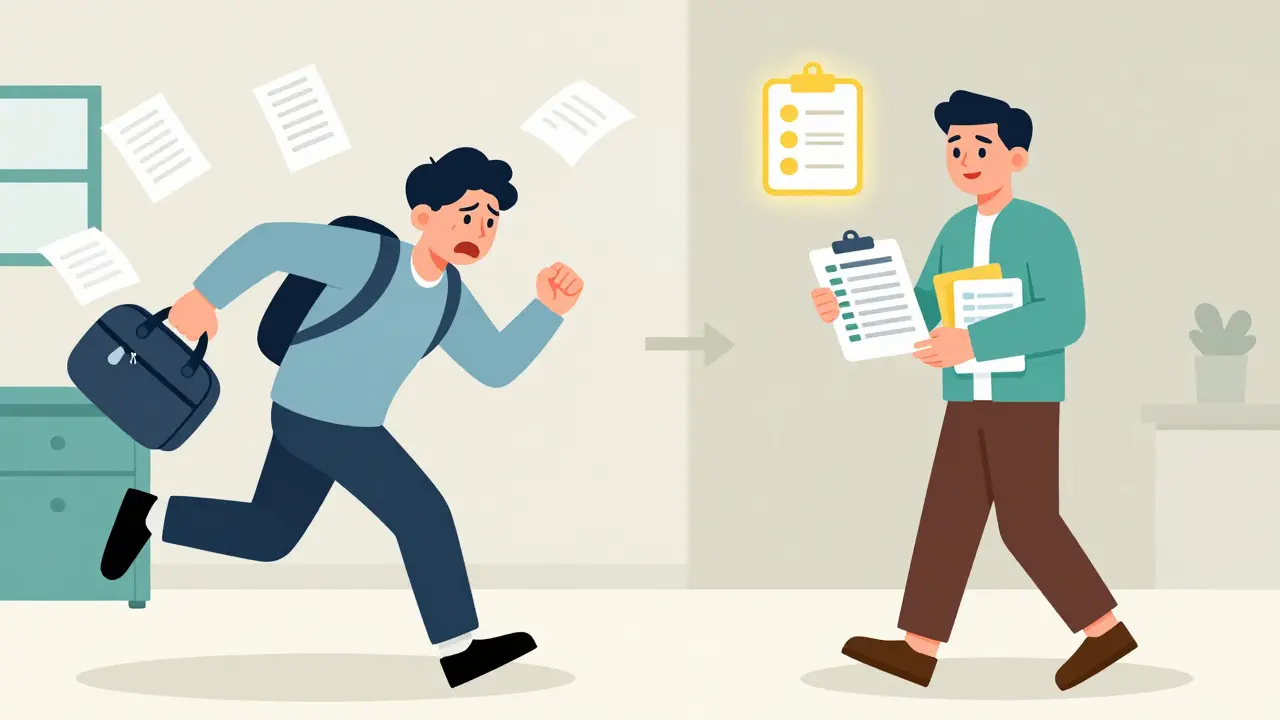
Some clinics, like Cleveland Clinic, use digital check-in systems that require you to log in 30 minutes early to scan a barcode. Even if yours doesn’t, arriving 15-20 minutes early gives you time to find parking, sign in, and settle in. Rushing in means you’re already stressed before you sit down.
What Happens If You Don’t Prepare?
You might walk out thinking everything’s fine - but miss something important.
One patient came in with fatigue. She didn’t mention she’d been taking melatonin nightly for sleep, or that she’d stopped her blood pressure pill because it made her dizzy. Her doctor prescribed a new sleep aid. Three weeks later, she had a mild stroke. The missed connection? The blood pressure medication was the key. She hadn’t told anyone she stopped taking it.
Another patient thought her bloating was just diet-related. She didn’t mention her mother had ovarian cancer. By the time she brought it up, the cancer had spread. Early detection could have changed everything.
These aren’t rare stories. A 2022 study across 12 clinics in the UK found that patients who didn’t prepare lost an average of 14.7 minutes per visit - time spent asking for basic info instead of solving problems.
What’s New in 2026
More clinics are pushing digital prep tools. If your practice uses MyChart, NHS App, or another portal, check it before your visit. Some now auto-fill your medication list from pharmacy records. Others send you a short questionnaire via text or email a day before your appointment.
AI tools are starting to suggest questions based on your health history. If you’ve had high cholesterol before, the system might remind you to ask about statin side effects. If you’re over 50, it might prompt you to discuss bowel changes or breast screening.
But tech doesn’t replace your voice. The best tool is still your own memory - and your willingness to speak up.
Final Checklist
Before you leave for your appointment, do a quick scan:
- ✅ Medication list (name, dose, frequency, reason, prescriber)
- ✅ Insurance card and ID
- ✅ Family health history (parents, siblings, grandparents)
- ✅ List of symptoms with timing and intensity
- ✅ List of 3-5 questions you want answered
- ✅ Any recent test results or letters from other doctors
- ✅ Notes on lifestyle: alcohol, sleep, exercise, smoking
That’s it. No need for fancy folders or apps. Just a piece of paper and the courage to ask.
What if I forget something during my appointment?
It’s normal to forget things in the moment. Most doctors are happy to follow up. Ask if you can send a message through the patient portal, or call the clinic the next day. Write down what you remembered later and bring it to your next visit. Don’t wait - even a small detail can matter.
Should I bring someone with me?
Yes, especially if you’re dealing with a new or serious issue. A second set of ears helps you remember what was said. They can also ask questions you didn’t think of. Just let the doctor know ahead of time so they’re prepared.
Can I ask for a longer appointment?
Absolutely. If you have multiple concerns, ask when booking: “I have several things to discuss - can I book a longer appointment?” Many practices offer 15- or 20-minute slots for complex issues. Don’t assume you’re stuck with 10 minutes.
What if I’m nervous about talking about my lifestyle?
Doctors hear this every day. They’re not there to judge - they’re there to help. Saying “I’ve been drinking more since my dad passed” or “I haven’t exercised in months” is a step toward change. If you’re uncomfortable, start with: “I’m not sure if this matters, but…” - they’ll take it seriously.
Do I need to bring my pill bottles?
Not always, but it helps. If your medication list is messy or you’re unsure of the names, bringing the bottles saves time. Some doctors will check them against your list to spot errors. If you can’t bring them, take clear photos on your phone.
 Medications
Chris Urdilas
January 26, 2026 AT 17:54Bro, I showed up to my last doc visit with nothing but my socks and a half-eaten granola bar. Got prescribed a pill for ‘chronic existential dread.’ Turns out I just needed to sleep more. Thanks, healthcare system.
fiona vaz
January 28, 2026 AT 01:24I started keeping a little notebook in my purse after my mom missed her cancer screening because she forgot to mention the lump she’d been ignoring for 8 months. Now I write down everything-even the weird stuff like ‘dreamed I was being chased by a toaster.’ Turns out, that’s actually relevant if you’re having seizures.
Doctors don’t judge. They just need the data. Even if it feels dumb, say it. I once told my GP I drank chamomile tea to ‘calm my anxiety’ and he asked if I’d tried therapy. I cried. Then I went. Best decision ever.
doug b
January 29, 2026 AT 03:25Just bring a piece of paper. Write down what’s wrong. Write down what meds you take. Write down your questions. That’s it. No apps needed. No fancy folders. Just paper and guts. You got this.
Katie Mccreary
January 30, 2026 AT 00:38Ugh. I hate when people act like ‘bringing a list’ is some revolutionary act. My doctor’s been begging me to do this for 3 years. I finally did. He didn’t even look at it. Just said ‘thanks’ and ordered a CT scan. So yeah. Paper doesn’t fix broken systems.
Kevin Kennett
January 31, 2026 AT 23:46Let me tell you something real: your doctor isn’t your friend. They’re a professional who’s juggling 20 patients a day. But if you show up ready, they’ll treat you like a person, not a number. I used to be nervous talking about my drinking. Then I said, ‘I have two glasses of wine every night and I’m scared I’m dependent.’ He didn’t flinch. He said, ‘Let’s talk about that.’ That’s the moment I stopped feeling ashamed.
Don’t wait until you’re in crisis. Start now. Write one thing down tonight. You’ll thank yourself later.
Irebami Soyinka
February 1, 2026 AT 22:45USA people think they invented ‘preparation’? LOL. In Nigeria, we bring our whole family, three bottles of palm oil, and a goat to the clinic. If you don’t show up with something to offer, they don’t take you seriously. Your ‘med list’? Cute. We bring receipts, prayers, and ancestral blessings. You think your doctor cares about your ‘St. John’s Wort’? They care if you brought something to eat for the nurse.
Stop pretending Western medicine is sacred. It’s just capitalism with a stethoscope.
SRI GUNTORO
February 3, 2026 AT 17:06How can you even call yourself an adult if you don’t know your own family medical history? My grandmother died of ovarian cancer at 47. My mother had it at 51. I’m 32. I’ve been screening since 28. If you’re not doing this, you’re not just careless-you’re selfish. You’re putting your ignorance before your life.
Jeffrey Carroll
February 3, 2026 AT 23:21While the advice here is sound, I must emphasize the importance of documentation in clinical settings. The data-driven approach outlined-particularly the structured recording of medications and symptom timelines-aligns with evidence-based best practices in primary care. Moreover, the integration of digital tools such as MyChart and wearable health trackers represents a meaningful evolution in patient-provider communication. I would encourage all individuals to treat their health records with the same rigor as financial or legal documents.
Jess Bevis
February 4, 2026 AT 10:27My dad’s from Ghana. He always said: ‘If you don’t speak, they think you’re fine.’ So I speak. Even when I’m scared. Even when I’m embarrassed. Even when I’m high on painkillers and can’t remember my own name. I speak.
Ambrose Curtis
February 5, 2026 AT 18:42Bro I just took a pic of all my pill bottles with my phone and showed it to my doc. He said ‘damn, you’re organized.’ I said ‘nah, I’m just not dead yet.’ Then he gave me a free referral to a therapist. Turns out my ‘anxiety’ was just me not sleeping because I was too stressed about remembering to take my meds. So yeah. Take pics. Bring your bottles. Don’t be cool. Be alive.
Also, if you’re on melatonin and you’re 40? Stop. Your body’s not a toddler. Try sleep hygiene instead. Just saying.
Amber Daugs
February 7, 2026 AT 09:17People who don’t bring their meds list are literally playing Russian roulette with their health. And don’t even get me started on those who say ‘I don’t remember’ when asked about alcohol. You don’t remember? You’re an adult. You drink. You know how much. Stop lying to yourself and your doctor. Your liver doesn’t care about your shame.
Phil Davis
February 9, 2026 AT 02:32So I brought my list. My family history. My sleep tracker. My symptom log. My questions. My doctor glanced at it, said ‘great,’ and then spent 8 minutes asking me if I’ve tried yoga. I didn’t say anything. I just left. You can prepare all you want-but if your doctor’s not listening, it doesn’t matter.
Maybe the real problem isn’t the patient. Maybe it’s the system that treats us like tickets to be punched.