


Why Timing Matters When You’re Breastfeeding and Taking Medication
If you’re taking medication while breastfeeding, you’re not alone. Millions of new moms need pain relief, antibiotics, antidepressants, or other drugs - and they want to keep nursing. The good news? You don’t have to choose between your health and your baby’s safety. Breastfeeding medication timing is a proven, science-backed way to cut your baby’s exposure to drugs by up to 75% - without stopping breastfeeding.
It’s not about avoiding meds. It’s about when you take them. A dose taken at the wrong time can mean your baby gets more than they should. Take it at the right time, and you’re minimizing risk while still getting the relief you need.
How Drugs Get Into Breast Milk - And Why Timing Changes Everything
Medications don’t magically appear in breast milk. They move from your bloodstream into your milk, following the same path your body uses to process everything you take. The amount in your milk rises and falls with your blood levels. That’s why timing matters.
When you swallow a pill, it hits your bloodstream in 30 minutes to 2 hours - depending on the drug. That’s when milk levels peak. If you breastfeed right after taking your dose, your baby gets the highest concentration. But if you wait until your blood levels drop, your baby gets much less.
Think of it like this: your milk is a mirror of your blood. When your blood is high, your milk is high. When your blood drops, so does your milk. Timing your feedings around your doses means you’re feeding when the mirror is clearest - not when it’s fogged with medicine.
The Science Behind Safe Timing: RID and Half-Life
Doctors don’t guess when to time meds. They use two key numbers: Relative Infant Dose (RID) and half-life.
RID tells you how much of your dose your baby actually gets through breast milk. If your baby gets less than 10% of your dose (adjusted for weight), it’s generally considered safe. For example:
- Codeine: RID 0.6-8.1%
- Morphine: RID 9-35%
- Ibuprofen: RID under 1%
Half-life is how long it takes for half the drug to leave your body. Short half-life drugs (like ibuprofen - 2 hours) clear fast. Long half-life drugs (like diazepam - 48 hours) stick around. Timing works best with short half-life meds. For long ones, it barely matters - the baby gets a steady trickle, no matter when you feed.
That’s why you can’t use the same strategy for everything. A 12-hour painkiller? Timing won’t help much. A 4-hour painkiller? Timing can cut exposure in half.

Best Timing Strategies for Common Medications
Here’s what works for the most common drugs moms take:
Analgesics: Ibuprofen and Acetaminophen
These are the gold standard. Low RID, fast clearance, minimal transfer. You can take them anytime. But if you want to be extra careful, take them right after a feeding. That way, your next feed is 3-4 hours later, and levels are even lower.
Opioids: Morphine, Hydrocodone, Oxycodone
These are trickier. Morphine peaks in 30-60 minutes. Oxycodone in 1-2 hours. The safest move? Feed your baby right before you take your dose. Then wait 2-3 hours before the next feed. This gives your body time to clear the drug before the next milk supply fills up.
And skip codeine and tramadol. The FDA warns these can turn dangerous in babies, especially if you’re a fast metabolizer. No timing trick fixes that risk. Avoid them entirely.
Benzodiazepines: Alprazolam, Diazepam
Alprazolam clears in about 11 hours. Take it right after a feed, and wait 3-4 hours. Diazepam? It sticks around for days. Timing won’t help much here. Use the lowest dose possible, and talk to your doctor about alternatives.
Antidepressants and Psychiatric Meds
For SSRIs like sertraline, timing matters less - they’re generally low-risk. But for meds with immediate-release formulas, take them after nursing. Avoid long-acting versions unless necessary. Your mental health matters, but so does your baby’s calm. Work with your psychiatrist to find the right balance.
When Timing Doesn’t Help - And What to Do Instead
Some drugs are just too slow to clear. If your medication has a half-life over 12 hours, or if it’s extended-release, timing won’t make a big difference. That doesn’t mean you can’t breastfeed. It just means you need a different plan.
Here’s what to do:
- Pump and dump before your dose - then feed your baby the stored milk.
- Use the lowest effective dose - even a tiny reduction helps.
- Ask your doctor about safer alternatives. Sometimes, switching from oxycodone to morphine cuts exposure by half.
- For long-term meds, monitor your baby for drowsiness, poor feeding, or breathing changes. If you see any, call your pediatrician.
And remember: the first few days after birth? Milk volume is low. Even if a drug transfers well, your baby gets very little. Timing is less critical then. Focus on bonding and feeding often - the rest will fall into place.
Real-Life Tips for Making Timing Work
Life doesn’t run on a clock. Babies feed when they’re hungry - not when it’s convenient. So how do you make timing practical?
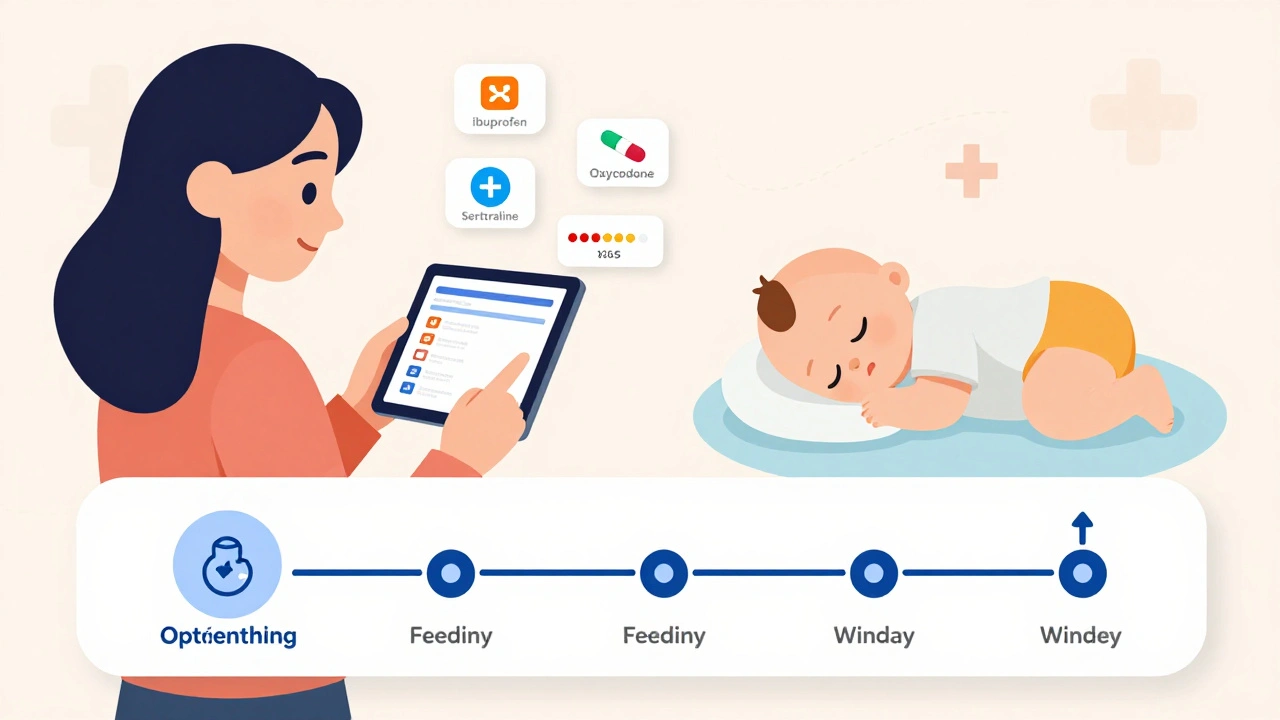
- Keep a simple log: note when you take your med and when you feed. After a few days, you’ll see the pattern.
- Use alarms on your phone: one for your dose, one for the next feed. Set it 2-3 hours apart.
- Ask for help. Have someone else feed pumped milk while you rest after your dose.
- Don’t stress over one missed timing. One off-day won’t hurt. Consistency matters more than perfection.
- Tell every healthcare provider you’re breastfeeding - your dentist, your OB, your pharmacist. They might have better options.
Many moms find that after 1-2 weeks, timing becomes second nature. It’s not about rigid rules. It’s about building a rhythm that keeps both you and your baby safe.
What Experts Say - And What You Can Trust
Major groups like the American Academy of Pediatrics, the Academy of Breastfeeding Medicine, and the CDC all agree: timing is a safe, effective tool. Dr. Thomas Hale, author of the go-to reference Medications and Mothers’ Milk, says timing can reduce infant exposure by 50-75% for short-acting drugs. That’s not a guess. That’s data.
And here’s something important: the LactMed database, run by the U.S. National Library of Medicine, has detailed timing advice for over 1,000 medications - updated quarterly. If you’re unsure, check it. It’s free, reliable, and used by doctors worldwide.
But don’t rely on internet forums or well-meaning relatives. They might say, “Just pump and dump everything.” That’s not necessary - and it can hurt your supply. Or they might say, “It’s fine, no risk.” That’s not true either. The truth is in the science. And the science says timing works.
When to Call Your Doctor
Most meds are fine with timing. But call your pediatrician or lactation consultant if your baby shows any of these signs:
- Unusual sleepiness or difficulty waking to feed
- Weak sucking or poor weight gain
- Fast or shallow breathing
- Blue lips or skin
- Excessive fussiness or jitteriness
These are rare - but they matter. Don’t wait. Get help fast.
Final Thought: You Can Do Both
You don’t have to choose between being a healthy mom and a nursing mom. Medication timing gives you back control. It’s not magic. It’s math. It’s physiology. It’s smart.
Take your meds after a feed. Wait a few hours. Feed again. Repeat. You’re not just protecting your baby - you’re protecting your own peace of mind. And that’s worth more than any pill.
Can I take ibuprofen while breastfeeding?
Yes, ibuprofen is one of the safest pain relievers for breastfeeding moms. It transfers in very low amounts (RID under 1%) and clears quickly. You can take it anytime, but taking it right after a feed gives you the lowest possible exposure for your baby.
Should I pump and dump after taking medication?
Only if your medication has a long half-life or you’re taking a high dose. For most short-acting drugs, pumping and dumping isn’t needed - and it can reduce your milk supply. Timing your feeds around your doses is more effective and less disruptive. Use pumping as a backup, not a routine.
Is it safe to take codeine while breastfeeding?
No. The FDA warns against codeine while breastfeeding because some moms metabolize it into morphine too quickly, leading to dangerous levels in breast milk. This can cause breathing problems or even death in infants. Avoid codeine entirely - even with timing.
How long should I wait after taking a pill before breastfeeding?
Wait 2-3 hours after taking a short-acting medication like ibuprofen, oxycodone, or alprazolam. This allows your blood levels to drop significantly. For drugs with a 4-hour half-life, 3 hours is ideal. Always check the specific drug’s peak time - it’s not the same for everything.
What if my baby feeds every 2 hours?
Newborns feed often - that’s normal. If your baby feeds every 2 hours, you may not be able to wait 3 hours between dose and feed. In that case, take the lowest effective dose, use immediate-release forms, and pump and store milk before your dose. You can also ask your doctor about switching to a safer alternative with a shorter half-life.
Can I use LactMed to check my medication?
Yes. LactMed is a free, trusted database from the U.S. National Library of Medicine. It gives detailed info on how much of a drug gets into breast milk, its half-life, and timing recommendations. Search by drug name - it’s updated quarterly and used by healthcare providers worldwide.
 Medications



Mellissa Landrum
December 5, 2025 AT 14:51Mark Curry
December 6, 2025 AT 08:16Annie Grajewski
December 6, 2025 AT 23:25Mark Ziegenbein
December 7, 2025 AT 11:57Rupa DasGupta
December 7, 2025 AT 22:52Marvin Gordon
December 9, 2025 AT 11:06ashlie perry
December 9, 2025 AT 22:01Manish Shankar
December 10, 2025 AT 05:24