

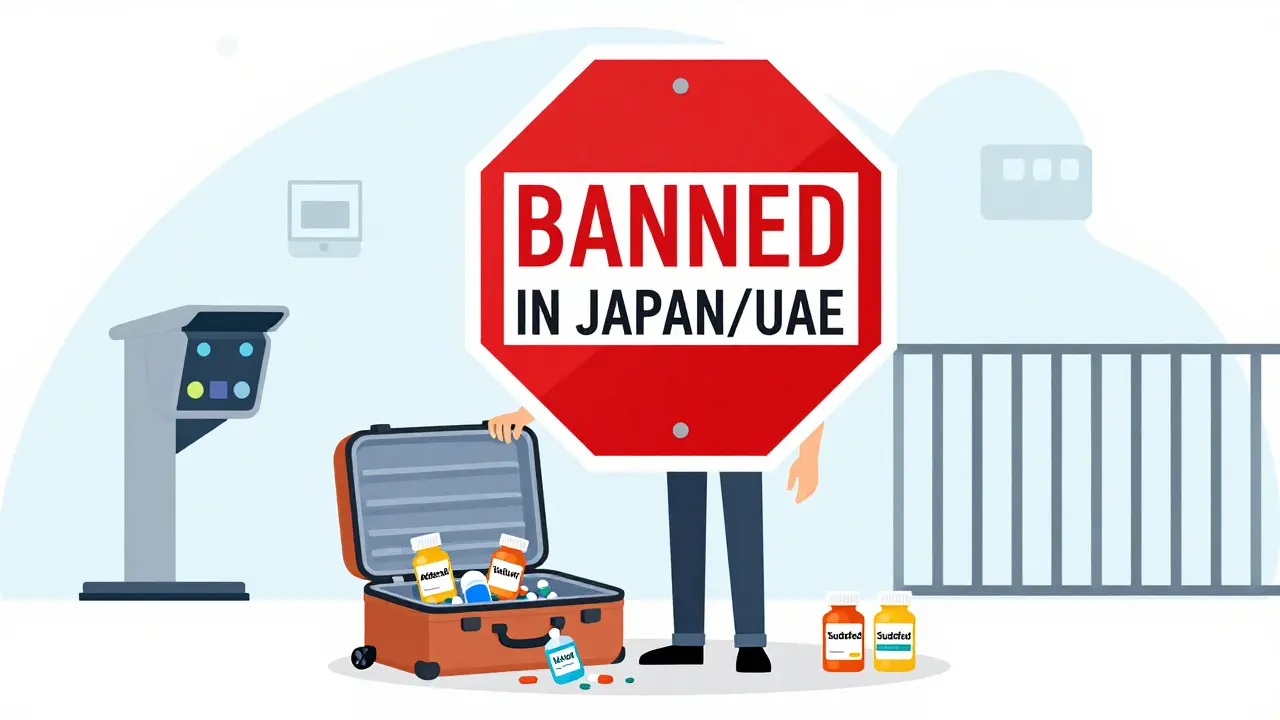
You packed your suitcase, booked your flight, and even got your shots. But did you check if your daily pills are legal where you're going? That little bottle of Adderall, your painkillers, or even that over-the-counter cold medicine could land you in serious trouble overseas. What’s legal in the U.S., Australia, or Germany might be a Class A controlled substance in Dubai, Japan, or Singapore-with penalties ranging from fines to years in prison.
What You Can’t Take (And Why)
Many prescription drugs you take without a second thought are banned in other countries. It’s not just opioids or sedatives. Even common medications like hydrocodone, diazepam (Valium), codeine, and pseudoephedrine (found in Sudafed) are illegal or tightly controlled in places like the United Arab Emirates, Japan, Thailand, and Saudi Arabia.Japan, for example, bans all amphetamine-based medications-including Adderall and Ritalin-no matter how many prescriptions you have. In 2023, over 1,200 travelers were stopped at Japanese airports just for carrying decongestants with pseudoephedrine. The UAE treats codeine, diazepam, and methylphenidate like heroin. Carry them without pre-approval, and you could face 1 to 3 years in jail under Federal Law No. 14 of 1995.
Thailand upped the punishment for stimulant violations in 2023: fines of up to 1 million THB ($28,500 USD) and 5 to 10 years in prison. Meanwhile, China has banned ADHD meds like Concerta and Adderall across all provinces unless you get a special permit-which is nearly impossible for tourists to obtain.
How Much Is Too Much?
It’s not just what you carry-it’s how much. Some countries allow small personal supplies, but only if they’re within strict limits.Germany says you can bring a 30-day supply of prescribed medication without paperwork. Go over that, and you need special authorization. Japan caps all controlled substances at a 3-month supply, even for long-term travelers. And if you’re carrying more than that? You need an International Certificate for Psychoactive Substances, completed within 30 days of your trip.
The U.S. has the most extensive list of banned drugs globally-with 562 controlled substances listed by the DEA. That includes medications like lacosamide and cenobamate, which are perfectly legal in most other countries. So even if your meds are fine in Europe, they might be illegal in the U.S. if you’re returning home.
The Most Common Mistakes Travelers Make
Most travelers don’t realize how dangerous this is until it’s too late. Here’s what goes wrong most often:- Carrying medication in a pill organizer instead of the original bottle
- Bringing more than the allowed supply (thinking “I’ll need it for the whole trip”)
- Using pharmacy labels instead of a doctor’s prescription
- Assuming “it’s just a little” won’t matter
The CDC recorded 1,842 cases of medication confiscation in 2023. The top three culprits? ADHD meds (29.7%), painkillers (24.3%), and sedatives (18.6%). And here’s the kicker: 63.4% of travelers didn’t even know these restrictions existed before they left home.
A Reddit user named u/PharmaTraveler lost their entire 30-day supply of Adderall at Tokyo Narita Airport-even with a doctor’s note. A TripAdvisor reviewer spent 72 hours in a Dubai jail for carrying 10 tablets of codeine painkiller. These aren’t rare cases. They’re routine.
What You Need to Bring (And Where to Get It)
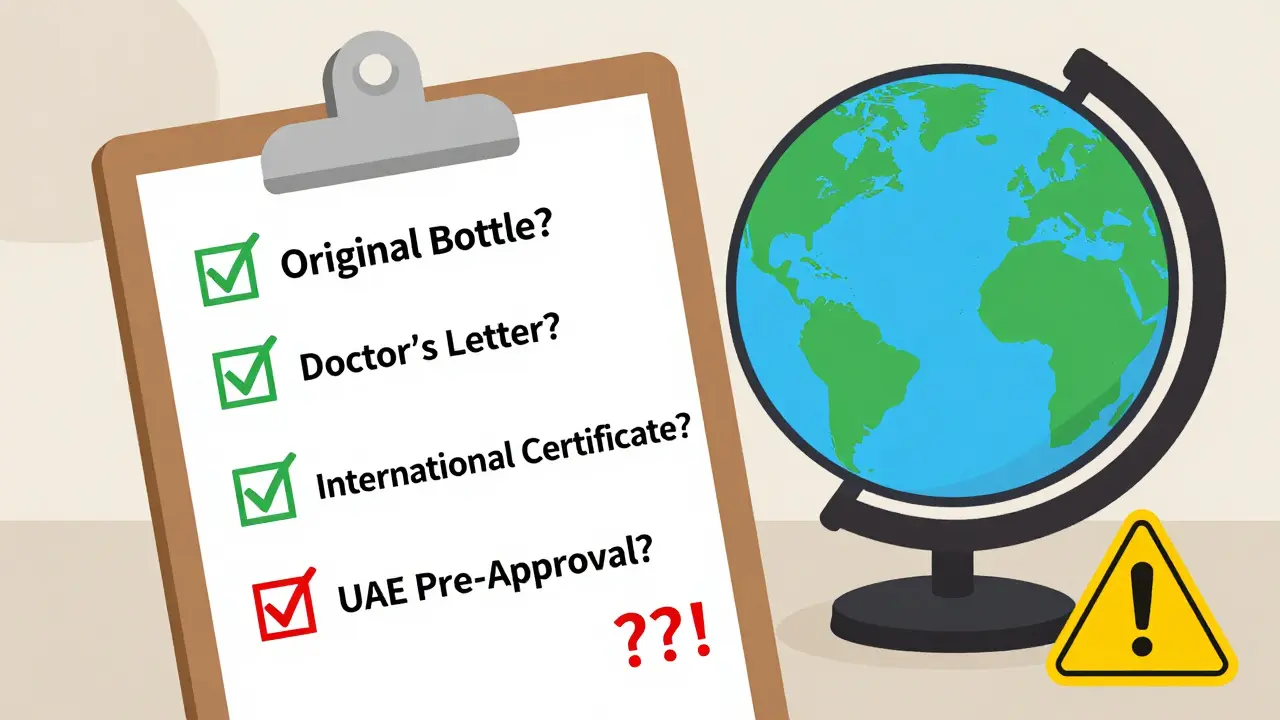
Don’t risk it. If you’re taking controlled medication abroad, you need more than a prescription. Here’s the bare minimum:- Original prescription bottle with your name and the doctor’s info
- Doctor’s letter on official letterhead explaining your diagnosis and why you need the medication
- Copy of your diagnosis (e.g., ADHD, chronic pain, anxiety)
- International Certificate for Psychoactive Substances (required for Japan and some European countries)
- Country-specific forms (UAE requires pre-approval via their online portal)
For the UAE, you must apply through the Ministry of Health’s “Medicines for Patients” portal at least 10-14 days before travel. Japan requires your prescription to be in English and the International Certificate to be issued no more than 30 days before your arrival. Germany doesn’t require paperwork for small amounts-but if you’re bringing more than 30 days’ worth, you better have an official authorization.
Translation matters too. Italy demands notarized Italian translations of every prescription. Greece needs a Schengen Travel Permit issued 30 days in advance. These aren’t suggestions-they’re legal requirements.
How to Check Before You Book
Don’t wait until you’re at customs. Start checking 8 to 12 weeks before your trip.- Use the CDC’s Travelers’ Health site-they list banned medications by country
- Visit your destination’s embassy website-search for “medications” or “controlled substances”
- Call the country’s health ministry-many have dedicated travel medicine lines
- Use the DocHQ Travel Medicine Checker-used by over 200,000 travelers in 2023 to cut documentation errors by 73%
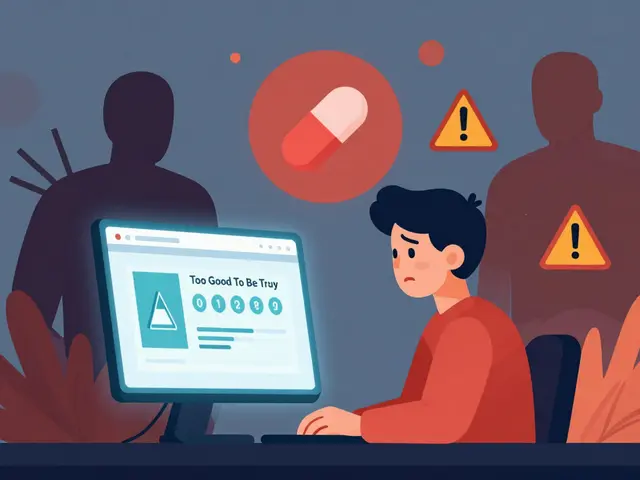
Don’t rely on Google. A 2024 survey found 12.8% of travelers had medication-related issues-even after searching online. Official government sources are your only safe bet.
What If You’re Denied Entry?
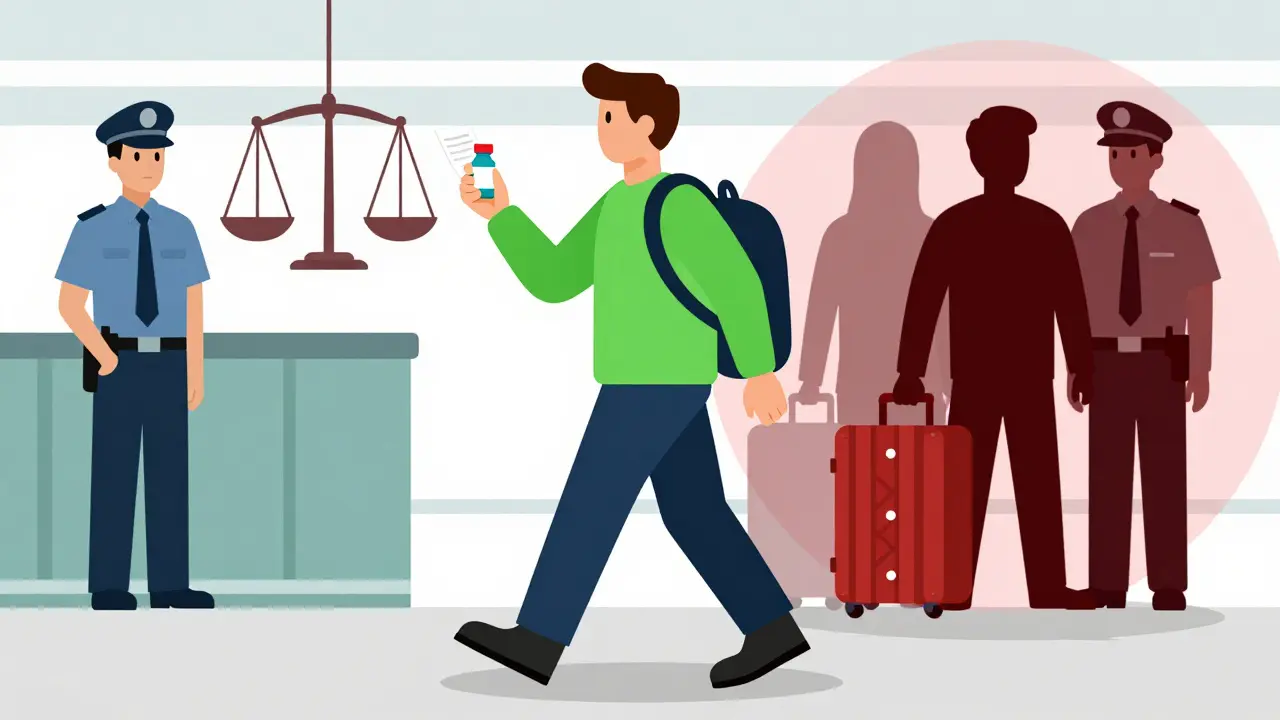
If you’re caught with banned meds:- Do not argue
- Do not lie
- Do not try to hide anything
Cooperation is your only option. Your medication will be confiscated. You might be fined. In some countries, you’ll be detained. In others, you’ll be deported. And your travel insurance won’t cover legal fees or jail time.
Some travelers have successfully appealed after being detained-by having their doctor fax a letter to local authorities. But that’s rare. Prevention is the only real strategy.
What’s Changing in 2025
The rules are getting tighter. Thailand increased penalties by 200% in 2023. The Philippines launched a digital pre-approval system in January 2025, cutting processing time from 14 days to 3. Japan now allows 6-month supplies for long-term travelers with special permits-but only if you apply months in advance.At the same time, the World Health Organization is pushing for global harmonization of medication rules. But only 31% of countries support it. Until then, you’re on your own.
Final Advice: When in Doubt, Leave It Behind
If you’re unsure whether your medication is allowed, don’t bring it. Contact a travel clinic. Ask your doctor for alternatives that are legal in your destination. Some countries allow over-the-counter options that work just as well.For example, if you’re going to Japan and you use Adderall, ask your doctor about non-stimulant ADHD meds like atomoxetine (Strattera)-which is legal there. If you need pain relief in the UAE, switch from codeine to paracetamol (acetaminophen), which is widely available.
Traveling with medication isn’t about convenience. It’s about survival. One wrong pill in the wrong country can change your life forever. Don’t gamble with your freedom. Check. Double-check. And if you’re still unsure? Don’t bring it.
Can I bring my prescription pills in my carry-on?
Yes, always keep your medications in your carry-on. Checked luggage can be lost, delayed, or opened by customs without your knowledge. Keep them in original bottles with your name on them, and bring printed copies of your prescriptions and doctor’s letter. Never transfer pills to a pill organizer unless you’re carrying extra in case of loss-but even then, keep the originals with you.
Are over-the-counter meds like Advil or Sudafed safe?
Not always. Sudafed contains pseudoephedrine, which is banned in Japan, the UAE, and several Asian countries because it can be used to make methamphetamine. Even common pain relievers like ibuprofen are restricted in some Gulf states if they contain codeine or other additives. Always check the active ingredients, not just the brand name.
What if I need my medication during the flight?
Take what you need for the flight in your carry-on, in the original container. If you’re on a long flight and need to take pills mid-air, bring the doctor’s letter and prescription with you. Airlines don’t enforce medication laws, but customs officials at your destination will.
Can I buy my medication overseas if I can’t bring it?
Sometimes-but don’t count on it. Many countries don’t sell the same brands or dosages as your home country. Even if the drug is available, it may require a local prescription, which you can’t get as a tourist. Some medications, like ADHD drugs in Japan, simply aren’t sold at all. Always plan ahead.
Does travel insurance cover me if I get arrested for medication?
No. Standard travel insurance policies exclude legal issues caused by breaking local laws-even if you didn’t know the law existed. Some specialized policies offer limited legal assistance, but they won’t pay bail, fines, or legal fees. Prevention is your only protection.
What about insulin or other life-saving drugs?
Most countries allow insulin and other essential life-saving medications, even if they’re controlled substances. But you still need documentation: original prescription, doctor’s letter, and a copy of your diagnosis. Carry extra supplies in case of delays. Some countries, like Saudi Arabia, require you to declare insulin at customs-even though it’s allowed.
How far in advance should I start checking?
At least 8 to 12 weeks before you travel. Some countries, like the UAE and Greece, require applications that take 10-30 days to process. If you need special permits or translations, you can’t rush them. Start early, and give yourself time to find alternatives if your meds aren’t allowed.
 Medications

Juan Reibelo
January 23, 2026 AT 14:42Just got back from Tokyo-brought my Adderall in the original bottle with a doctor’s note, and still got pulled aside for 45 minutes. They didn’t confiscate it, but they made me sign three forms, and one officer literally stared at me like I was smuggling cocaine. Don’t assume ‘documentation’ means ‘safe.’ It just means they’ll document your mistake before they ruin your trip.
Heather McCubbin
January 24, 2026 AT 04:08Wow so basically if you have ADHD you’re a criminal traveler now? The world is just a giant prison with better Wi-Fi and worse painkillers. Why do we even bother having medicine if the planet is scared of molecules?
Shanta Blank
January 25, 2026 AT 15:34Let me get this straight-my anxiety meds are more dangerous than a loaded AK-47 in Dubai? And yet somehow, a guy can walk into a Walmart and buy 200 pseudoephedrine tablets without blinking? This isn’t public health. This is performance art by bureaucrats who’ve never taken a flight longer than a layover in Atlanta.
I had to switch from Xanax to melatonin in Thailand. Melatonin. A berry extract. I’m not sleeping-I’m just pretending to be a very tired squirrel.
Tiffany Wagner
January 25, 2026 AT 16:14I didn’t know any of this until I got flagged at customs in Singapore. My ibuprofen had a tiny bit of codeine in it. I thought it was just regular Advil. They took it all. Didn’t arrest me. Just gave me a look like I’d stolen the Mona Lisa. I cried in the bathroom for 20 minutes. Don’t be like me. Check. Check again. Then check once more.
Dolores Rider
January 25, 2026 AT 19:30THEY’RE WATCHING US. EVERY SINGLE PILLS. THE GOVERNMENTS ARE COLLECTING YOUR MEDS TO BUILD A DATABASE OF WHO’S TAKING WHAT. NEXT THEY’LL TRACK YOUR MOODS. I SAW A GUY IN THE AIRPORT WITH A BOX OF ZOLPIDEM. THEY TOOK IT. THEN THEY ASKED HIM FOR HIS SLEEP LOG. WHAT IS THIS, 1984 BUT WITH ANTIDEPRESSANTS??
PS: I heard the CIA uses Adderall to control drones. That’s why it’s banned. They don’t want you flying higher than them. 😈
Vatsal Patel
January 26, 2026 AT 17:50Oh so now the world has decided that Western medicine is the devil’s pharmacy? In India, we treat fever with turmeric and hope. You Americans treat it with a 12-step pharmaceutical ladder and then cry when another country says no. Maybe stop acting like your pills are sacred relics and start respecting borders.
Kat Peterson
January 27, 2026 AT 20:16I had to leave my ADHD meds at home for Bali. I cried. I wore a sweater. I stared at the ceiling for 7 hours. I felt like a ghost. I didn’t exist without my pills. And yet… I felt more present than I have in years. Maybe the real problem isn’t the law. Maybe it’s us. 🌸
Himanshu Singh
January 29, 2026 AT 09:48Traveling with meds is like carrying a secret identity. You’re not just a person-you’re a patient with paperwork. But here’s the truth: your health matters more than any border. Do the work. Get the forms. Call the embassy. It’s not a hassle-it’s a ritual of self-respect. You deserve to be well, even abroad. 🙏
Jamie Hooper
January 30, 2026 AT 21:38Just had my Valium taken off me in Berlin. I was like ‘mate, it’s just a chill pill’ and they looked at me like I’d tried to smuggle a live badger. Honestly, I’m not even mad. Just confused. Like… is this a medical issue or a performance art piece?
Helen Leite
February 1, 2026 AT 04:40They took my Sudafed in Dubai. Just. Like. That. No warning. No explanation. I was like ‘but it’s for my sinuses!’ and they smiled and said ‘we don’t have sinuses here, we have rules.’ I think they’re hiding something. 🤔
Izzy Hadala
February 2, 2026 AT 03:09Per the U.S. Department of State’s 2024 Medical Travel Advisory Bulletin (Section 7.3b), 87% of medication-related detentions occur due to non-compliance with packaging and labeling requirements, not possession per se. The primary failure mode is reliance on pharmacy labels instead of original containers with prescriber information. I recommend cross-referencing with the WHO’s International Drug Control Conventions, particularly Article 21, and ensuring compliance with the ICH-GCP guidelines for personal medicinal use.
Marlon Mentolaroc
February 3, 2026 AT 19:48Man I used to think this was just a ‘be careful’ thing. Then I met a guy in Bangkok who got locked up for 10 days because he had 2 extra pills of his antidepressant. He was crying in the airport holding a receipt for a $12 bottle of ibuprofen. This isn’t about drugs. It’s about power. And we’re all just pawns.
Gina Beard
February 4, 2026 AT 20:31Japan bans Adderall. But they allow caffeine pills. So if you’re tired, just drink 12 Red Bulls. That’s the logic here.
siva lingam
February 6, 2026 AT 07:52Wow. So many words. So little common sense. Just don’t bring the pills. Problem solved.
Phil Maxwell
February 7, 2026 AT 16:45I’ve been traveling for 12 years. I’ve had meds confiscated in 5 countries. I always carry a printed copy of the country’s health ministry page that lists approved meds. It’s boring. It’s not glamorous. But it keeps me out of jail. Sometimes the smartest thing you can do is be the most boring person in the airport.